
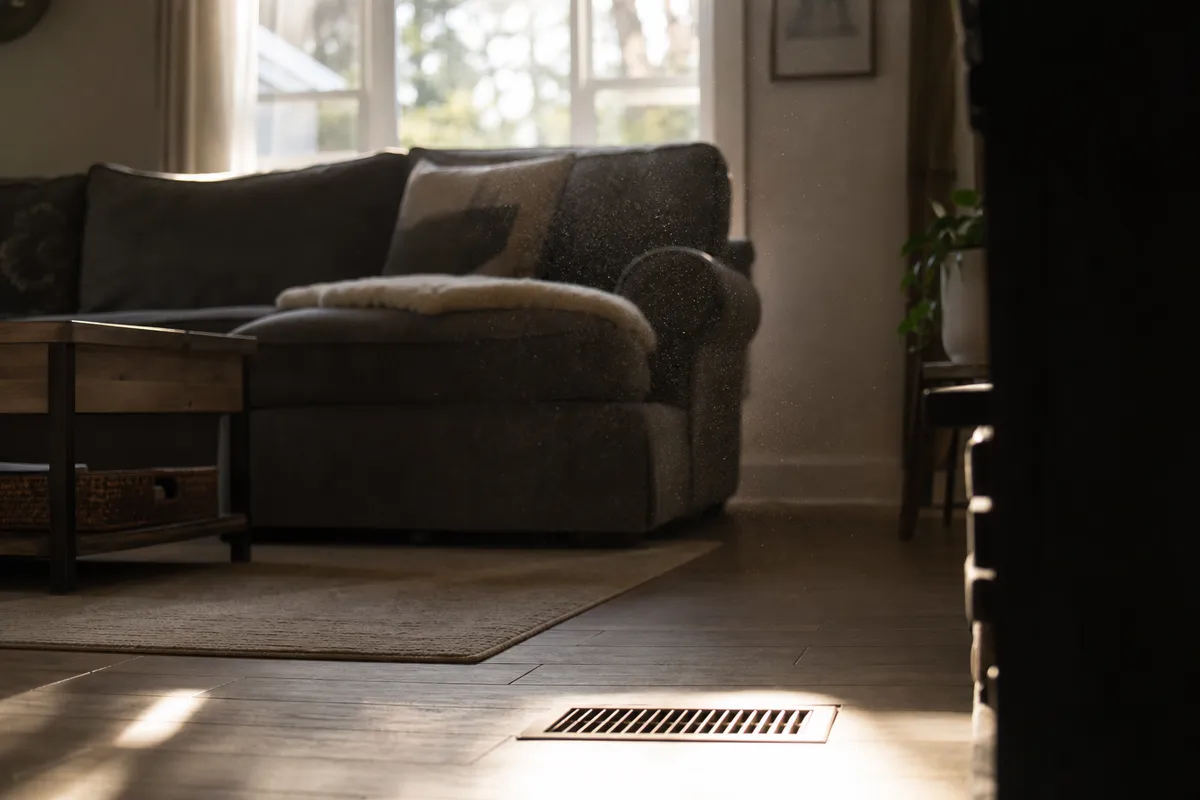
A couple in Mill Creek called me this spring with a complaint I hear a lot: “We dust on Saturday, and by Tuesday everything’s gray again.” They’d already bought two air purifiers and a robot vacuum. They were talking about ripping out the carpet. Before letting anyone spend money like that, I do one test that takes ninety seconds: I pulled the cover off a return grille, ran the blower, and held a smoke pencil near the duct joints in the crawlspace. The smoke got sucked sideways into a gap you could fit a pencil into. Their return duct was vacuuming up crawlspace air — dirt, insulation fibers, the works — and delivering it to every room, filtered only by a bargain 1-inch filter that was half-collapsed in its slot.
That’s the thing about dust: it’s almost never a cleaning problem. It’s an air problem. Dust shows up because air is carrying it in from somewhere, and your job — my job, on a service call — is to find the somewhere. After hundreds of these visits around King and Snohomish counties, the causes sort into a pretty consistent list of nine.
TL;DR
- The #1 cause I find in this region: leaky return ducts pulling unfiltered air from vented crawlspaces and attics. Very common in PNW homes.
- Cheap 1-inch filters are the #2 cause — they capture large lint and let the fine, visible-on-furniture dust straight through.
- Negative pressure from bath fans, range hoods, and dryers pulls dusty air in through every crack in the building.
- Most fixes are cheap: a better filter is $15–$40, sealing accessible duct joints is a few hundred. Full duct sealing is the top of the ladder.
- Duct cleaning removes dust already in the system; duct sealing stops new dust from getting in. Most dusty houses need the second one more.
Where is all this dust actually coming from?
Here are the nine causes, roughly in the order I check them on a real visit:
- Leaky return ducts in the crawlspace or attic. The big one. Return ducts run at negative pressure — any gap sucks air in. In our vented PNW crawlspaces, that’s damp, dirty air bypassing your filter entirely.
- Cheap 1-inch fiberglass filters. These exist to protect the blower, not your lungs or your furniture. They pass most fine dust. My comparison of filter grades is in the MERV ratings guide.
- Supply duct leaks. Less direct, but leaking supply air pressurizes the crawlspace and depressurizes the house, which drives infiltration through the building shell.
- Negative pressure from exhaust fans. Range hood, bath fans, and dryer all push air out; makeup air sneaks in through rim joists, outlets, and window frames — carrying dust with it.
- Carpets and rugs. They’re dust reservoirs. Every footstep re-launches what the vacuum missed.
- Air that’s too dry. Below about 30% relative humidity, dust stays airborne longer and static makes it cling to screens and furniture. Our winters can get there when the furnace runs hard — see the right humidity level for your home.
- A filtration gap at the equipment. Filter racks with gaps around the filter, missing filter doors, or bypass slots let air detour around even a good filter.
- Construction or roadwork nearby. New development in growth corridors like Bothell and Lynnwood puts real dust loads in outdoor air for months.
- Pets. Dander plus the dirt they carry in. Not fixable, but manageable with better filtration.
How does a tech trace it on a visit?
You can do a rough version of my process yourself:
- Look at the dust. Gray and fluffy is textile and skin — normal indoor sources. Gritty, dark, or with fiberglass sparkle means it’s coming from ducts, attic, or crawlspace.
- Check the filter and the rack. If the filter is clean after two months, that’s bad news — air is going around it, not through it.
- Run the tissue test. Blower on, hold a tissue near return duct joints you can reach. If it pulls toward a seam, you’ve found a leak.
- Sniff the supply air. A musty, earthy smell when the blower starts often means crawlspace air in the ducts — related to what I cover in musty HVAC smells.
- Count the exhaust fans. If the house has a big range hood and no makeup air, negative pressure is almost guaranteed.
On a professional visit I add a duct pressure test, which puts an actual number on leakage — typical older systems around here leak 20–30% of their airflow.
“Homeowners are always surprised when I schedule a dust complaint as a duct diagnostic instead of a cleaning. But the data from pressure testing tells the story: seal the returns first, and half the time the dust problem is gone before we’ve cleaned anything.”
— Danil Sokolov, Heat Pump & Mini-Split Specialist at SPS Pro Services
What do the fixes cost, from free to serious?
| Fix | Typical cost | Dust impact |
|---|---|---|
| Close crawlspace access, weatherstrip doors | Free–$30 | Small–medium |
| Upgrade to MERV 11–13 pleated filter | $15–$40 | Medium–large |
| Foil-tape accessible duct joints yourself | $20–$50 | Medium |
| Seal filter rack gaps, add gasketing | $50–$150 | Medium |
| Professional duct sealing (accessible runs) | $300–$900 | Large |
| Whole-home duct cleaning | $350–$700 | Large if ducts are contaminated |
| 4–5“ media filter cabinet installed | $600–$1,100 | Large, ongoing |
Note the order: the cheap items are near the top for a reason. I’d rather a customer spend $40 on a good filter and a roll of foil tape before spending $700 with me. And a note on that last comparison — duct cleaning costs in the Seattle area run $350–$700 for a whole home, but cleaning only helps if the ducts are actually dirty inside. If they’re leaky, duct cleaning plus sealing together is the combination that ends the dust cycle for good.
Could my furnace itself be part of the problem?
Sometimes, yes. A blower cabinet with a failing door gasket pulls unfiltered air from the furnace closet or garage. A cracked or rusted-out filter rack does the same. And a system that short-cycles never runs long enough to filter the air properly — that’s a mechanical problem worth a furnace repair visit (most repairs run $189–$950, and the diagnostic fee is credited toward the work). During annual furnace maintenance we check the cabinet seal and filter fit as a standard step, which is one more reason the fall tune-up earns its keep — I put the full list in the fall furnace maintenance checklist.
Will an air purifier solve this?
It’ll help the room it sits in, and during wildfire smoke weeks it’s genuinely worth having — I wrote up whether air purifiers actually work separately. But if the dust source is your ductwork, a portable purifier is a treadmill: it cleans air that the duct system keeps re-contaminating. Fix the ducts first; then a purifier or a media cabinet keeps things clean instead of fighting a losing battle. That holds for a 1960s rambler in Seattle and for newer construction in Everett alike — I’ve seen brand-new houses with return leaks from sloppy installs.
Frequently asked questions
Why does my house get dusty so fast after cleaning?
Fast re-dusting — within a day or two — almost always means dust is being actively delivered by moving air, not settling from normal indoor sources. The usual suspects are leaky return ducts, a bypassing filter, or strong negative pressure pulling air through the building shell. Check the filter fit and reachable return joints first.
Does duct cleaning reduce dust in the house?
Only if the ducts are actually dirty inside — and per the EPA, duct cleaning has never been shown to prevent health problems, so treat it as a dust and contamination fix, not a health cure. If the ducts are leaky, cleaning without sealing means they’ll be dirty again in a year or two.
What filter should I use to reduce dust?
A pleated MERV 11 is the sweet spot for most systems: it catches fine dust without choking airflow. MERV 13 is better still if your blower can handle the pressure drop. Whatever you choose, make sure it fits the rack snugly with no gaps — a bypassed MERV 13 filters worse than a well-seated MERV 8.
Sources
- EPA — Should You Have the Air Ducts in Your Home Cleaned?
- EPA — Air Cleaners and Air Filters in the Home
- U.S. Department of Energy — Energy Saver
Tired of dusting the same shelves twice a week? Call SPS Pro Services at (206) 427-8907 and book a duct diagnostic and cleaning visit.