
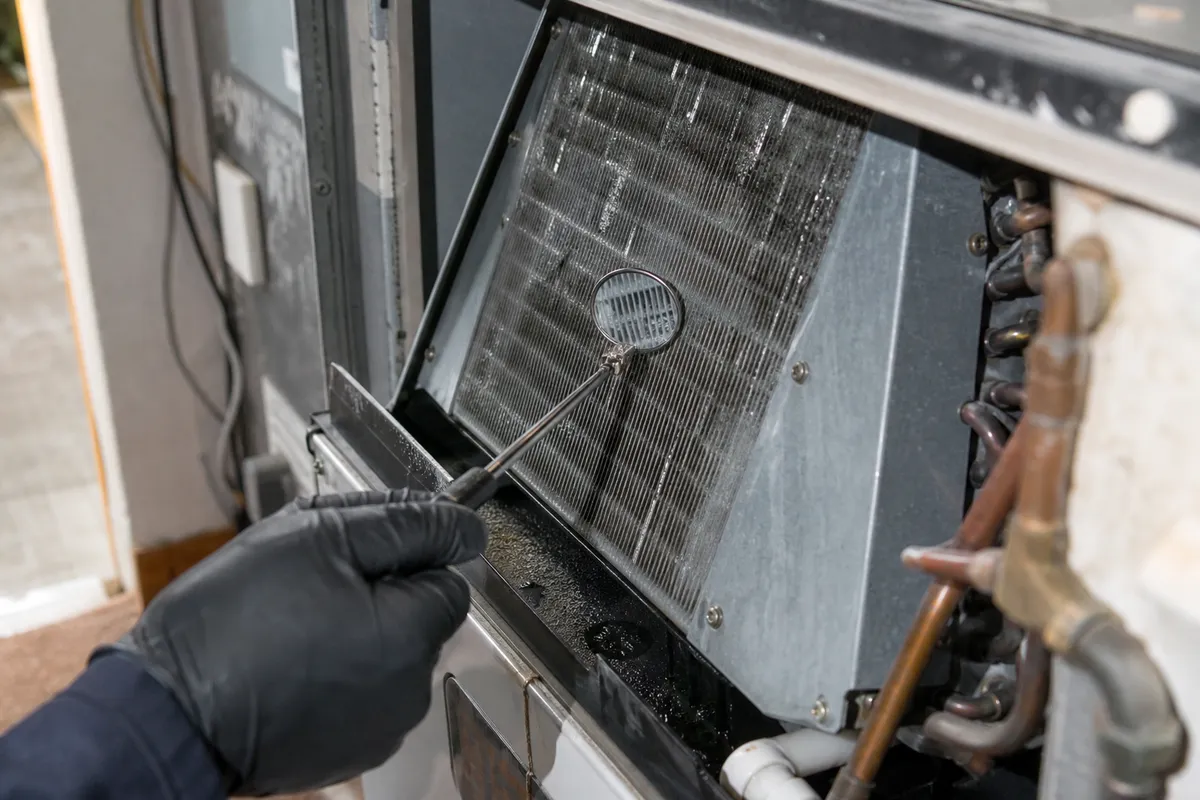
First cold snap last October, a homeowner in Ballard turned on her furnace for the season and the whole house filled with a smell she described as “a gym bag left in a lake.” She shut the system down, opened every window, and called us half-convinced the ducts were full of black mold. When I got there, the ducts were fine. The evaporator coil above her furnace — the indoor coil for her AC — was coated in a slimy biofilm that had spent a damp Pacific Northwest summer quietly growing in the dark. First heat of the season warmed it up and broadcast the smell through every register. Techs call it dirty-sock syndrome, and it’s one of the most common calls we run every fall.
Musty HVAC smell is your system telling you exactly one thing: there is moisture plus organic material somewhere in the air path. The whole diagnostic job is figuring out where. Around here, with our wet crawlspaces and nine months of damp, the list of suspects is short and predictable.
TL;DR
- A musty smell means moisture plus biological growth somewhere in the air path — coil, condensate pan, ducts, or filter. It doesn’t tell you which; the timing of the smell does.
- Smell at first heat of the season = usually the coil (dirty-sock syndrome). Smell strongest during AC season = usually the condensate pan or drain.
- Wet crawlspace ducts are the most PNW-specific cause: sagging, sweating, or flooded duct runs growing mildew from the outside in.
- Most fixes are $150–$700. Coil cleaning and condensate treatment are cheap; contaminated ducts are the expensive end.
- The smell is usually a comfort problem, not an emergency — but people with asthma or mold allergies shouldn’t wait on it, and per the EPA the fix for mold is always moisture control, never just killing what’s grown.
Why does it smell worse when the system first kicks on?
Timing is the best diagnostic clue you have, and it costs nothing to observe:
- Strong at first furnace use of the fall, fades over days: classic dirty-sock syndrome. Biofilm grew on the cool, damp evaporator coil all summer; the first heating cycles bake it off. It often fades — and returns next year, worse, until the coil is properly cleaned.
- Worst during cooling season, steady: think condensate. The pan under your coil collects water every time the AC or heat pump runs, and a pan or drain line with biofilm is a swamp with a fan over it. If you’re also seeing water pooling around the furnace, the drain is fully clogged, and the fix is the same cleaning plus a flush.
- Constant, in every room, any season: the ducts themselves, or the air they’re pulling in. In our region that usually means crawlspace duct runs that are wet, sweating, or lying in standing water — or return leaks pulling musty crawlspace air into the system, which overlaps with why houses get dusty.
- Smell appears right after a filter change is overdue: a damp, dirt-loaded filter can grow mildew all by itself. Cheapest fix on this whole page — and a good reason to follow a real schedule, like the one in how often to change your furnace filter.
Is the smell dangerous or just gross?
Honest answer: usually gross, occasionally worth taking seriously. Microbial growth on a coil or in a pan is a comfort and odor problem for most healthy adults. The EPA’s guidance on mold is blunt about the part that matters: if mold is growing, you have a moisture problem, and killing the mold without fixing the moisture guarantees it comes back.
When I tell customers not to wait:
- Someone in the house has asthma, mold allergies, or a compromised immune system.
- You can see visible growth at supply registers or inside accessible duct sections.
- The smell appeared suddenly after water intrusion — a crawlspace flood, a roof leak, a burst pipe.
- The smell is more sharp or chemical than musty. That’s a different problem — possibly electrical or refrigerant — and worth an immediate furnace repair or AC repair call, not an air freshener.
What can I check myself before calling anyone?
Run this checklist with the system off:
- Pull the filter. If it’s damp, gray, or smells musty on its own, replace it and run the system a day — you may be done for $25.
- Look into the condensate pan under the indoor coil (flashlight, access panel). Standing slimy water means the drain is clogged.
- Flush the condensate drain line with a cup of distilled vinegar at the access tee, if you can find it.
- Walk the crawlspace entrance with a flashlight: look for duct runs touching soil, sagging low spots, standing water, or torn insulation.
- Sniff individual supply registers. If one room is far worse, the problem is likely in that branch run.
- Note the timing pattern from the section above — it’s the first thing a tech will ask you.
If the smell survives a fresh filter and a drain flush, the coil or the ducts are the remaining suspects, and both are professional territory — coil cleaning means removing panels around live electrical and refrigerant components.
“The calls I flag for same-week scheduling are the ones where the smell showed up right after water got somewhere it shouldn’t be. Growth on a wet surface establishes fast, and every week of waiting turns a coil-cleaning ticket into a duct-cleaning ticket. If a customer mentions a flooded crawlspace, I don’t put them at the back of the queue.”
— Alina Kovalenko, Service Coordinator & Comfort Advisor at SPS Pro Services
What do the common fixes cost?
| Fix | Typical cost | When it’s the answer |
|---|---|---|
| Filter replacement (DIY) | $15–$40 | Damp, dirty, or mildewed filter |
| Condensate drain flush (DIY) | $5 | Slow or smelly drain, no clog |
| Condensate pan/drain cleaning + treatment | $150–$300 | Biofilm in pan, clogged line |
| Evaporator coil deep cleaning | $250–$500 | Dirty-sock syndrome |
| Whole-home duct cleaning | $350–$700 | Confirmed growth or contamination in ducts |
| Crawlspace duct repair/re-support | $200–$800+ | Wet, sagging, or soil-contact duct runs |
Two notes on that table. First, we credit the diagnostic fee toward the repair, so finding the source doesn’t cost extra if you fix it with us. Second — and this is me talking a customer out of spending money — don’t buy duct cleaning for a musty smell until someone has actually looked at the coil and pan. I’ve seen too many people spend $600 cleaning ducts when the smell was a $200 coil problem the duct crew never touched. Cleaning contaminated ducts is absolutely worth it when ducts are the confirmed source; I break down the decision in is duct cleaning worth it.
How do I keep the smell from coming back?
Moisture control, full stop. The growth is a symptom; dampness is the disease. The habits that work in our climate:
- Annual furnace maintenance in the fall — coil inspection, pan cleaning, and drain check are standard steps, and they catch this before the first-heat stink.
- Keep indoor humidity in the healthy band, roughly 30–50%.
- If your crawlspace is chronically wet, fix that first — vapor barrier, drainage, ventilation. No amount of coil cleaning outruns a swamp under the house.
- Get duct runs up off the soil and properly supported. We see this constantly in older homes from Seattle to Everett, and it’s a permanent fix once done.
- Change filters on schedule, especially through damp season.
Frequently asked questions
Why does my furnace smell musty when it first turns on in the fall?
Almost always dirty-sock syndrome: biofilm that grew on your AC’s indoor coil over the damp summer gets heated for the first time and releases the odor through every vent. It often fades after a few cycles, but the growth is still there, and it comes back stronger each season until the coil is cleaned.
Can I just spray something into the vents to kill the smell?
I’d skip it. Deodorizer sprays mask the odor briefly and add chemicals to your airstream, and biocide foggers in ducts are something the EPA does not endorse for routine use. Nothing sprayed into a vent reaches the actual growth on a coil or in a pan — and the moisture source is still there.
Is a musty HVAC smell a sign of black mold in my ducts?
Usually not. In my experience the coil and condensate system are the source far more often than duct interiors. Genuine duct mold does happen — mostly after water intrusion or in chronically wet crawlspace runs — and it’s confirmed by looking, not by smell alone. A camera inspection settles it in minutes.
Sources
Musty smell that survived a new filter? Call SPS Pro Services at (206) 427-8907 and we’ll trace it to the source — start with a furnace maintenance visit.