
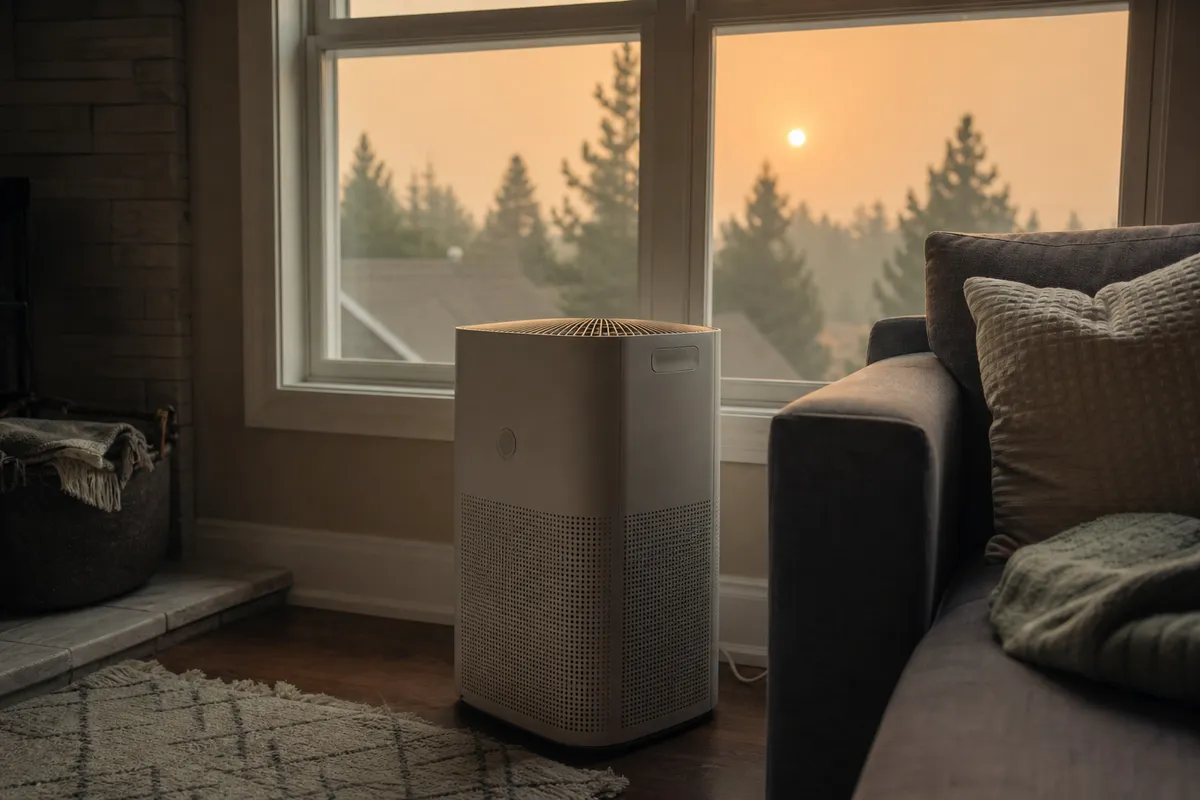
Last September, during that stretch when the smoke rolled down from the Cascades and the whole Puget Sound region sat under an air quality alert for nine days, I got a call from a customer in Ravenna. She had bought three air purifiers in one weekend — a $90 unit from a big-box store, a $250 one, and a $700 one — and wanted to know why her living room still smelled like a campfire. I drove out, checked the units, and found the answer in about four minutes: two of the three were too small for the room, and all three were fighting a leaky front door and a kitchen fan that was pulling smoky outside air straight into the house.
That call sums up my whole opinion on air purifiers. The technology works. HEPA filtration is real, proven physics, and the EPA says plainly that portable air cleaners reduce indoor particle levels. But the machines get sold with promises they can’t keep, in sizes that don’t match the rooms they end up in. So here’s the honest version, from a guy who has no purifiers to sell you.
TL;DR
- Portable HEPA purifiers genuinely remove particles: wildfire smoke, pollen, pet dander, dust. That claim is solid and EPA-backed.
- They do almost nothing for gases, odors from cooking, moisture, or the source of your dust — and no purifier fixes leaky ductwork.
- Size by CADR: you want a smoke CADR of at least two-thirds of the room’s square footage. A 150 CADR unit in a 400 sq ft great room is decoration.
- The killer use case in our area is August–September wildfire smoke. For those weeks, a properly sized HEPA unit in the bedroom earns its money.
- If your whole house has a dust or allergy problem, a media filter cabinet at the furnace usually beats a fleet of portables on cost per square foot.
What can a portable HEPA purifier actually remove?
Particles. That’s the whole answer, and it’s a good one. A true HEPA filter captures at least 99.97% of particles at 0.3 microns — the hardest size to catch — and does even better on bigger and smaller ones. In practice that means wildfire smoke particles, alder and grass pollen, pet dander, dust mite debris, and mold spores floating in the air.
What it can’t do:
- Gases and odors. The smell of smoke, cooking, or off-gassing furniture is molecular, not particulate. A thin carbon pre-filter helps a little for a short while, then saturates. Don’t pay a premium for it.
- Moisture and humidity. A purifier moves air through a filter. It does not dry anything. If your real issue is condensation and musty smells, read my piece on ideal indoor humidity instead.
- The source of the dust. If your return ducts are pulling dirty air from a crawlspace, a purifier is bailing a boat with a hole in it. I wrote a whole article on why houses get dusty — the purifier is rarely the fix.
How big a unit do I actually need?
This is where most people waste money. The number that matters is CADR — Clean Air Delivery Rate — printed on the box, usually split into smoke, dust, and pollen ratings. My field rule: the smoke CADR should be at least two-thirds of the room’s square footage (assuming 8-foot ceilings). A 200 sq ft bedroom needs roughly CADR 130 or better. A 450 sq ft open-plan living area needs CADR 300, which puts you in the larger, louder, more expensive class of machine.
The mistake I see on almost every service call: one mid-size unit set in a hallway, expected to clean the whole floor. Air doesn’t work that way. A purifier cleans the room it’s in, and only if the doors are mostly closed.
“During smoke season we tell every customer the same thing: one properly sized unit in the bedroom you sleep in beats three undersized units scattered around the house. You spend eight hours in that one room. Protect it first, then worry about the rest.”
— Alina Kovalenko, Service Coordinator & Comfort Advisor at SPS Pro Services
Is a portable purifier or a whole-house filter the better buy?
If you own your home and run ducted heating — which is most of the houses I service from Seattle up through Lynnwood and Everett — the honest comparison looks like this:
| Option | Typical cost | Covers | Ongoing cost/year |
|---|---|---|---|
| Portable HEPA, small (CADR ~130) | $80–$200 | One bedroom | $40–$80 filters |
| Portable HEPA, large (CADR 300+) | $300–$800 | One large room | $80–$150 filters |
| 4–5“ media filter cabinet at furnace | $600–$1,100 installed | Whole house | $60–$120 filters |
| Electronic air cleaner | $1,200–$2,400 installed | Whole house | Cleaning + cell replacement |
The media cabinet wins on coverage per dollar, with one catch: it only filters when the blower runs. Set your thermostat fan to circulate a few hours a day and it does real work. As for electronic air cleaners — I install them when asked, but for most homes I think the media cabinet is the better value, and some electronic models produce trace ozone, which the EPA specifically cautions about. That’s me being honest about a product I could sell you.
One more thing a whole-house filter depends on: clean, sealed ductwork. If your ducts are contaminated, filtration downstream only does so much — that’s when professional duct cleaning at $350–$700 for a whole home is the actual fix. But if your ducts are clean and tight, cleaning them again does nothing for air quality; I break down when duct cleaning is worth it separately.
What should I do before smoke season hits?
August and September are when Puget Sound air goes from some of the cleanest in the country to genuinely unhealthy, sometimes for a week or more at a stretch. Here’s the checklist I run at my own house in Bothell every July:
- Buy or test your bedroom HEPA unit before the first smoke alert — units sell out in days once the sky turns orange.
- Stock one spare filter per purifier; smoke season can kill a filter in two weeks.
- Upgrade the furnace filter to MERV 13 if your system can handle it (see my MERV ratings guide), and set the fan to circulate.
- Check weatherstripping on exterior doors — smoky infiltration undoes a purifier fast.
- Know how to set your HVAC to recirculate instead of pulling outside air, if your system has fresh-air intake.
- If your furnace or air handler hasn’t been serviced in over a year, book furnace maintenance now; a clean blower and coil move noticeably more air through a dense filter.
When is a purifier the wrong answer entirely?
A few patterns from real service calls where the purifier was treating a symptom:
- Dust returning within a day of cleaning. Usually leaky return ducts pulling from the attic or crawlspace. Common in older homes in Bellevue and north Seattle.
- Musty smell that a purifier “almost” hides. That’s biological growth on a coil or in a wet crawlspace duct — see my article on musty HVAC smells. Filtering the air above a mold source is not a plan.
- Allergies that spike when the heat kicks on. That points at the filtration and ductwork on your furnace, not the room air. Sometimes it’s a failing furnace component cooking dust — worth a furnace repair diagnostic ($189–$950 for most repairs, and our diagnostic fee is credited toward the work).
Frequently asked questions
Do air purifiers help with wildfire smoke?
Yes — this is their best use case. Wildfire smoke is fine particulate matter, exactly what HEPA filters capture. A properly sized unit running on high with doors closed can drop particle levels in a bedroom dramatically during a smoke event. Size it by CADR and start it before the smoke arrives.
Should I run my air purifier all the time?
During smoke season or peak pollen, yes, continuously on medium or high. The rest of the year, running it in the bedroom overnight covers most of the benefit. Filters are the real cost, so match runtime to need.
Are expensive purifiers worth it over cheap ones?
Above roughly $200, you’re mostly paying for higher CADR, quieter motors, and smart features — not better filtration. A $150 true-HEPA unit and a $700 one clean a small bedroom about equally well. Pay for CADR, not for the app.
Sources
- EPA — Air Cleaners and Air Filters in the Home
- EPA — What is a HEPA filter?
- EPA — Indoor Air Quality (IAQ)
Want a whole-house filtration setup sized for your actual system? Call SPS Pro Services at (206) 427-8907 or start with a duct cleaning and air quality visit.