
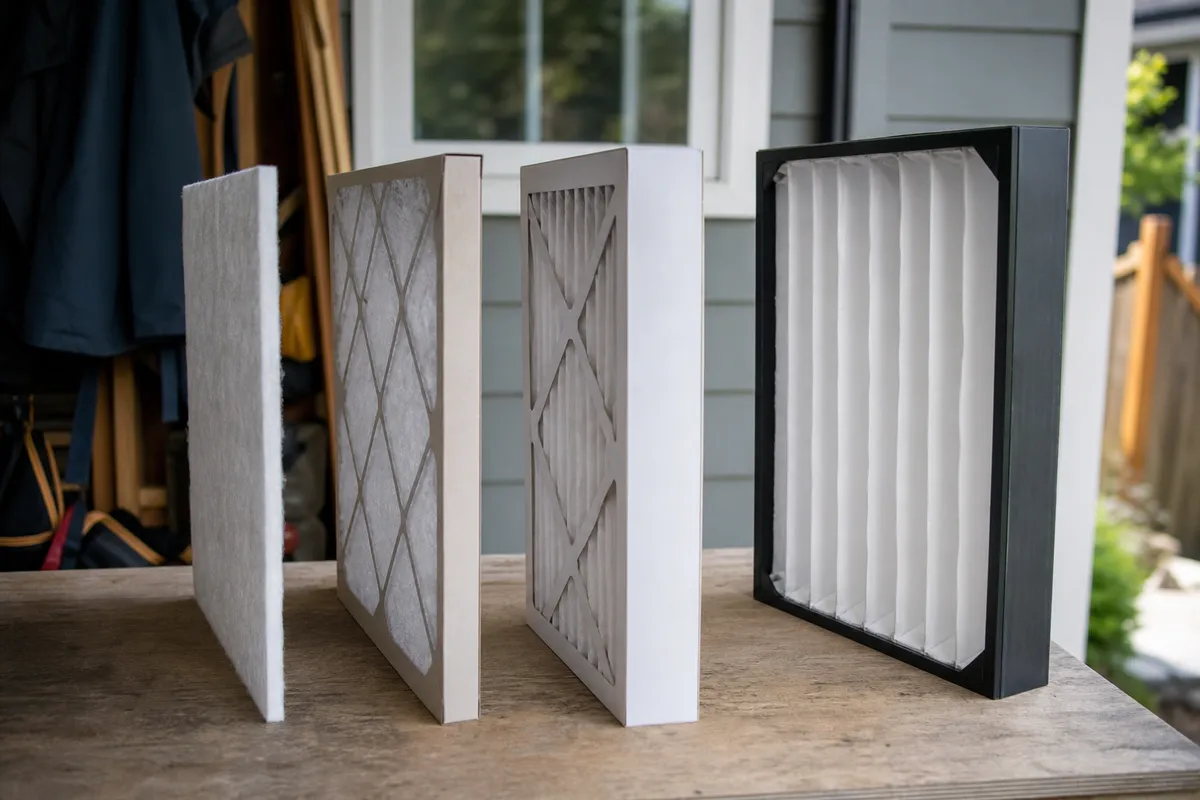
In March I ran a no-heat call in Lynnwood that turned out to have nothing wrong with the furnace at all. The homeowner’s allergist had told him to upgrade his filter, so he’d bought the highest-rated 1-inch filter on the shelf — a MERV 13 — and stuffed it into a 20-year-old furnace that was designed around a flimsy fiberglass pad. The blower couldn’t pull enough air through it. The furnace overheated, tripped its high-limit switch a few dozen times, and locked out on a 38-degree night. He’d followed good advice into a real problem, because nobody told him the other half of the story: filtration is a trade between what you catch and how hard your blower has to work.
I fit filters to systems all over King and Snohomish counties, and allergy filtration is one of our most common requests — especially February through April, when alder pollen turns car hoods yellow from Seattle to Everett. Here’s what the MERV numbers mean, what actually helps allergies, and when the answer isn’t a better 1-inch filter at all.
TL;DR
- MERV rates how well a filter captures particles: MERV 8 handles dust and pollen, MERV 11 adds pet dander and finer dust, MERV 13 catches smoke and many bacteria-sized particles.
- For allergies, MERV 11 is the practical floor and MERV 13 is the goal — if your system can breathe through it.
- A dense 1-inch MERV 13 can choke older blowers, causing overheating, short cycling, and lockouts. Higher MERV is a system decision as much as a shopping decision.
- A 4–5“ media cabinet ($600–$1,100 installed) delivers MERV 13 filtration with far less airflow restriction than any 1-inch filter. Best long-term answer for allergy households.
- Our alder season (Feb–Apr) and grass season (May–Jul) are when filter choice matters most here — have the good filter in before the pollen starts, not after.
What do the MERV numbers actually mean?
MERV — Minimum Efficiency Reporting Value — is a standard 1-to-16 scale for how effectively a filter captures particles of different sizes. Per the EPA: higher MERV, better capture of fine particles. Here’s the practical version for a homeowner:
| Rating | Catches | Misses | Best for |
|---|---|---|---|
| MERV 8 | Dust, lint, pollen grains, dust mite debris | Fine dust, dander fragments, smoke | Baseline for any ducted system |
| MERV 11 | Above + most pet dander, finer dust, mold spores | Smoke, smallest particles | Allergy households, pets |
| MERV 13 | Above + wildfire smoke particles, many bacteria-sized particles | Ultrafine particles, gases | Allergies + smoke season |
| HEPA (beyond MERV) | 99.97% of 0.3-micron particles | Gases, odors | Portable units and dedicated whole-house systems only |
Two things worth saying plainly. First, HEPA is not a furnace filter — a true HEPA element is too restrictive for a standard residential blower, so it lives in portable purifiers and dedicated bypass systems (more on portables in do air purifiers actually work). Second, MERV 8 to MERV 11 is the biggest allergy upgrade per dollar on this table, because dander and fine dust are exactly what MERV 8 lets through.
Will a MERV 13 filter hurt my furnace?
It can — and this is the part the filter aisle doesn’t mention. Every filter resists airflow; engineers call it static pressure. Pack MERV 13 media into a 1-inch frame and you get a dense mat that older blowers were never designed to pull through. What I find on service calls when the filter is choking the system:
- Furnace runs hot and trips the high-limit switch, then short cycles.
- Weak airflow at the far registers; rooms that never quite warm up.
- On heat pumps and AC, a starved coil that can freeze into a block of ice — a call we run all summer, and one of the cheaper causes behind an AC repair visit ($189–$1,200 for most repairs, diagnostic credited toward the work).
- In the worst cases, repeated overheating shortens heat exchanger life — turning a $20 filter decision into furnace repair territory.
My rule of thumb by system age: a variable-speed system under 10 years old usually handles a quality 1-inch MERV 11–13 fine. A 10–20-year-old single-speed system gets MERV 11, and I check temperature rise before blessing anything denser. Over 20 years old, I keep the 1-inch slot at MERV 8–11 — or, better, solve it properly with a media cabinet. And if you’re replacing equipment anyway, filtration should be part of the design conversation; modern systems, including the heat pumps we put in through our heat pump installation service, can be specced from day one for high-MERV media.
“Static pressure is the reading homeowners never see and techs obsess over. I’ve measured systems where a brand-new 1-inch MERV 13 nearly doubled the total external static — the blower was working like it had a pillow taped over the return. The same MERV 13 in a five-inch cabinet barely moved the needle. Surface area is the whole trick.”
— Danil Sokolov, Heat Pump & Mini-Split Specialist at SPS Pro Services
Why is a 4–5 inch media cabinet better than a 1-inch filter?
Surface area. A 4–5“ media filter is pleated deep, so it packs 20+ square feet of filter media into the airstream where a 1-inch filter has maybe 5. That means MERV 13 capture at a fraction of the airflow resistance — the whole trade-off basically dissolves. The practical numbers:
- Cost: $600–$1,100 installed for the cabinet, then $60–$120 a year in media.
- Filter changes: once or twice a year instead of every 1–3 months. (The 1-inch schedule is its own topic — see how often to change a furnace filter.)
- Fit: the cabinet is sealed and gasketed, so air can’t bypass around the filter edges the way it does in most 1-inch racks.
For a household with real allergies, this is the upgrade I recommend before fancy thermostats, before duct cleaning, before almost anything. Speaking of which — customers regularly ask whether duct cleaning will fix their allergies. Honest answer: it helps when ducts are genuinely contaminated, but the EPA has never found duct cleaning to prevent health problems. Filter first; clean only if inspection shows a reason.
When does filter choice matter most around Puget Sound?
Our pollen calendar is front-loaded and brutal:
- February–April: alder and birch. Alder is the heavy hitter in western Washington — it starts as early as late January in a mild year and hits allergy sufferers harder than anything else on the calendar.
- May–July: grasses. Long season, steady load.
- August–September: wildfire smoke. Not pollen, but the same fine-particle problem, and the weeks when MERV 13 earns its price outright.
- October–January: indoor season. Windows closed, furnace running, dust mites and dander recirculating.
The takeaway: get the good filter in by late January, before alder wakes up.
What’s the simple decision path for my house?
Work down the list:
- Allergies mild or none, system any age: quality MERV 8 pleated, changed on schedule.
- Allergies real, system under 10 years: MERV 11 pleated; step to MERV 13 if airflow stays strong and rooms heat evenly.
- Allergies real, system 10–20 years: MERV 11, and have static pressure checked at your next tune-up before going denser — we test it as part of furnace maintenance.
- Any system over 20 years, or anyone chasing MERV 13 comfort: install a 4–5“ media cabinet and stop fighting the 1-inch trade-off.
- Smoke-season concern on top of allergies: media cabinet plus a portable HEPA in the bedroom.
- Whatever you pick: check the filter monthly during heavy pollen, and make sure it seats with no gaps around the edges.
That last point is bigger than it sounds. A perfectly seated MERV 8 outperforms a MERV 13 with a quarter-inch gap around it, because bypassed air is filtered at MERV zero. This applies everywhere from older ramblers in Bellevue to new builds in Bothell — I find gapped filter racks in both.
Frequently asked questions
What MERV rating is best for allergies?
MERV 11 as a floor, MERV 13 as the target — MERV 13 captures the fine dander fragments and smoke particles that drive symptoms. But only run MERV 13 if your blower can handle it: in a 1-inch slot on an older system, drop to MERV 11 or install a media cabinet instead.
Is a higher MERV rating always better?
No. Above MERV 13, residential returns are diminishing and airflow penalties climb fast — MERV 14–16 belongs in commercial equipment designed for it. And any MERV rating is only as good as the filter’s fit in the rack. A sealed MERV 11 beats a gapped MERV 13 every time.
How often should I replace a MERV 11 or 13 filter?
For 1-inch filters: check monthly, replace every 1–3 months — toward the short end during alder season and smoke season, when filters load up fast. A 4–5“ media filter goes 6–12 months. Set a phone reminder; the filter you forget is the one that chokes the system.
Sources
- EPA — What is a MERV rating?
- EPA — What is a HEPA filter?
- EPA — Air Cleaners and Air Filters in the Home
Want to know if your system can handle MERV 13 — or get a media cabinet quoted? Call SPS Pro Services at (206) 427-8907 or book a furnace maintenance visit and we’ll test it.