
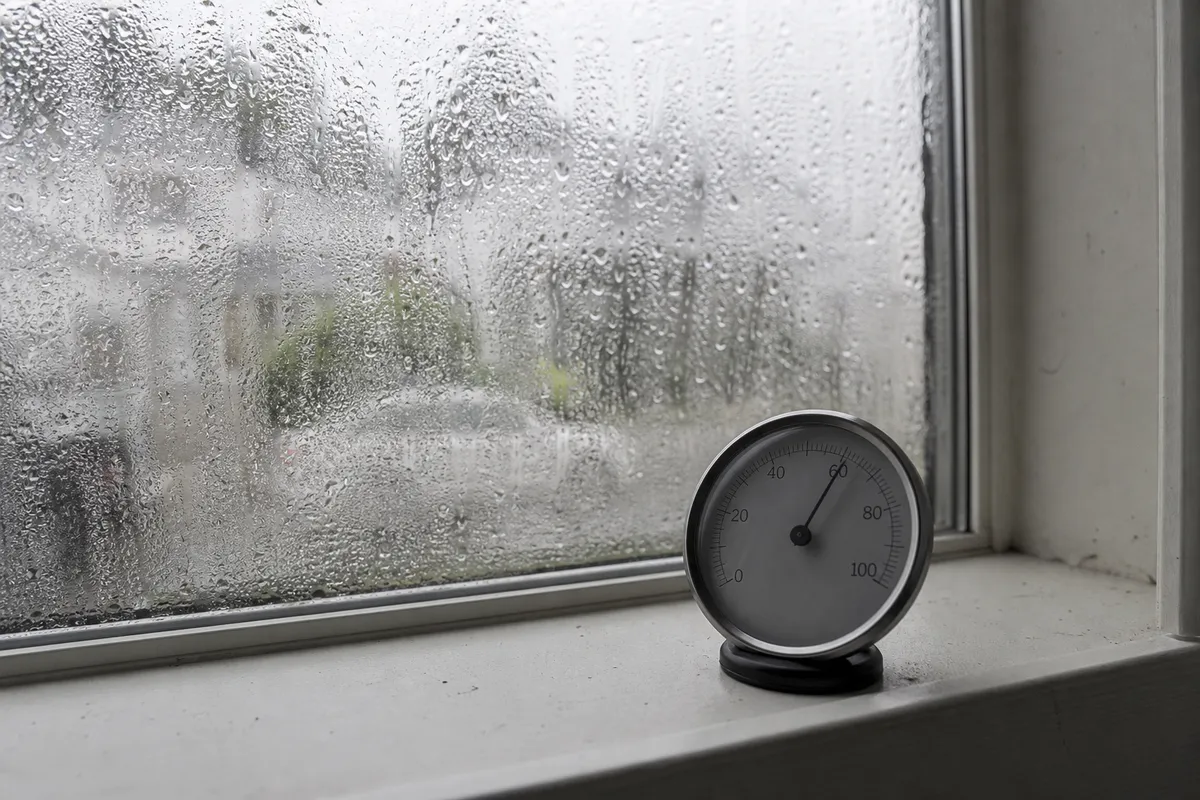
A while back I took a call from a man in Edmonds convinced he needed a whole-house humidifier. He’d just moved from Minneapolis, where his old house had one, and wanted the same setup. Then he mentioned, almost as an aside, that the bedroom windows were dripping every morning and his wife’s coats smelled “like a lake cabin.” I had to gently tell him he was about to pay good money to make his actual problem worse.
I hear some version of this every fall. People move here from drier parts of the country, or read national advice written for Arizona and Minnesota, and assume indoor air needs moisture added. Around Puget Sound it’s usually the opposite: our marine climate keeps outdoor air damp most of the year, and our houses — especially older ones with crawlspaces and single-pane windows — collect that moisture like a sponge. The condensation, the musty closet, the fogged glass in the morning: that’s the story of too much humidity, not too little.
So let’s talk about the right number, how to find out where your house sits, and what to do about it — because the fix is often cheaper than people fear.
TL;DR
- The healthy target is 30–50% relative humidity indoors; the EPA recommends staying below 60% to prevent mold.
- Around Puget Sound, the common problem is winter dampness, not winter dryness — the opposite of the Midwest.
- Step one costs about $10: put a hygrometer in the bedroom and hallway and just watch it for a week.
- Dripping windows, musty closets, and peeling paint are humidity symptoms, and ventilation habits fix more of them than equipment does.
- A dehumidifier helps in specific rooms and seasons; whole-house humidifiers are rarely needed here.
What humidity level should I actually aim for?
The band to remember is 30–50% relative humidity, and the EPA’s mold guidance says to keep it below 60% at all costs, ideally 30–50%. Within that band:
- Below 30%, air feels scratchy — static shocks, dry sinuses, gappy hardwood floors. This genuinely happens in Midwest winters, when furnaces heat brutally cold, bone-dry air. Here it’s rare outside a brief cold snap.
- Above 50–60%, the trouble starts quietly: dust mites thrive, windows condense overnight, and any surface that stays damp — a closet against an exterior wall, the far corner of a crawlspace — becomes a mold candidate.
Our marine climate parks outdoor humidity high most of the year, and fall through spring, homes around here drift into the 55–70% range indoors without anyone noticing. That’s why my winter calls are about condensation and musty smells, almost never about dry air.
Step one is always the same, and it’s the cheapest step in this whole article: buy a small digital hygrometer — about $10 at any hardware store — set it in the room that worries you, and check it morning and evening for a week. When someone calls me about a musty smell, “what does the hygrometer say?” is my first question, and half the time the answer solves the mystery on the spot.
Why are my windows wet every morning?
Because warm indoor air holds moisture, and when it touches a cold surface, that moisture condenses — same as a cold drink sweating in summer. Single-pane windows, common in homes built before the 1980s in Everett, Seattle, and Edmonds, get cold enough overnight to wring water out of ordinary indoor air.
The window itself is the messenger. The message is: your indoor air is carrying more moisture than your coldest surfaces can tolerate. The same condensation is happening wherever else surfaces run cold — inside exterior-wall closets, behind furniture pushed against north walls, on cold-water pipes in the crawlspace. You see the window because it’s glass; you smell the closet because it’s fabric.
Where does the moisture come from? Mostly daily living: showers, cooking, laundry, breathing — a family of four releases gallons of water vapor into the house every week. Add a damp crawlspace, which many older homes here have, and moisture migrates up through the floor continuously. That musty smell when the furnace kicks on in October? Often it’s damp air being pulled through ducts that run under the house — we wrote about what different HVAC smells mean, and if ducts themselves have collected debris and moisture, a duct cleaning runs $350–$700.
Do I need a dehumidifier — and what size?
Sometimes, and this is where I save people money on the phone, because the answer depends on where the reading is high.
Whole house sitting at 55–65% in winter? Start with ventilation habits (next section) — they’re free and usually enough.
One problem area — a basement, a crawlspace-adjacent room, a bedroom that condenses badly? That’s where a portable dehumidifier earns its keep. Sizing by pint capacity:
| Space | Condition | Suggested size | Typical cost to run |
|---|---|---|---|
| Bedroom / small room (up to ~300 sq ft) | Damp, musty | 20–30 pint | $5–$10/month |
| Basement or large room (~500–800 sq ft) | Damp | 30–40 pint | $10–$15/month |
| Basement | Visibly wet, standing moisture | 50 pint | $15–$25/month |
| Crawlspace | Chronic dampness | Dedicated crawlspace unit + assessment | varies |
Buy one with a built-in humidistat so it holds a setpoint (set it to 45–50%) instead of running constantly, and empty or hose-drain it routinely. If a crawlspace is the source, a dehumidifier upstairs is treating the symptom — the crawlspace needs ground cover and ventilation attention first.
And whole-house humidifiers? In Minneapolis, sensible. Here, rarely. Our winters are mild and damp, so furnaces don’t dry the air the way they do in the Midwest — most local homes have the opposite problem all season. Adding a humidifier to a Puget Sound furnace often pushes homes past 60% and straight into condensation trouble, like my caller from Edmonds nearly did. The exception: if your hygrometer genuinely reads below 30% for weeks each winter, let’s talk — but measure first.
“Heat is actually your ally against dampness — warm air holds moisture instead of dropping it on cold surfaces, which is why a well-heated house condenses less than a chilly one. When I see chronic condensation, I check the heating system before anything else. A furnace that’s underperforming, or rooms the system doesn’t reach, show up as wet windows long before anyone thinks to call HVAC.”
— Danil Sokolov, Heat Pump & Mini-Split Specialist at SPS Pro Services
That’s worth underlining: if parts of your house stay cold and damp because the heating can’t keep up, that’s a heating problem wearing a humidity costume — sometimes solved by a furnace repair visit, sometimes by better filtration and airflow (see our MERV rating explainer for the filter side).
What daily habits actually keep humidity in check?
The unglamorous truth from hundreds of these calls: ventilation habits fix more moisture problems than any machine. The EPA’s mold prevention guidance comes down to controlling moisture at the source, and in a house that means:
- Run the bath fan during every shower and for 20–30 minutes after. This is the single highest-impact habit. If the fan can’t hold a square of toilet paper against the grille, it’s too weak or clogged — replace or clean it.
- Use the kitchen exhaust when boiling or simmering — a pasta pot releases a remarkable amount of vapor.
- Vent the dryer outside and check the duct yearly. A blocked dryer duct dumps moist air (and lint) into the house.
- Crack windows briefly on dry days — ten minutes of cross-breeze swaps out a houseful of damp air cheaply.
- Pull furniture a few inches off exterior walls so air circulates behind it — this alone cures many “mystery mold spots.”
- Leave closet doors ajar on exterior walls, or add a louvered door, so closets share the house’s warm air.
- Fix drips promptly — a slow sink leak or a wet crawlspace pipe feeds the moisture budget every single day.
- Address any mold patch bigger than a dinner plate properly — per EPA guidance, small areas can be cleaned with detergent and water, but recurring or large growth means finding the moisture source rather than wiping the surface.
Frequently asked questions
What should indoor humidity be in winter here?
Same band — aim for 40–50% in a Puget Sound winter. If you’re seeing readings above 55% along with morning condensation, lean on ventilation and heat before buying equipment. Below 30% is uncommon here and usually short-lived during cold snaps.
Does air conditioning lower humidity in summer?
Yes — cooling coils condense moisture out of the air as they cool it, so a properly running AC or heat pump dehumidifies as a side effect. If your air-conditioned house feels cool but clammy, the system may be oversized and short-cycling, which is a fixable diagnosis — start with our AC sizing guide or an AC repair visit.
Can high humidity damage my house, or is it a comfort thing?
It can absolutely damage the house. Sustained readings above 60% feed mold on walls and window frames, rot window sills, peel paint, swell doors, and shorten the life of anything stored in damp closets and crawlspaces. The good news: it’s gradual, so a $10 hygrometer and a few habit changes this month genuinely prevent the expensive version of the problem.
Sources
Wet windows or a musty smell you can’t trace? Call SPS Pro Services at (206) 427-8907 or start with a duct cleaning assessment — we’ll help you find the source.