
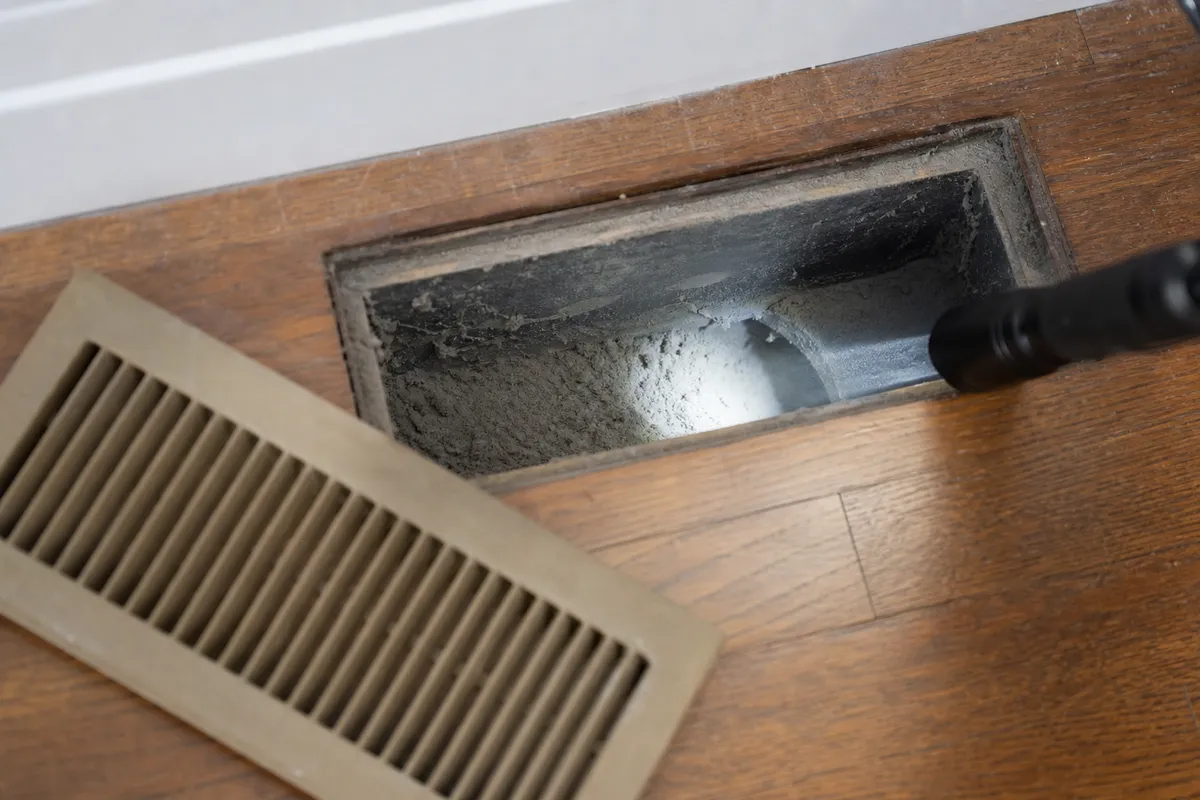
A homeowner in Ballard called me last month convinced her ducts were “full of mold” because her allergies got worse every winter. I ran a camera through her supply trunk. What I found wasn’t mold — it was a disconnected duct run dumping conditioned air into her crawlspace, and a furnace filter she hadn’t changed in over a year. Duct cleaning wouldn’t have fixed either problem. This is the question I get asked more than almost anything else, so let’s go through it with actual numbers instead of sales talk.
TL;DR
- Duct cleaning helps with visible dust, debris, and rodent contamination — it does not cure allergies, mold growth, or high energy bills on its own.
- If your ducts have never been cleaned and your home is 20+ years old, a one-time cleaning is reasonable. Annual cleaning is not necessary for most homes.
- Leaky, disconnected, or crushed ducts cost you more in wasted energy than dirty ducts ever will — sealing and repair usually beats cleaning for return on investment.
- Mold smell, standing water in ducts, or rodent nesting are the real red flags that justify professional cleaning.
- If your real complaint is weak airflow, uneven temperatures, or high bills, the fix is usually in the equipment or the duct design, not a vacuum truck.
What Duct Cleaning Actually Does (and Doesn’t Do)
A proper duct cleaning job uses negative pressure and rotating brushes to pull dust, pet hair, insulation fragments, and debris out of your supply and return lines. Done right, it’s a mechanical cleaning — nothing more, nothing less.
What it does not do:
- It does not seal air leaks. A duct system with 20% leakage before cleaning still has 20% leakage after.
- It does not remove mold that’s growing inside wall cavities or on the coil of your furnace or heat pump.
- It does not fix a system that’s short-cycling, wheezing, or blowing weak air. That’s almost always a mechanical issue worth a call to furnace repair or heat pump installation, not a cleaning crew.
I’ve crawled through hundreds of attics and crawlspaces from Shoreline to Kent, and the ducts themselves are rarely the villain. The villain is usually a torn flex duct, a return that’s pulling air from an unconditioned attic, or a filter that hasn’t been swapped since the Seahawks last made the playoffs.
“I measure airflow for a living, and here’s the honest answer: cleaning ducts rarely changes system performance unless there was a real blockage. Where it earns its money is contamination — mold, rodents, construction dust. The EPA’s guidance says essentially the same thing. Sealing leaky ducts, on the other hand, pays for itself in almost every older home we test.”
— Danil Sokolov, Heat Pump & Mini-Split Specialist at SPS Pro Services
When It’s Worth It vs. When You’re Wasting Money
Here’s how I sort real service calls into “worth it” and “skip it.”
Worth it:
- You just finished a remodel and there’s visible drywall dust in the supply registers.
- You had a rodent problem in the attic or crawlspace and found droppings or nesting material near the ducts.
- You bought an older home and have zero documentation the ducts were ever cleaned, and you can see dust buildup with a flashlight at the register.
- Someone in the house has genuine dust sensitivity and you’ve already ruled out the filter, the coil, and the humidifier as sources.
Skip it:
- Your only symptom is “the house feels dusty” but you’re not changing your filter on schedule (every 1–3 months for standard filters).
- You’re hoping it will lower your energy bill. It won’t move the needle compared to sealing leaks or upgrading an aging system.
- Your real complaint is a room that never gets warm or cold enough — that’s a balancing or equipment issue, and duct cleaning won’t touch it.
- You had it done within the last 3-5 years and there’s no new contamination source.
Cost Comparison: Duct Cleaning vs. the Fixes That Actually Move the Needle
Here’s how the numbers typically stack up for a standard single-family home in the Seattle area. These are general ranges, not quotes — every home is different once we’re actually in the attic.
| Service | Typical Cost Range | What It Actually Solves |
|---|---|---|
| Whole-home duct cleaning | $450 – $900 | Dust, debris, rodent contamination in the ductwork itself |
| Duct sealing (leaks, disconnects) | $600 – $1,800 | Wasted conditioned air, uneven room temps, higher bills |
| Furnace tune-up and repair | $150 – $650 | Weak airflow, short cycling, strange noises, poor efficiency |
| Filter and return upgrade | $100 – $400 | Dust load reduction, improved indoor air quality long-term |
| Heat pump installation | $6,500 – $14,000 | Whole-system replacement when ducts and equipment are both aging out |
Most jobs land somewhere in these ranges depending on duct length, attic vs. crawlspace access, and how many returns and supplies the house has. If a company quotes you a flat $99 whole-house special, ask what’s actually included — that price usually covers two vents and a lot of upselling once the truck is in your driveway.
The Seattle-Area Duct Reality
Housing stock here matters more than people think. A lot of the Craftsman and post-war bungalows in /seattle/ neighborhoods like Wallingford or Ravenna were built with duct systems added decades after original construction, often routed through unconditioned crawlspaces. That setup is prone to moisture intrusion, which is a real reason to inspect — not automatically clean — your ducts if you’re in one of these older homes.
Out toward /bellevue/, newer construction tends to have tighter, better-sealed duct runs, but I still find plenty of disconnected boots behind finished basements where a remodel crew cut corners. In /everett/ and greater Snohomish County, older mill-era homes have similar crawlspace duct issues to Seattle, and the higher humidity near the water means I check for moisture staining more carefully on every inspection.
One more regional note: our mild, wet climate means mold conversations come up constantly, but true duct mold is uncommon unless there’s a moisture source — a leaking water heater nearby, a crawlspace vapor barrier failure, or condensation from an oversized AC unit. If you smell must every time the system kicks on, that’s worth a real inspection, not only a cleaning appointment. And if the smell traces back to a leaking unit rather than the ducts, that’s a job for water heater repair, not a duct vacuum.
Checklist: How to Tell If Your Ducts Actually Need Cleaning
- Visible dust or debris when you remove a register and shine a flashlight down the duct
- Known rodent activity in the attic or crawlspace within the last 2 years
- Recent remodel, insulation work, or demolition near ductwork
- Musty smell specifically when the blower is running, not present when it’s off
- No record of cleaning in the last 5+ years and the home was built before 2000
- Family members with new or worsening respiratory symptoms after ruling out filters and coils
If you check two or more of these, a cleaning makes sense. If none apply, save the money and put it toward a furnace tune-up or duct sealing instead — you’ll get more comfort per dollar.
A Word on What Gets Missed
I’ll be honest: duct cleaning companies rarely check your electrical panel, but I do, because most of my crew cross-trains across HVAC and electrical. Older homes with knob-and-tube wiring or a 60-amp panel often can’t safely support a new high-efficiency furnace blower or a heat pump’s outdoor unit without an upgrade. If you’re bundling projects, it’s worth asking about electrical panel upgrade at the same time, especially if you’re also considering EV charger installation down the road. And if summer comfort is your real complaint rather than dust, get your AC repair system checked before spending money on ducts — a failing capacitor or low refrigerant charge will make a house feel stuffy long before dirty ducts will.
Mini FAQ
How often should I actually get my ducts cleaned? For most homes, every 5-7 years is plenty unless you’ve had a specific contamination event like a rodent problem or major renovation. Annual cleaning is marketing, not necessity.
Will duct cleaning lower my energy bill? Rarely by any measurable amount. Sealing leaks and fixing equipment issues will save you far more on your PSE or Snohomish County PUD bill than a cleaning will.
Can dirty ducts make my furnace or heat pump fail sooner? Heavy dust buildup can strain the blower motor over years, but it’s a slow, minor factor compared to skipped filter changes or a system that’s simply undersized or aging out.
If you’re not sure whether your ducts need cleaning or your system needs a real repair, call SPS Pro Services at (206) 427-8907 and we’ll tell you straight what’s actually worth doing.