
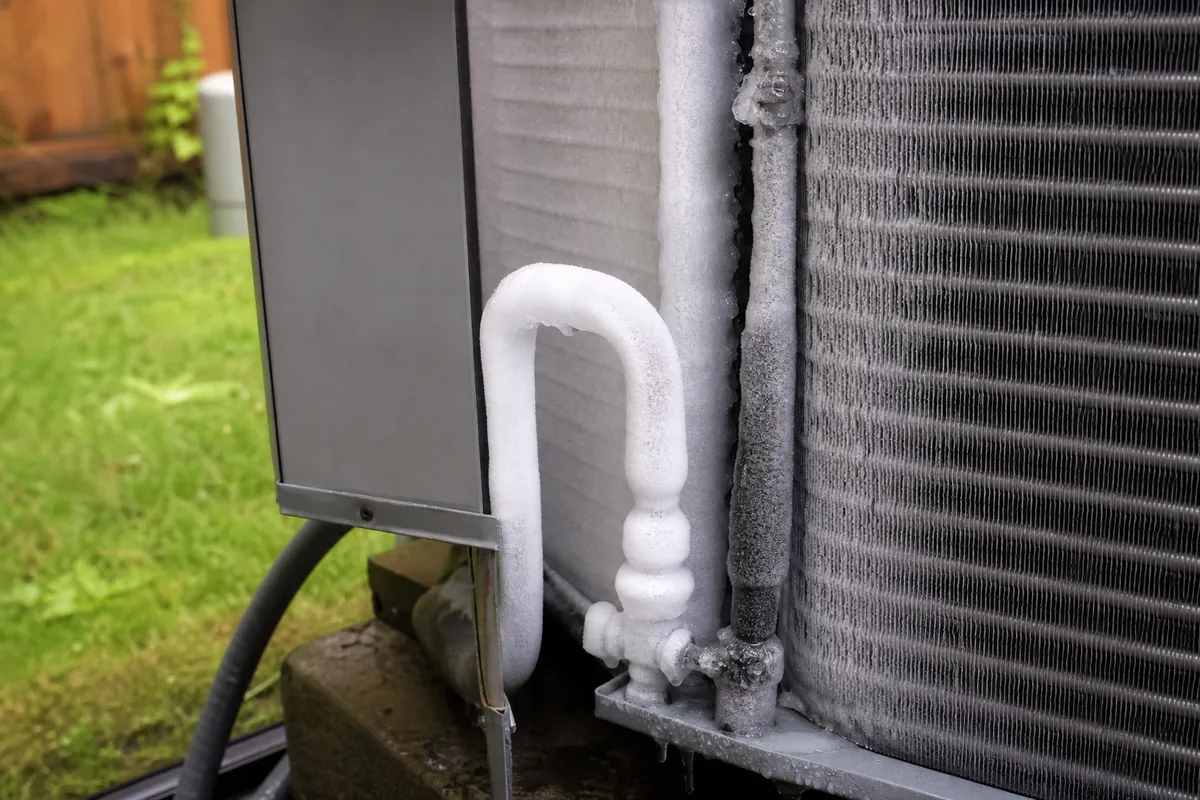
Two weeks ago in Mukilteo I walked up to a condenser with the big copper line wearing a sleeve of ice an inch thick — in 88-degree weather. The homeowner’s first words: “How does it freeze when it’s this hot out?” His second question was whether he could keep running it at night, and the answer was an emphatic no. That answer is the difference between a $250 repair and a dead compressor.
His system had a filter unchanged since fall and a return grille blocked by a new sectional. Classic. But I’ve also chased frozen coils in Redmond and Marysville this summer that came down to refrigerant leaks, and telling those cases apart is what the rest of this is about.
TL;DR
- Ice forms for exactly two reasons: not enough warm air across the indoor coil, or not enough refrigerant inside it. Both drop the coil below 32°F.
- Ranked by how often I find them: dirty filter, blocked vents, dirty evaporator coil, weak blower, refrigerant leak.
- Thaw first, always. Thermostat OFF, fan ON, wait 4-6 hours. Running it iced can destroy the compressor.
- “Topping off” refrigerant without fixing the leak buys weeks, not a fix — the money is gone when it leaks out again.
- Airflow fixes are cheap ($0-$450); refrigerant-side repairs run $600-$1,200, and on old R-22 systems often mean replacement talk.
How does an air conditioner freeze on a hot day?
Here’s the whole mechanism in one paragraph. Your indoor evaporator coil is where liquid refrigerant boils off, and boiling refrigerant absorbs heat — that’s the entire trick of air conditioning. The coil’s temperature is a balance: heat delivered by warm air over the fins versus heat carried away by evaporating refrigerant, normally landing around 40°F. Cut the airflow (less heat in) or cut the charge (lower pressure, and refrigerant boils colder at lower pressure), and the balance slides below 32°F. Humidity condensing on the coil now freezes instead of dripping away, ice insulates the fins so even less heat gets in, and the ice feeds itself until the coil is a block.
That’s why outdoor temperature is irrelevant. Every frozen AC is one of two stories — low airflow or low refrigerant — and everything below is the list of ways to get there.
What actually causes it, ranked by frequency?
From my service tickets across the Eastside and Snohomish County, in order:
1. Dirty filter. Half my freeze-up calls, maybe more. A loaded filter chokes airflow across the coil and the freeze cycle starts. Cheapest fix in HVAC — a filter and five minutes. If yours was gray felt when you pulled it, get on a real schedule; here’s how often to change it.
2. Blocked or closed vents and returns. Furniture over return grilles, registers closed in “unused” rooms. Closing registers doesn’t save energy on a central system — it starves airflow and can ice the coil. The Mukilteo sofa is this category’s poster child.
3. Dirty evaporator coil. Years of dust past cheap filters mats the coil face like felt. Same starvation, but the fix is a coil cleaning, not a filter swap. If the coil is filthy, the ducts feeding it usually are too — that’s when duct cleaning at $350-$700 stops being cosmetic.
4. Failing blower motor. A blower running slow — bad capacitor, failing ECM module — moves too little air even with a clean filter. The giveaway: weak airflow at every vent. In winter this motor serves your heat too, so it overlaps with furnace repair territory.
5. Low refrigerant from a leak. The minority of cases, but the expensive ones. Charge doesn’t get “used up” — an AC is a sealed loop, so low charge always means a leak: a corroded coil, a rubbed-through line, a failing valve. The tell: everything else checks out and it froze anyway, or it ices repeatedly after thaws with good airflow.
What should I do the moment I see ice?
One rule, no exceptions: thaw first. Thermostat OFF for cooling, fan ON, and let household air melt the coil from the inside for 4-6 hours. Towels around the air handler — melting ice becomes a lot of water fast.
Why never run it iced? An iced coil barely cools, but the wallet-killer is this: refrigerant that can’t evaporate in a frozen coil returns to the compressor as liquid, and compressors compress vapor. Liquid doesn’t. Slugging it into a compressor bends valves and washes out bearings, turning a freeze-up into a $2,000-$3,000 failure or a full replacement conversation. I watched exactly this in an Everett rambler: a $300 problem run two more weeks until it became a new system.
While it thaws, work the airflow list:
- Pull the filter; replace it if you can’t see light through it
- Open every supply register, even in unused rooms
- Clear furniture, rugs, and curtains off all return grilles
- Note any rooms with genuinely weak vent flow for the tech
- Flashlight the thawed coil if accessible — matted gray dust means it needs professional cleaning
- After a full thaw, run the system and check every couple of hours for new frost on the big copper line
If it stays ice-free and cools normally, an airflow fix solved it. If frost creeps back with good airflow, stop running it — you’re in refrigerant territory.
Why is “just topping it off” a waste of money?
Because charge doesn’t disappear without a hole. A company that adds refrigerant without leak-testing has sold you a countdown timer: the new charge escapes through the same hole — sometimes in a season, sometimes in six weeks — and you’re back to a frozen coil, minus a few hundred dollars.
The honest sequence costs more up front and less over time: find the leak (electronic detector, nitrogen pressure test, or dye), repair it, pull a vacuum, weigh in the correct charge. That’s the $600-$1,200 line in the table below, and it’s a real fix.
One big exception: if your system runs R-22 — most units installed before 2010 — production ended in 2020 and reclaimed supply is priced accordingly. On an R-22 system with a leaking coil, the math almost always favors new equipment, and “new equipment” here should include a heat pump quote next to the AC quote — same cooling, plus it replaces most of your heating, and it’s the option Puget Sound Energy rebates actually pay for. If you’re weighing that fork, start with what a heat pump is.
“Freeze-ups are where homeowners get talked into the wrong repair, in both directions. I’ve re-diagnosed ‘you need a new system’ calls that were a $30 filter, and ‘we topped it off, you’re fine’ calls that were a corroded coil on its last legs. Any quote that skips straight from ‘it’s low’ to a dollar figure should make you ask what the leak is and where.”
— Sergei Petrov, Founder & Lead HVAC Technician at SPS Pro Services
What does fixing a frozen AC cost around Seattle?
Ranges from our invoices in King and Snohomish counties, parts and labor:
| Cause | The fix | Typical cost |
|---|---|---|
| Dirty filter | New filter (DIY) | $10-$40 |
| Blocked vents/returns | Rearranging (DIY) | $0 |
| Blower capacitor | Capacitor replacement | $189-$350 |
| Dirty evaporator coil | In-place coil cleaning | $250-$450 |
| Failing blower motor | Motor/module replacement | $450-$1,200 |
| Refrigerant leak | Leak search, repair, recharge | $600-$1,200 |
| Leaking evaporator coil (R-410A) | Coil replacement | $1,200-$2,500 |
| Leaking coil on R-22 system | Usually replacement | see install ranges |
Diagnostic visit credited toward any repair. Notice the shape of the table: everything airflow-related lives in the cheap half. Keeping filters fresh and vents clear is how you choose which half you’ll eventually shop from.
When does ice mean a bigger problem?
A few patterns tell me something larger is going on. Repeated freezing with verified good airflow means an active leak — and on an aging system, coils corrode from the inside and pinholes multiply. Ice paired with short, frequent cycles can mean an oversized system that never runs long enough to stabilize, a design problem covered in AC sizing for Seattle summers. And a heat pump that freezes in cooling and struggled to heat last winter has charge or metering faults spanning seasons — that’s a heat pump repair visit, not a summer band-aid.
Age is the multiplier. A freeze-up on a 5-year-old system is a repair; on an 18-year-old R-22 system, it’s usually the event that starts the replacement conversation — better held in September on your schedule than during next July’s heat wave.
Frequently asked questions
How long does it take a frozen AC to thaw?
With the system off and the fan running, figure 2-6 hours; a fully blocked coil can take most of a day. Never chip at the ice — fins are soft aluminum, tubing is thin copper, and I’ve seen a screwdriver “assist” turn into a punctured coil.
Can I pour hot water on a frozen AC coil or line?
Lukewarm water on the outdoor line won’t hurt, but it barely helps — the ice is being made at the indoor coil. Don’t pour anything into the indoor unit; water plus blower electronics is a bad trade for saving an hour. Fan-on patience is the method.
Will low refrigerant damage my AC if I keep running it?
Yes: the coil ices, liquid refrigerant returning to the compressor damages valves and bearings, and since the motor is cooled by returning vapor on most systems, low charge also overheats it. A low system should run as little as possible until repaired.
Sources
- U.S. Department of Energy — Energy Saver
- ENERGY STAR — Air-Source Heat Pumps
- Puget Sound Energy — Rebates
Coil iced over and it’s not the filter? Call SPS Pro Services at (206) 427-8907 for AC repair with a real leak test — diagnostic credited toward the fix.