
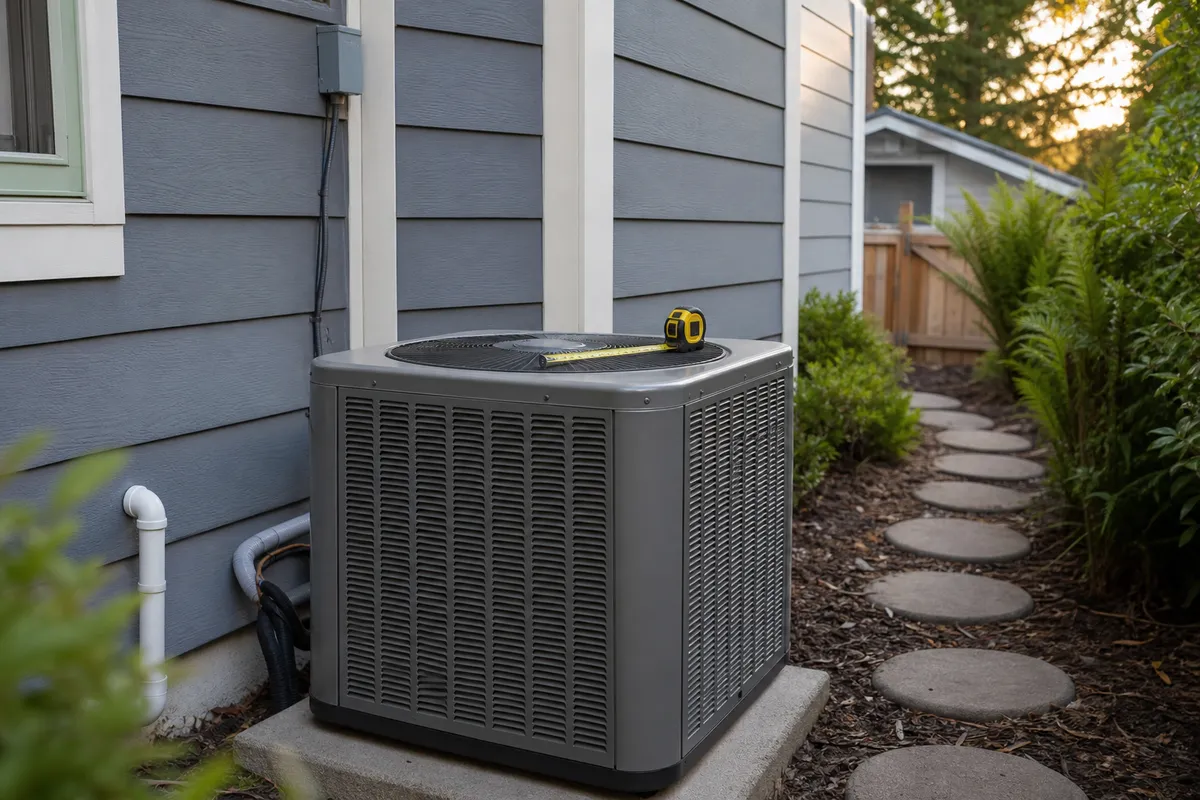
Every July, I get the same call: “My AC is only two years old, why is my house still humid and my PSE bill through the roof?” Nine times out of ten, the answer isn’t a broken unit. It’s an oversized one. In a climate like ours — mild, marine, with short but intense heat spikes — bigger is almost never better. Let me walk you through the math.
TL;DR
- Seattle’s climate rarely needs more than 1.5 to 3 tons of cooling for an average single-family home.
- Oversized units cool the air fast but don’t run long enough to remove humidity, leaving rooms feeling clammy.
- Short-cycling from an oversized system burns more kWh per degree of comfort and wears out compressors faster.
- A Manual J load calculation, not square footage guesswork, should size any new system.
- Heat pumps often solve both heating and cooling sizing problems better than a standalone AC in our region.
Why Seattle’s Climate Confuses AC Sizing
King and Snohomish counties sit in a Marine West Coast climate zone. That means our summers are short, our humidity is moderate, and our design temperature (the hottest it reasonably gets for sizing purposes) hovers around 85 to 88 degrees Fahrenheit, not the 100-plus numbers contractors in Texas or Arizona plan for. A lot of national HVAC sizing rules of thumb — like “1 ton per 500 to 600 square feet” — come from hotter, drier climates and simply don’t apply here.
Homes in neighborhoods like Wallingford, Ballard, and Ravenna were often built between 1920 and 1970, with smaller window areas, decent shade from mature trees, and less insulation than modern code requires but also less solar heat gain than a glass-heavy new build in Bellevue. Each of these factors changes the actual cooling load, and none of them show up in a simple square-footage estimate.
“The most common sizing mistake I see in Seattle is oversizing. A unit that’s too big short-cycles — it cools the air fast but never runs long enough to dehumidify, so the house feels clammy. We run a Manual J load calculation on every install; if a contractor quotes you a tonnage without measuring anything, that’s a red flag.”
— Sergei Petrov, Founder & Lead HVAC Technician at SPS Pro Services
What Happens When Your AC Is Too Big
An oversized air conditioner cools your living room to the thermostat setpoint in eight minutes instead of twenty. That sounds like a win, but it isn’t:
- Short cycling. The compressor turns on, satisfies the thermostat almost immediately, and shuts off. It never runs long enough to pull moisture out of the air, so the room feels cool but sticky.
- Higher electric bills. Compressors draw the most current during startup. An oversized unit starts more often per hour, and those repeated startup surges add up on your PSE or Snohomish PUD bill even though total runtime is lower.
- Faster wear. More on/off cycles mean more mechanical stress on contactors, capacitors, and the compressor itself. I’ve seen 4-year-old oversized units need the same repairs as an 12-year-old properly sized one.
- Uneven temperatures. Because the system shuts off so fast, air never fully circulates through ductwork, so back bedrooms and upstairs rooms stay warmer while the room with the thermostat overshoots cool.
If any of that sounds familiar and your system is already struggling, it might be worth a diagnostic before you assume you need a whole new unit — see our AC repair page for what a typical service call covers.
What Happens When It’s Too Small
Undersizing has its own problems, though it’s less common in our market. A too-small unit will run constantly on the hottest days, never quite catching up to the setpoint, and drive up utility costs from sheer runtime. It also shortens equipment life from continuous strain. The goal is a system matched to the actual, calculated load of your house — not the biggest one that fits the budget, and not the cheapest one that fits the space.
The Right Way to Size: Manual J, Not Square Footage
A Manual J load calculation (the industry-standard method from the Air Conditioning Contractors of America) accounts for:
- Square footage and ceiling height
- Window count, orientation, and glazing type
- Insulation levels in walls, attic, and floor
- Air infiltration and duct location
- Local design temperatures for Seattle, Bellevue, or Everett specifically
- Internal heat gains from occupants and appliances
This is the same calculation we run before any heat pump installation project, because heat pumps are even more sensitive to correct sizing than standalone AC — an oversized heat pump short-cycles in both heating and cooling mode, doubling the problem.
Cost and Sizing Comparison for a Typical Seattle-Area Home
Here’s a realistic estimate range for a 1,800 to 2,200 square foot single-family home in the Seattle area, comparing a properly sized system to a commonly oversized alternative sold on square footage alone.
| System | Typical Sizing Mistake | Estimated Install Cost | Estimated Annual Cooling Cost (PSE electric rates) |
|---|---|---|---|
| 2-ton AC, Manual J sized | Correctly matched to load | $4,500–$6,500 | $110–$160 |
| 3.5-ton AC, “rule of thumb” sized | Oversized by 1–1.5 tons | $5,800–$7,800 | $180–$240 |
| 2-ton ducted heat pump | Correctly matched, adds heating | $7,000–$10,500 | $95–$140 (cooling only, heating separate) |
These are estimates only, based on typical Seattle-area electric rates and average summer runtime — most jobs land somewhere in these ranges depending on ductwork condition, electrical capacity, and home age. Note that the oversized 3.5-ton unit costs more upfront and more to run than a correctly sized 2-ton system doing the same job. That’s the core problem with sizing by guesswork.
Where a Heat Pump Changes the Equation
If you’re due for a new cooling system, it’s worth asking your contractor about a heat pump instead of a standalone AC. A properly sized heat pump handles both summer cooling and shoulder-season heating, often replacing an aging furnace at the same time. Given how mild our winters are in Seattle, Bellevue, and Everett compared to inland climates, heat pumps run efficiently for the majority of the heating season here too, only needing backup heat strips on the coldest nights. If your current furnace is on its last legs, it may make more sense to plan a heat pump conversion than to patch the furnace and separately install AC — check furnace repair if you want a repair-versus-replace opinion first.
Electrical Capacity: The Piece Homeowners Forget
Bigger isn’t better on the mechanical side, but you do need to make sure your electrical panel can handle a new AC or heat pump, especially if you’re also thinking about an EV charger down the road. Many homes in older Seattle neighborhoods still have 100-amp service, which can be tight once you add a heat pump’s outdoor unit, an EV charger, and a modern water heater. Before installation day, it’s worth having someone check panel capacity — we cover this in detail on electrical panel upgrade. If you’re planning both a heat pump and an EV charger installation in the same year, bundling the panel evaluation upfront saves a second service call.
Sizing Checklist Before You Sign a Contract
- Ask if the contractor performed a Manual J load calculation, not simply a square-footage estimate.
- Get the calculated tonnage in writing, not only “we recommend a 3-ton unit.”
- Confirm your home’s insulation and window details were part of the calculation.
- Ask how existing ductwork was evaluated — undersized or leaky ducts can make even a correctly sized unit underperform.
- Check your electrical panel capacity, especially in homes built before 1990.
- Get the estimated annual operating cost, not simply the install price.
- If replacing a furnace soon, ask for heat pump pricing alongside AC pricing.
A Few Other Systems Worth Checking While You’re At It
While you have a technician in the house for AC sizing, it’s efficient to ask about other aging systems. Water heaters, for instance, often fail around the same age as an original AC unit — if yours is making noise or running out of hot water faster than it used to, see water heater repair for signs it needs attention. And if you’re in Seattle proper, Bellevue, or Everett and unsure which contractor covers your area, our service area pages at Seattle, Bellevue, and Everett list what we handle locally.
Mini-FAQ
Does a bigger AC cool my house faster in an emergency heat wave? It cools the thermostat’s room faster, but not the whole house evenly, and it won’t handle humidity well. A correctly sized unit run continuously during a heat wave actually keeps the whole home more stable.
Can I just add a smaller AC to my existing oversized ductwork? Sometimes, but ductwork sized for a bigger unit can cause airflow problems with a smaller one. This is exactly what a load calculation and duct evaluation are meant to catch before installation.
Is a heat pump really enough for Seattle winters? For most homes in King and Snohomish counties, yes, given our moderate winter design temperatures. Backup heat strips or a dual-fuel setup with an existing furnace cover the occasional cold snap.
Call SPS Pro Services at (206) 427-8907 for a Manual J-based AC or heat pump sizing estimate before your next summer heat wave hits.