
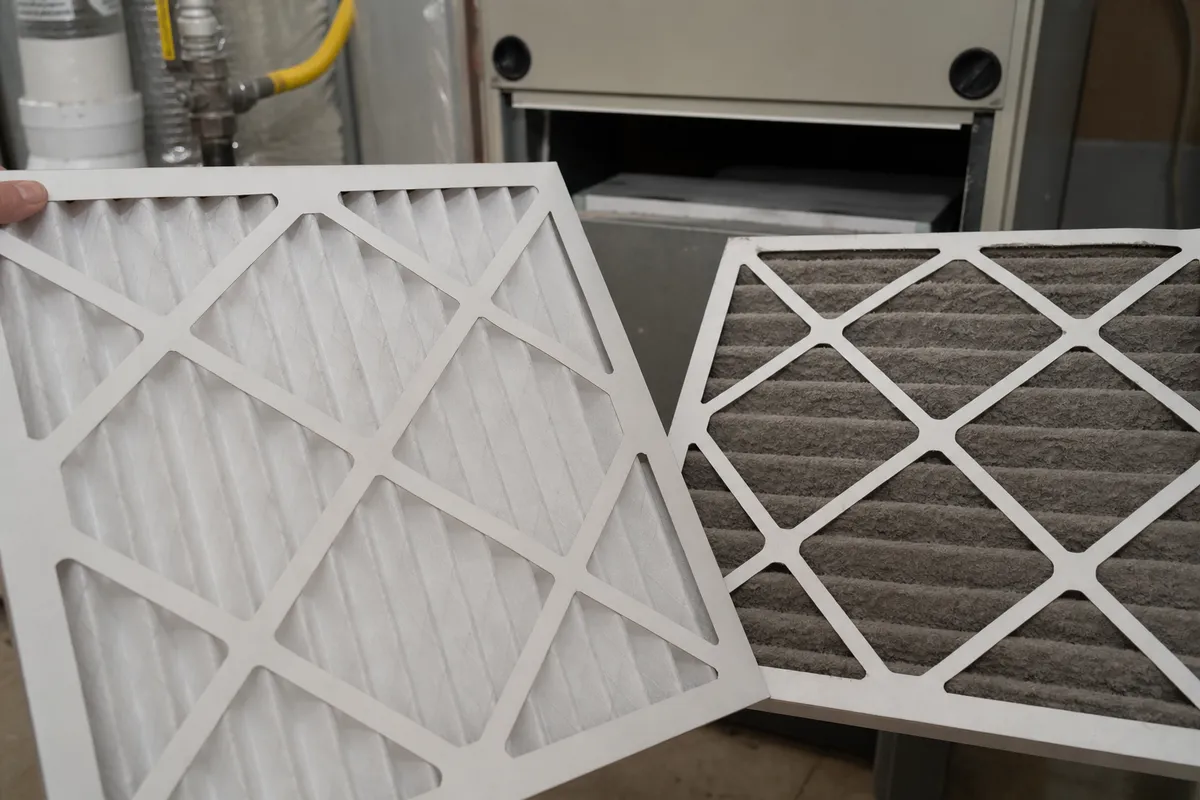
In February I pulled a filter out of a furnace in Kenmore that was so packed it had bowed inward and partially collapsed into the blower compartment. The homeowner was a careful guy. He’d written “replace filter” on his calendar for every six months, because that’s what the guy at the hardware store told him. Problem: it was a 1-inch filter, he had two golden retrievers, and the furnace had run through a smoky September. The blower motor was running 30 degrees hotter than spec and had maybe a season left. A $12 filter changed on time would have prevented a repair bill that landed near the top of our $189-$950 range.
That call stuck with me because the advice he got wasn’t wrong in general. It was wrong for his filter, his house, and this climate. Filter schedules printed on the packaging assume an average American home in an average climate, and the Puget Sound area is not that.
So this is the filter-only article. If you want the full pre-winter routine, that’s the fall furnace maintenance checklist. Here we’re staying narrow: how often, which filter, and what actually happens inside the furnace when you forget.
TL;DR
- Baseline: 1-inch filters every 1-3 months, 4-5 inch media filters every 6-12 months.
- In the Seattle area, lean toward the short end: spring pollen, fall mold spores, and August-September wildfire smoke all load filters faster.
- Pets, allergies, remodeling dust, and homes near arterials each shorten the interval further.
- A clogged filter overheats blower motors and can crack heat exchangers. It’s the cheapest part in the system and causes the most expensive failures.
- MERV 8-11 is the sweet spot for most residential systems. Higher isn’t automatically better.
How often should I really change it, by filter type?
Thickness is the variable that matters most, because it determines how much surface area the filter has to load up with dust before airflow suffers. Here’s the schedule I give customers from Shoreline to Renton, adjusted for our conditions:
| Filter type | Package says | My PNW baseline | With pets or allergies |
|---|---|---|---|
| 1“ fiberglass (basic) | 30 days | Every 30 days | Every 2-3 weeks |
| 1“ pleated (MERV 8-11) | 90 days | Every 60-90 days | Every 30-45 days |
| 4“ media cabinet | 6-12 months | Every 6 months | Every 4-6 months |
| 5“ media cabinet | 12 months | Every 6-9 months | Every 6 months |
| Washable/electrostatic | Clean monthly | Clean monthly, replace if damaged | Clean every 2-3 weeks |
During a wildfire smoke event, check any filter weekly regardless of type. I’ve seen 1-inch filters go from white to gray in ten days of smoky air, and the filter is doing exactly its job when that happens. It just needs relief sooner.
Why does Western Washington chew through filters faster?
Three seasonal loads stack up here that a generic schedule ignores.
Spring pollen runs long. Alder and birch start in February, grasses carry it through June. That’s four-plus months of fine particulate that pleated filters catch efficiently, which means they load up efficiently too.
Fall and winter bring mold spores. Our damp climate keeps outdoor mold active most of the year, and homes with crawlspace returns or duct leakage pull that air in. The EPA’s indoor air quality guidance is clear that filtration is one of the main tools here, but only if the filter has capacity left.
Then there’s smoke season. Most Augusts and Septembers now bring at least a few days of wildfire smoke into King and Snohomish counties. Smoke particles are small, they load filters fast, and people run their systems on fan-only for days straight to filter indoor air. A filter that was already three months old going into a smoke week comes out of it done.
One more local factor: older homes around Seattle often have leaky return ducts running through dusty crawlspaces, so the filter sees far more debris than the living space alone would produce. If every filter you pull is gray in weeks, duct leakage or dirty ducts may be the real problem; a duct cleaning runs $350-$700 and sometimes doubles filter life afterward.
What actually breaks when I forget?
A clogged filter doesn’t politely reduce performance. It starves the furnace of airflow, and the furnace responds badly in a specific sequence.
First, the blower motor works harder against the restriction, runs hotter, and its bearings and windings age fast. Blower motor replacement is one of the most common major repairs we do, and dirty filters are behind a large share of them.
Second, with less air moving across it, the heat exchanger runs hotter than design. The furnace’s limit switch will shut things down to protect it, which shows up as short-cycling: heat for a few minutes, off, repeat. Do that for a couple of winters and the repeated thermal stress can crack the heat exchanger. At that point you’re not buying a filter, you’re pricing a furnace replacement, because a cracked exchanger on an older furnace is rarely worth repairing.
Third, weak airflow means rooms far from the furnace stop getting warm, which people misread as a failing furnace. A surprising number of our furnace repair calls end with me holding up a matted filter as the diagnosis. We credit the diagnostic fee toward the repair, but I’d rather you spend $12 at the hardware store than call me for that.
“When I’m scheduling no-heat calls in December, I always ask when the filter was last changed. If the answer is ‘I’m not sure,’ I tell them to check it before the tech arrives. A few times a month, that phone call fixes the furnace before we ever roll a truck.”
— Alina Kovalenko, Service Coordinator & Comfort Advisor at SPS Pro Services
What MERV rating should I actually buy?
MERV measures how small a particle the filter captures; the EPA explains the rating scale here. Higher numbers catch smaller particles, but they also resist airflow more, and residential blowers have limits.
For most systems I recommend MERV 8-11. MERV 8 handles dust, pollen, and lint. MERV 11 adds most pet dander and finer smoke particles, which is worth it for allergy households and our smoke season. MERV 13 catches even more, but on an older furnace with a 1-inch filter slot, it can restrict airflow enough to cause the exact overheating problems you’re trying to avoid. If you want MERV 13 filtration, the right way is usually a 4-5 inch media cabinet, which has enough surface area to filter finely without choking the blower. We install those during furnace maintenance visits or as part of a new furnace installation.
Skip the cheap see-through fiberglass filters unless your only goal is protecting the equipment from large debris. They do almost nothing for air quality.
How do I check my filter size, direction, and condition?
The two-minute routine, no tools needed:
- Find the filter: usually in a slot between the return duct and the furnace cabinet, sometimes behind a return grille in a hallway or ceiling.
- Read the size off the old filter’s frame (for example 16x25x1 or 20x25x4) and buy exactly that size. A filter that’s close-but-not-exact lets air bypass around it.
- Look for the airflow arrow on the frame. It points toward the furnace, in the direction air travels, not toward the return duct.
- Hold the filter up to a light. If you can’t see light through most of it, it’s done, regardless of the calendar.
- Write the install date on the filter frame with a marker. Future you will thank present you.
- Set a phone reminder matched to your filter type from the table above.
- While you’re there, glance for water or rust streaks under the furnace. Catching that early is a separate, cheaper conversation.
Frequently asked questions
Can I run the furnace without a filter for a few days?
Please don’t. Dust goes straight into the blower wheel and heat exchanger passages, and cleaning a fouled blower costs far more than any filter. A slightly dirty filter beats no filter every time.
Do more expensive filters last longer?
Thicker, yes; pricier at the same thickness, not really. A $25 MERV 11 1-inch filter clogs on roughly the same schedule as a $8 MERV 8 in the same house. Pay for thickness and the right MERV, not for marketing.
My filter is clean but airflow still seems weak. What now?
Check that supply vents are open, then look at the ducts. Crushed flex duct, closed dampers, or heavy internal dust buildup all mimic filter problems. If the basics check out, book a diagnostic; it’s credited toward the repair if we find something.
Sources
- EPA — What is a MERV rating?
- EPA — Indoor Air Quality (IAQ)
- U.S. Department of Energy — Energy Saver
If a neglected filter has already turned into a no-heat problem, call SPS Pro Services at (206) 427-8907 or book a furnace repair visit and we’ll get you warm again.