
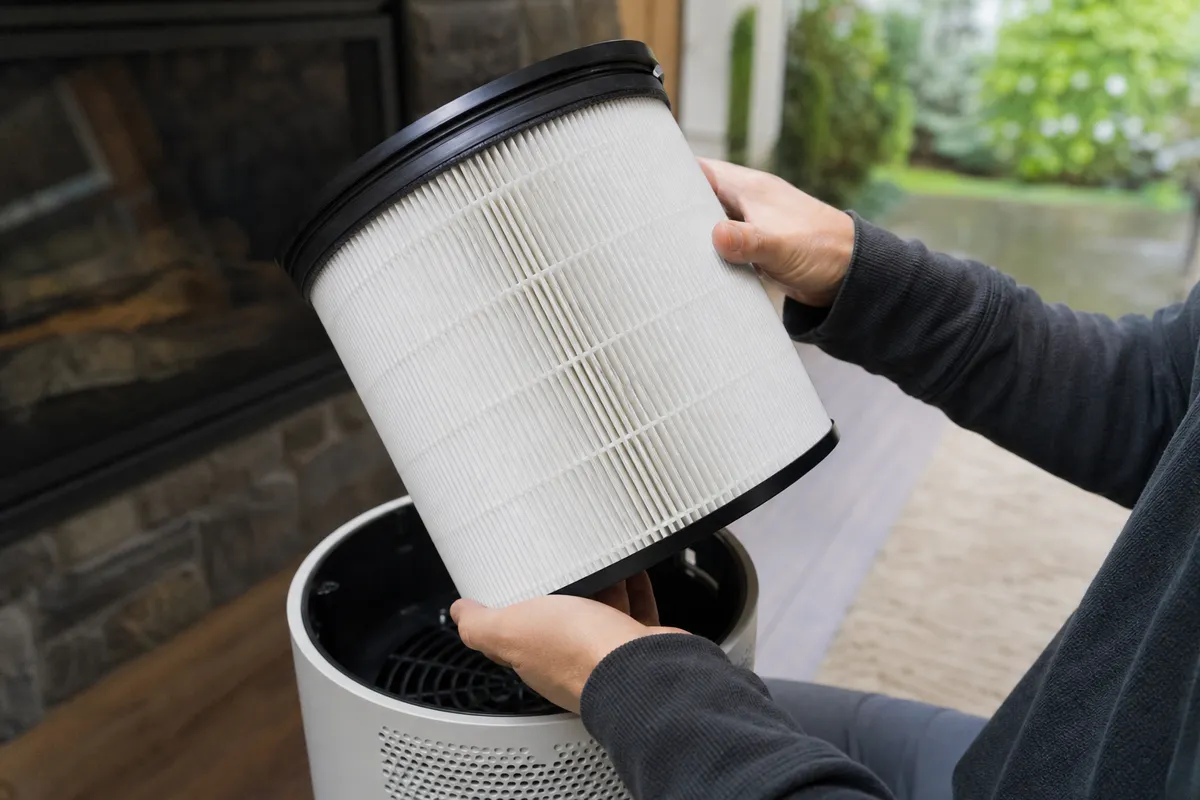
Two summers ago, during the worst of the wildfire smoke, I got called to a house in Bellevue where the furnace blower had died in August. The owner had read that HEPA filters catch smoke particles — true — so he’d bought the densest filter he could find, jammed it into the return slot, and run the fan around the clock for a week. The blower motor had been straining against it like a shop vac with a sock over the hose. It overheated, the house filled with smoke anyway, and now he was paying for a repair on top of it.
He did nothing unreasonable. The marketing on filter boxes practically begs you to make this mistake, and “HEPA” has become a magic word slapped on everything from vacuum bags to $40 desk gadgets. The real definition is precise and worth knowing, because it tells you exactly where HEPA filtration belongs in a home — and where it doesn’t. Here’s the honest version, including what I put in my own house.
TL;DR
- True HEPA means capturing at least 99.97% of 0.3-micron particles — a tested standard, not a marketing adjective.
- “HEPA-type,” “HEPA-like,” and “99% HEPA” on a box mean the filter did not meet that standard.
- Your furnace or air handler almost certainly cannot run a true HEPA filter — the airflow resistance can damage the blower.
- The right home setup is usually a MERV 11–13 filter in the HVAC system plus portable HEPA units in the rooms you occupy most.
- During wildfire-smoke season, one properly sized portable HEPA unit in a closed room outperforms almost anything you can do to central equipment.
What does 99.97% at 0.3 microns actually mean?
A true HEPA filter must capture at least 99.97% of particles 0.3 microns in diameter. For scale, a human hair is around 50–70 microns across — these particles are more than a hundred times finer.
Here’s the counterintuitive part: 0.3 microns isn’t chosen because it’s the smallest particle — it’s the hardest particle to catch. Engineers call it the most penetrating particle size (MPPS). Big particles slam into fibers like bugs on a windshield. Very small particles get bounced around by air molecules, zigzag randomly, and blunder into a fiber almost immediately. Particles around 0.3 microns are stuck in between: too small to crash, too big to zigzag, so they follow the airflow and thread the needle through the filter.
So when a filter proves 99.97% capture at 0.3 microns, it performs even better at every other size — the standard tests the filter’s own worst case. Wildfire smoke sits mostly in the 0.4–0.7 micron range, right in HEPA’s strike zone.
Is “HEPA-type” the same thing?
No, and this is where most of the marketing games live. Watch for these on packaging:
- “True HEPA” — meets the 99.97% @ 0.3 micron standard. This is the phrase you want.
- “HEPA-type,” “HEPA-like,” “HEPA-style” — legally meaningless. Often 85–95% capture, sometimes worse. If it met the standard, the box would say so.
- “99% HEPA” — a contradiction. 99% is below the standard, so this is a non-HEPA filter borrowing the word.
- Vacuum cleaners and cars — “HEPA filtration” claims here often describe the filter media, while unsealed housings let air leak around it. Sealed-system design matters as much as the media.
For portable air cleaners, the number that cuts through all of it is CADR (clean air delivery rate) — an independently tested measure of how much cleaned air the whole unit actually delivers. A cheap true-HEPA unit with a weak fan can be beaten by an honest non-HEPA unit with a strong one. Check CADR against your room size before you check the filter’s badge.
Why can’t I put a HEPA filter in my furnace?
Because of static pressure — the resistance your blower has to push against.
Residential furnaces and air handlers are designed to move air through relatively open filters. A true HEPA filter is so dense that forcing your system’s full airflow through it would require several times the pressure your blower can produce. Put one in anyway and airflow collapses: rooms heat and cool poorly, the coil can freeze in cooling season, the heat exchanger can overheat in winter, and the blower motor grinds itself down — exactly what happened in that Bellevue house. If your system is already misbehaving after a filter experiment, a diagnostic visit (furnace repair in winter, AC repair in summer) is cheaper than a new blower motor.
What belongs in your central system instead is a MERV 11–13 filter — ideally a 4–5 inch media cabinet rather than a 1-inch slot filter, because the deeper pleats add surface area, which keeps resistance low while filtration stays high. MERV 13 captures a large share of smoke and allergen particles while letting a healthy blower breathe. I run a MERV 13 media cabinet at home. If the MERV scale is new to you, we’ve got a plain-English MERV rating explainer.
True whole-house HEPA does exist — as a dedicated bypass unit with its own fan, plumbed alongside the ductwork — but at $2,000–$4,000 installed it’s a specialty item for severe allergy and immune-compromise situations, not a default recommendation.
So where does true HEPA belong in my house?
In portable room units. This is the setup I recommend to most Seattle-area homeowners, and it’s what the EPA’s guidance supports: filter the whole airstream at MERV 11–13, then put true-HEPA cleaning in the rooms where people spend their hours — bedrooms first, since you’re in them a third of your life.
Portable units shine during smoke season precisely because they’re room-scale. Close the bedroom door, run a properly sized unit on medium, and that room can hold clean air even when the neighborhood AQI is ugly.
Here’s how the money shakes out:
| Option | Upfront cost | Ongoing cost | What it does |
|---|---|---|---|
| Portable true-HEPA unit (per room) | $120–$400 | $40–$100/yr filters | Best particle removal in occupied rooms; smoke season workhorse |
| MERV 11–13 media cabinet (whole house) | $400–$900 installed | $60–$120/yr filters | Good whole-house filtration at safe static pressure |
| MERV 11–13 1-inch filters (whole house) | $0 (existing slot) | $80–$160/yr | Decent filtration; loads up faster, check monthly |
| Filter subscription service | $0 | $50–$150/yr | Convenience — right size arriving on schedule beats a forgotten filter |
One more honest note: filters only clean what passes through them. If your ducts are visibly shedding debris or the system smells musty when it starts up, address the source too — that’s a duct cleaning ($350–$700) or moisture conversation, and here’s our guide to musty HVAC smells. And filtration is one leg of air quality, along with ventilation and source control — see do air purifiers actually work? for the full picture.
“Every smoke season we get calls from people who bought the densest 1-inch filter on the shelf and choked their blower with it. The filter can be too good for the equipment. Match the filter to the system’s static pressure budget, then add a portable HEPA unit in the bedroom — that combination beats any single heroic filter.”
— Sergei Petrov, Founder & Lead HVAC Technician at SPS Pro Services
How do I set up for wildfire-smoke season? A checklist
Do this in early summer, before the first smoke advisory:
- Buy the portable unit now — they sell out regionally within days of the first bad AQI forecast.
- Size it to the room: match the unit’s CADR rating to your room’s square footage; oversizing slightly means you can run it on quiet low speed.
- Stock replacement filters — a smoky month can consume a filter that would normally last a year.
- Upgrade the central filter to MERV 13 if your blower can handle it (we can check static pressure during any service visit).
- Plan your closed-room strategy: pick one or two rooms with doors that seal reasonably well; that’s where the portable units live.
- Set the HVAC fan to run during smoke events so the MERV filter keeps working between heating/cooling calls.
- Check the filter monthly during smoke events, not on the normal schedule — loading accelerates enormously.
Frequently asked questions
Does a HEPA filter remove smoke smell?
Only partially. HEPA media captures smoke particles, but odor comes largely from gases (VOCs), which pass straight through fibers. Units with a substantial activated-carbon stage — a real sorbent bed, measured in pounds, and replaced on schedule — handle odor. A thin black mesh pre-filter marketed as “carbon” does very little.
Do HEPA filters capture viruses and allergens?
Allergens, comfortably — pollen, dust-mite debris, and pet dander are large particles by HEPA standards. Individual viruses are tiny, but they travel attached to respiratory droplets and aerosols in the 0.3–5 micron range, which HEPA captures efficiently. A portable unit is a reasonable supplement to ventilation, not a substitute for it.
How often do portable HEPA filters need replacing?
Typically every 6–12 months under normal use — sooner after a heavy smoke season or in homes with several pets. Most good units have a filter indicator, but a visual check works: if the pleats have gone from white to gray-brown, replace it. A clogged HEPA filter mostly costs you airflow, which quietly guts the unit’s CADR.
Sources
- EPA — What is a HEPA filter?
- EPA — Air Cleaners and Air Filters in the Home
- U.S. Department of Energy — Energy Saver
Want to know what filtration your system can actually handle? Call SPS Pro Services at (206) 427-8907 and we’ll check it during a duct cleaning or any service visit.