
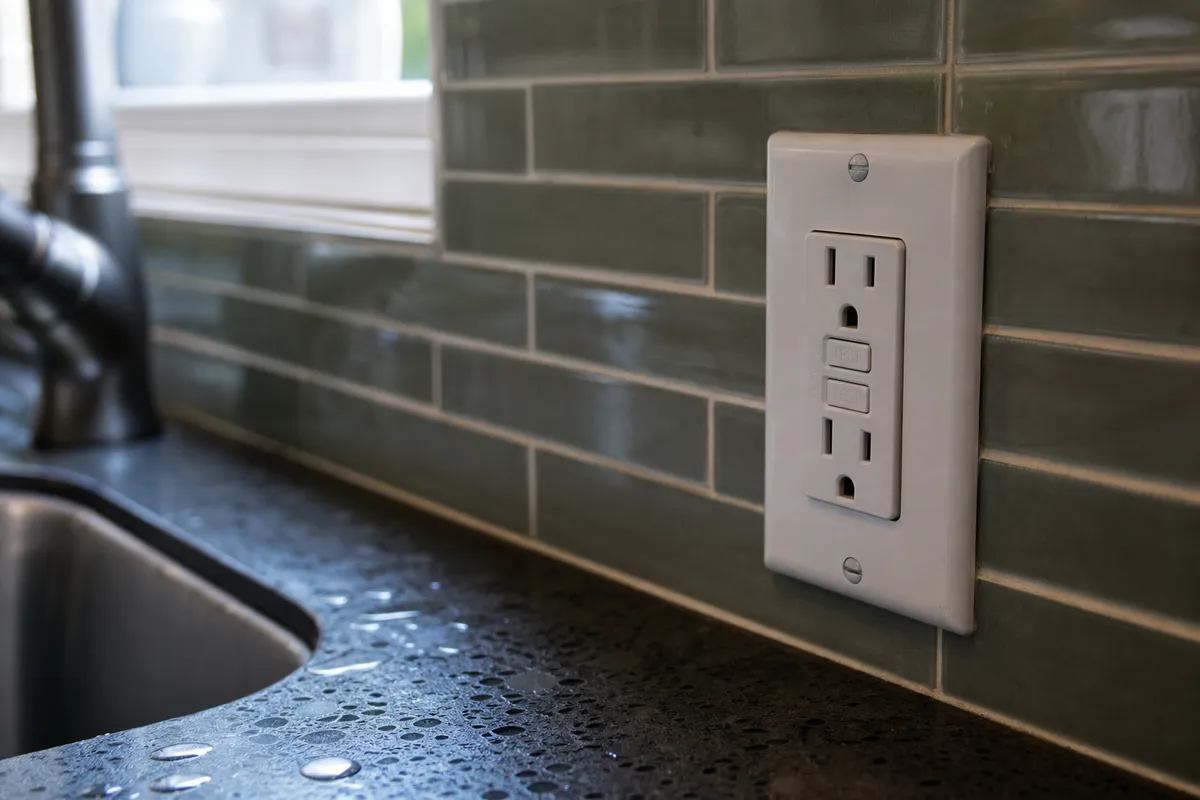
A few months back I did a pre-sale walkthrough on a 1958 house in Shoreline — original kitchen, original bathroom, original everything. The buyer’s inspector had flagged “no GFCI protection in wet locations,” and the seller was annoyed. “The outlets work fine,” he told me. “They’ve worked fine for sixty years.” He wasn’t wrong. They also would have done absolutely nothing to protect anyone who dropped a plugged-in radio into a sink full of water.
That’s the thing about GFCIs — the ordinary outlet and the GFCI outlet behave identically until the exact moment one of them saves a life. I install and test these devices every week across Seattle, Renton, and Burien, and the questions homeowners ask are remarkably consistent. Here are the honest answers.
TL;DR
- A GFCI compares current going out and coming back; a mismatch of a few thousandths of an amp trips it in a fraction of a second.
- Current code requires GFCI protection in bathrooms, kitchens, garages, outdoors, unfinished basements, laundry areas, and near sinks.
- Older Seattle-area homes often have zero GFCI protection in the rooms that need it most — the requirements arrived one room at a time over decades.
- One GFCI device can protect every ordinary outlet downstream on the same circuit.
- A two-prong ungrounded outlet can legally be replaced with a GFCI — no rewiring required — as long as it’s labeled correctly.
- Replacement is inexpensive: our service call starts at $149, and most homes need only a handful of devices.
How does a GFCI actually work?
Skip the electrical theory — here’s the plain version. Electricity flowing to your toaster travels out on one wire and returns on another, and in a healthy circuit those two amounts are identical. A GFCI continuously compares them. If even a few milliamps go missing — far less than what runs a nightlight — the device concludes electricity is leaking somewhere it shouldn’t be, possibly through a person, and opens the circuit in a few hundredths of a second, before a dangerous shock can become a fatal one.
That’s why GFCIs matter specifically around water: wet skin conducts far better than dry skin, and water gives current a path to ground. A standard breaker won’t help — it trips at 15 or 20 amps, and it takes far less than one amp to stop a human heart. The breaker protects the wiring. The GFCI protects you.
Should I get GFCI outlets or a GFCI breaker?
Both do the same job in different places.
A GFCI outlet (the one with TEST and RESET buttons) protects itself and, if wired that way, every standard outlet downstream on the same circuit. That’s why an outdoor outlet that “died” is often just a tripped GFCI hiding in the garage or a bathroom. A GFCI breaker sits in your electrical panel and protects the entire circuit, every outlet, every foot of wire.
I generally recommend outlets for retrofits — cheaper, and the reset is right where the problem is. Breakers make sense when outlets are hard to reach, when whole-circuit protection matters (hot tubs, outbuildings), or when we’re already doing panel work. Some older panels have limited breaker options — one more item in the case for upgrading, covered in our guide to panel warning signs.
Where does code require GFCI protection?
The list has grown steadily for fifty years, which is exactly why a home’s age predicts what’s missing. Current code requires GFCI protection, broadly, in: bathrooms, kitchen countertop outlets, garages, outdoor outlets, unfinished basements and crawl spaces, laundry areas, and near sinks in general. Washington adopts the national code through Labor & Industries with state amendments, and permitted work is inspected against the current edition (L&I link below).
Here’s the practical timeline I use when I walk into a house:
| Home built | GFCI protection you’ll typically find |
|---|---|
| Before 1971 | None, anywhere, unless someone retrofitted |
| 1970s | Outdoors and bathrooms only |
| 1980s | Bathrooms, outdoors, garages |
| 1990s | Above plus kitchen countertops and crawl spaces |
| 2000s | Above plus unfinished basements, near laundry sinks |
| 2010s–today | Essentially every wet or damp location, including laundry areas |
A 1955 Shoreline rambler was built before any of this existed. Nothing was done wrong — the code hadn’t been written yet. But “legal when built” and “as safe as it could easily be” are different things, and this is the cheapest safety upgrade in residential electrical work. It’s also one of the first things flagged in a pre-purchase electrical inspection.
Can I replace a two-prong outlet with a GFCI without rewiring?
Yes — and this surprises people, because it sounds like cheating. Code explicitly allows an ungrounded two-prong outlet to be replaced with a GFCI, even with no ground wire in the box. The logic is sound: a GFCI doesn’t need a ground wire, because it compares outgoing and returning current against each other, not against ground. You get shock protection the old outlet never provided.
Two requirements come with it: the outlet must be labeled “No Equipment Ground” (stickers come in every GFCI box), and you can’t pretend the ground exists — surge protectors and some electronics genuinely want a real ground and won’t get one. As a rewire-free safety improvement in an older home, this is the best value in the trade. Where we find this alongside other aging-wiring symptoms, a broader electrical inspection is usually the right next step.
“When homeowners call about a dead outdoor or bathroom outlet, I first ask them to find and press every RESET button in the house — garage, bathrooms, basement. About a third of those calls end right there on the phone, no visit needed. The rest we schedule, but I’d rather save you the trip charge when a button press is the fix.”
— Alina Kovalenko, Service Coordinator & Comfort Advisor at SPS Pro Services
Why does my GFCI keep tripping?
A GFCI that trips constantly is either doing its job very well or wearing out. The common causes, in the order I find them:
- Moisture in an outdoor box — failed gasket, wind-driven rain, a sprinkler hitting the outlet. Extremely common on Seattle homes without in-use (“bubble”) covers.
- An actual leaky appliance — old freezers, sump pumps, aquarium equipment, anything with a heating element. Plug the suspect into a different GFCI; if it trips there too, the appliance is telling you something.
- Too much circuit downstream — one GFCI protecting a long daisy chain accumulates small normal leakage from everything plugged in until it crosses the trip threshold.
- A worn-out device — GFCIs are electronics and they age; ten to fifteen years is a reasonable service life.
- Damaged wiring — nicked insulation or a neutral touching ground somewhere in the circuit. This one needs a licensed electrician to trace.
What a tripping GFCI is almost never: a reason to swap in a standard outlet so it “stops being annoying.” I’ve seen that done in garages around here, and it’s removing the smoke detector because it beeped.
How do I test my GFCIs — and what does replacement cost?
Monthly, thirty seconds per device. Make the checklist a habit:
- Press TEST on each GFCI — it should click and kill power to the outlet.
- Confirm power is actually off (plug in a lamp).
- Press RESET — power should come back.
- If TEST doesn’t kill power, or RESET won’t restore it, the device has failed and needs replacement.
- Note any two-prong outlets in kitchens, bathrooms, garages, and outdoors — those are your retrofit candidates.
- Check outdoor outlets for intact, closing covers before the fall rains arrive.
On cost: our service call starts at $149, which typically covers diagnosing and replacing a failed GFCI. Adding protection where none exists usually runs $25–$60 per additional device on the same visit, so bringing a 1960s home’s wet locations up to modern protection is commonly a $200–$400 project. Compare that to what the device protects against, and it’s the easiest recommendation I make. If you’re adding outdoor circuits for a generator installation or an EV charger, GFCI protection is part of that conversation too — those are damp-location circuits by definition.
Frequently asked questions
Do GFCIs wear out?
Yes. Ten to fifteen years is typical — less outdoors. The monthly test button is the only way to know yours still works; a failed GFCI often keeps passing power while having silently lost its ability to trip.
What’s the difference between a GFCI and an AFCI?
A GFCI detects current leaking out of the circuit — shock protection. An AFCI detects arcing inside the circuit — fire protection. Modern code requires AFCI in most living areas and GFCI in wet areas; some locations need both, available as a dual-function device.
My GFCI has no power and won’t reset. Now what?
Check whether a GFCI upstream tripped — the dead outlet may be fed from a GFCI two rooms away. Then check the breaker. If both check out and it still won’t reset, the device has likely failed or there’s a fault on the circuit, and that’s a call to us.
Sources
If your home predates GFCI requirements — or a dead outlet has you pressing buttons with no luck — call SPS Pro Services at (206) 427-8907 and we’ll sort it out with a proper electrical inspection.