
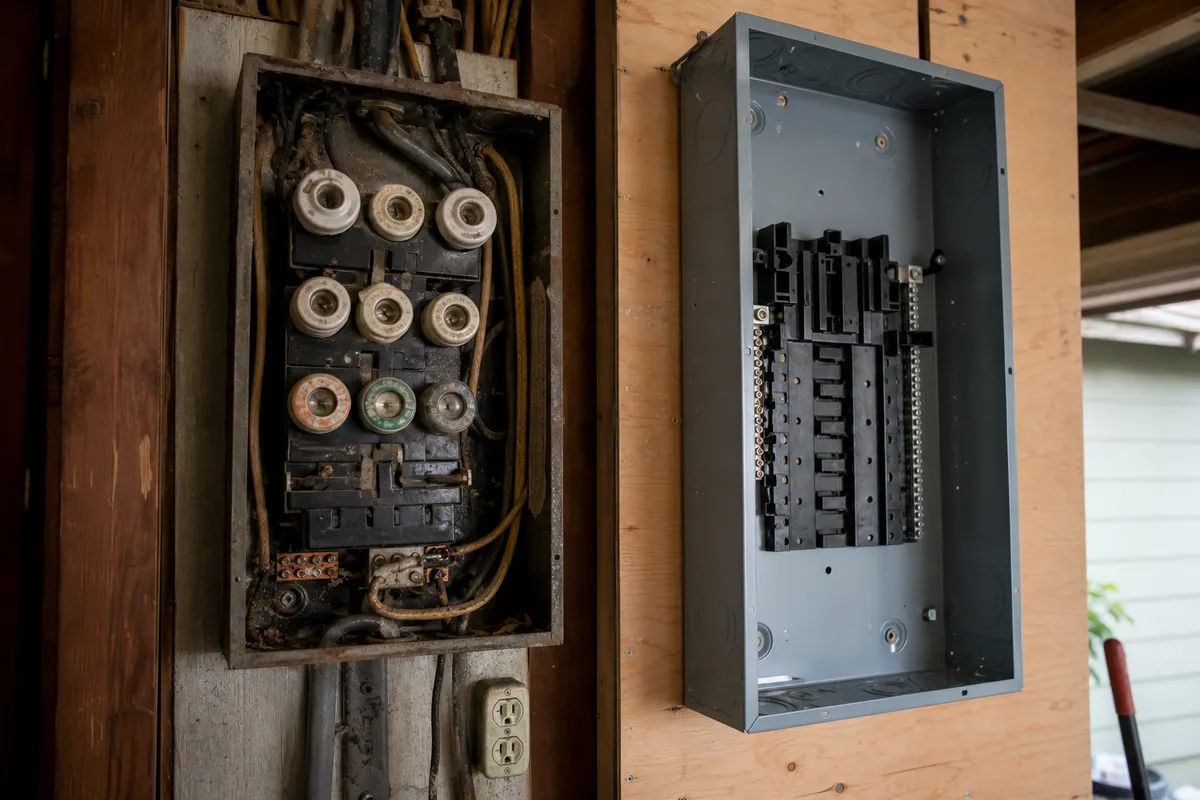
I’ve opened up hundreds of panels in Wallingford bungalows, Ballard four-squares, and split-levels out in Lynnwood, and I can tell within about ten seconds whether a panel is keeping up with a modern house or quietly working against it. Seattle has more housing stock from the 1940s through 1970s than most West Coast cities its size, and a lot of those homes still have the electrical panel they were built with — sometimes patched, sometimes not. That’s not automatically dangerous, but it’s worth understanding what your panel is telling you.
This guide walks through the eight signs I look for on every service call, what the National Electrical Code (NEC) and Washington L&I actually require, and where the common myths fall apart.
TL;DR
- Breakers that trip under normal use, warm panel covers, or a persistent burning smell are not “normal wear” — they’re signals to call an electrician.
- Federal Pacific, Zinsco, and older Bulldog Pushmatic panels have known failure patterns and are flagged by most Washington home inspectors.
- A 100-amp panel is often too small for homes adding EV charging, heat pumps, or electric water heaters — 200-amp service is the current practical standard.
- Washington L&I requires an electrical permit and inspection for panel upgrades; a licensed contractor pulls that permit, not the homeowner in most cases.
- Most panel upgrades in King and Snohomish counties land between $2,200 and $4,500 depending on amperage, panel location, and utility coordination.
- A hot panel, double-tapped breakers, or missing grounding are code violations under current NEC, even if the panel was legal when installed.
Sign 1: Breakers Trip More Than Once a Month
A breaker tripping occasionally when you run the microwave and a space heater at once is the breaker doing its job. A breaker tripping weekly, or tripping with nothing unusual plugged in, means the panel is undersized for your actual load or the breaker itself is failing. In homes built before 1975, it’s common to find a 60-amp or 100-amp main serving a house that’s since added central air, an electric dryer, and a couple of space heaters over the decades. The panel hasn’t changed; the load has.
“Half the panel upgrades we do now are driven by electrification, not failure. The panel was fine for the house as it was — then the owner adds a heat pump, an EV charger, and an induction range in the same year, and a 100-amp panel simply has no headroom left. If electrification is on your roadmap, plan the panel first.”
— Danil Sokolov, Heat Pump & Mini-Split Specialist at SPS Pro Services
Sign 2: The Panel Cover Is Warm or the Breakers Feel Hot
This one I don’t let clients wait on. NEC 110.3(B) and basic thermodynamics agree: a properly sized, properly connected breaker should run at close to ambient temperature. Warmth at the panel face usually means a loose lug, an overloaded circuit, or aluminum branch wiring from the 1960s-70s that’s corroding at the connection point. If you can feel heat through the cover, turn off what you can on that circuit and call us before it turns into a bigger problem.
Sign 3: You Smell Burning Plastic or See Scorch Marks
This is the one myth I want to kill outright: “a little scorch mark is just cosmetic.” It isn’t. Scorching at a breaker or bus bar means arcing has already happened. Under Washington L&I electrical rules, any panel showing thermal damage needs to be de-energized and evaluated before it’s touched again. Don’t reset a breaker that looks burned — call an electrician.
Sign 4: Your Panel Is a Federal Pacific, Zinsco, or Older Bulldog Pushmatic
If your panel has one of these brand names on it, it’s worth a phone call even if nothing seems wrong. Federal Pacific Stab-Lok breakers have a documented history of failing to trip during overloads — the exact opposite of what a breaker is supposed to do. Zinsco panels have similar bus bar corrosion issues. These aren’t rumors; they’re why most home inspectors in Seattle, Bellevue, and Everett flag them automatically during a real estate transaction, and why insurance companies sometimes require replacement before issuing a policy.
Sign 5: You’re Adding a Heat Pump, EV Charger, or Electric Water Heater
This is the sign I see most often now, and it’s not really a “problem” sign — it’s a planning sign. A heat pump system, especially a whole-home heat pump replacing an old gas furnace, typically needs a dedicated 240-volt circuit and enough panel capacity to run alongside your other electric loads. Same story for EV charger installation — a Level 2 charger draws 30-50 amps continuously, which a tired 100-amp panel usually can’t absorb without exceeding safe capacity. If you’re planning a heat pump installation or adding a charger, it’s worth having your panel evaluated first rather than discovering mid-project that there’s no room.
Sign 6: You Still Have Fuses Instead of Breakers
Fuse panels aren’t automatically illegal to keep, but they’re outdated technology — no reset button, easy to “fix” a blown fuse with a higher-amp fuse than the circuit was designed for (please don’t), and no ground fault or arc fault protection, both of which current NEC requires in most living spaces now. If your service panel still has round screw-in fuses, it predates most of the safety code we work under today.
Sign 7: Double-Tapped Breakers or Rust Inside the Panel
Two wires jammed under one breaker screw — “double-tapping” — is one of the most common violations I find on older Seattle homes, usually from a previous owner adding a circuit without pulling a permit. Most breakers aren’t rated for two conductors. Rust inside the panel, meanwhile, usually means water intrusion, often from an exterior panel without proper flashing, common on homes near the Sound where wind-driven rain gets under old panel covers.
Sign 8: Your Panel Is Rated for Less Than 100 Amps
A lot of homes built in the 1950s in Shoreline, Renton, and parts of Seattle were wired for 60-amp service, which was fine for a house with no air conditioning, no electric dryer, and one television. If your main breaker says 60 or even 100 amps and you’re running a modern household — furnace blower, AC, water heater, computers, EV — you’re likely closer to the edge of capacity than you’d like. Panel upgrades to 200-amp service are now the practical standard for most single-family homes in King and Snohomish counties.
What Washington L&I and NEC Actually Require
Washington State requires a licensed electrical contractor to pull a permit for panel work, and L&I inspects the completed job before it’s signed off — this isn’t optional paperwork, it’s a real inspection of grounding, bonding, breaker sizing, and clearances. The NEC (adopted with Washington amendments) sets minimum clearances in front of panels (typically 36 inches of clear working space), requires proper grounding electrode systems, and mandates AFCI/GFCI protection on most modern branch circuits. A legitimate panel upgrade means bringing the whole service up to current code.
Cost Comparison: Panel Upgrade Scenarios in the Seattle Area
| Scenario | Typical Amperage Change | Estimated Cost Range |
|---|---|---|
| Fuse panel to breaker panel, same capacity | 60A to 100A | $2,200 – $3,400 |
| Standard residential upgrade | 100A to 200A | $2,200 – $4,500 |
| Upgrade with utility service line replacement | 100A to 200A, PSE/SnoPUD coordination | $4,000 – $6,500 |
| Sub-panel addition for detached garage or ADU | New 60A–100A sub-panel | $1,800 – $3,200 |
These ranges cover most jobs we do across Seattle, Bellevue, and Everett; exact pricing depends on whether Puget Sound Energy or Snohomish County PUD needs to coordinate a service drop change, panel location, and whether the meter base also needs replacement.
Quick Self-Check Before You Call
- Panel brand is Federal Pacific, Zinsco, or older Pushmatic
- Breakers trip more than once or twice a month
- Panel cover, breakers, or nearby outlets feel warm to the touch
- Any scorch marks, burning smell, or buzzing sound from the panel
- Still using screw-in fuses instead of breakers
- Main breaker rated 60A or 100A and household has central AC, electric dryer, or plans for EV charging
- Visible rust, water staining, or double-tapped breakers inside the panel
- Home was built before 1980 and panel has never been upgraded
If you checked two or more boxes, it’s worth a real inspection, not a guess.
Mini FAQ
Can I just add a bigger breaker if mine keeps tripping? No. A breaker is sized to protect the wire behind it, not to be upgraded to stop tripping. Oversizing a breaker beyond what the wiring is rated for is a fire hazard and a straightforward code violation.
Does a panel upgrade fix problems with my furnace or water heater directly? Not directly, but an undersized panel can cause nuisance shutdowns on furnace blowers, water heater repair calls, or AC repair situations that look like equipment failure but are actually power delivery issues at the source.
How long does a typical panel upgrade take? Most single-family home upgrades take one full day for the electrical work, plus scheduling time for the L&I inspection, which usually happens within a few business days after the work is complete.
If any of these eight signs sound familiar, call SPS Pro Services at (206) 427-8907 and we’ll take an honest look at your panel before it becomes a bigger issue — and if a full electrical panel upgrade isn’t actually needed, we’ll tell you that too.
Sources
- WA Labor & Industries — Electrical Permits, Fees & Inspections
- U.S. Department of Energy — Energy Saver