
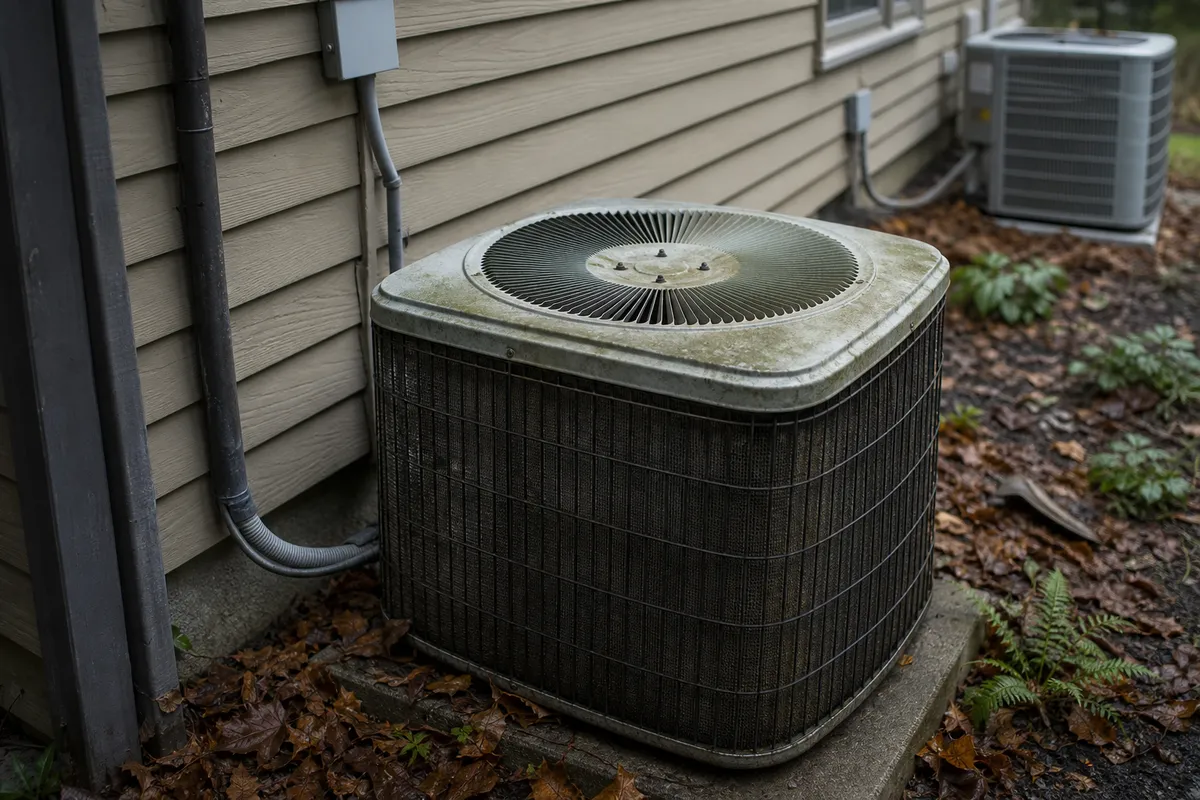
Last month I stood in a Kirkland side yard looking at a Carrier condenser with a manufacture date of 2003. Twenty-three years old, still cooling the house. Another company had told the owner anything past 15 years was “living on borrowed time.” The unit had a weak capacitor and a coil full of cottonwood fluff — ninety minutes of work and it was pushing 18-degree splits again.
Two weeks before that, I condemned a 12-year-old unit in Marysville. Salt-heavy marine air and a decade of zero maintenance had eaten the condenser coil until it leaked refrigerant through pinhole corrosion in three places. Same region, wildly different outcomes.
So how long does an AC last around Seattle? Longer than the national averages say, if you treat it right — and much shorter if you don’t. Here’s how I decide between AC repair and replacement.
TL;DR
- Central AC in the Seattle area typically lasts 15-20 years, often longer, because our cooling season is short and the unit accumulates far fewer runtime hours than one in Phoenix or Texas.
- What kills units here is not wear from runtime. It’s coil corrosion from marine air, neglected maintenance, and parts obsolescence on old R-22 systems.
- If your unit runs R-22 refrigerant (roughly pre-2010), any refrigerant-side failure usually means replacement. The refrigerant itself is phased out and absurdly expensive.
- Past year 15, I weigh repair cost against age: a $250 capacitor on an 18-year-old unit is fine; a $1,800 compressor is not.
- Because heat pumps heat and cool, replacing a dead AC with a heat pump often makes more financial sense here than a straight AC swap, especially if your furnace is also aging.
Why do AC units last longer here than the national average?
The number quoted everywhere is 12-15 years for central air. That figure comes from national data dominated by climates where AC runs six months a year, eight hours a day.
An air conditioner ages by runtime hours, not calendar years. A condenser in Phoenix might log 2,500-3,000 runtime hours a year; around Puget Sound, a typical system logs 300-600 — a couple of warm stretches in July and August plus the occasional heat event. That’s why I regularly see 20-year-old units in Redmond and Sammamish with plenty of mechanical life left. The compressor barely wears out here. What fails is everything around it.
What actually kills AC units in Western Washington?
Three things, in the order I see them on service calls:
Corrosion. We live next to salt water. Homes in Mukilteo, Edmonds, and anywhere near the Sound get marine air that attacks aluminum coil fins and copper tubing. Add nine damp months a year and you get rusted base pans, corroded connections, and eventually formicary corrosion — microscopic tunnels in the copper that leak refrigerant. This is the failure that genuinely ends a unit’s life, because a leaking condenser coil usually costs more to replace than the unit is worth.
Neglect. Because the AC only matters two months a year, it gets ignored the other ten. Cottonwood fluff and fir needles pack the condenser coil; the unit still cools, but head pressure climbs, the compressor runs hot, and electrical parts fail early. A capacitor that should last 15 years dies at 8. Most “dead” units I revive were killed by a $30 part that failed because the unit was overworked.
Obsolescence. Units built before roughly 2010 use R-22 refrigerant, which the EPA phased out — no new R-22 has been made since 2020. Reclaimed supply exists, but its price makes any leak repair on those systems a bad bet, even when the unit is mechanically fine.
How long does each type of cooling equipment last here?
Numbers below reflect what I actually see in King and Snohomish County homes, not manufacturer brochures.
| Equipment type | Typical Seattle-area lifespan | What usually ends it | Replacement cost range |
|---|---|---|---|
| Central AC (condenser + coil) | 15-20+ years | Coil corrosion, R-22 obsolescence | $5,500-$12,500 |
| Ducted heat pump | 12-17 years | Runs year-round for heating, so more hours | $6,500-$15,500 |
| Ductless mini-split | 15-20 years | Blower wheel gunk, board failures | $3,800-$9,500 |
| Window unit | 8-10 years | Fan motors, general build quality | $150-$800 (retail) |
Note the heat pump line: heat pumps last fewer calendar years than AC-only units here, not because they’re worse machines, but because they also carry the heating load and log 2,000+ hours a year instead of 500. Per runtime hour, they’re comparable. I cover how they work in more detail in what a heat pump actually is.
Should I repair or replace my aging AC?
My framework starts with two questions: how old is it, and what refrigerant does it use?
Under 10 years: Repair, almost always. Failures at this age are usually capacitors, contactors, or fan motors — a few hundred dollars against a machine with a decade left.
10-15 years, R-410A: Repair anything under about $1,000. Above that, we run the math together: a $1,500 repair buying maybe five years, versus that money going toward new equipment.
Any age, R-22: Repair only non-refrigerant failures. The moment the sealed system leaks, replacement is the answer — I’ve seen R-22 quoted at over $200 per pound, and a typical system holds 6-10 pounds.
Over 15 years: Cheap electrical fixes, yes. Compressors, coils, and major refrigerant work, no.
One factor people miss: an old AC usually shares its ductwork with a furnace of similar age. If your furnace is also 15+ and has needed furnace repair recently, replacing both with one heat pump system is often cheaper than replacing them separately over five years — and Puget Sound Energy rebates only apply to the heat pump path.
What can I do to get my unit to year 20?
The units that reach 20+ around here all have owners who did a few boring things consistently:
- Rinse the condenser coil every spring. Garden hose, gentle pressure, after cottonwood season. This is the single highest-value 15 minutes of AC maintenance that exists.
- Change the filter on schedule. A choked filter starves airflow and can freeze the indoor coil. Details in how often to change your furnace filter.
- Keep 2 feet of clearance around the outdoor unit. I have pulled blackberry vines out of a fan shroud in Marysville.
- Get a professional tune-up every year or two. Capacitor values, refrigerant charge, amp draws — the early-warning numbers a homeowner can’t read.
- Fix small problems fast. A hard start or one tripped breaker is a warning, not a fluke.
- If ducts are filthy, address them. Dirty ductwork raises static pressure and overworks the blower; duct cleaning runs $350-$700.
“People assume the compressor decides when the system dies, but in this climate I almost never condemn a compressor. I condemn coils that corroded and R-22 systems that sprang a leak. Keep the coil clean and the charge tight, and a Seattle AC will outlive the roof.”
— Sergei Petrov, Founder & Lead HVAC Technician at SPS Pro Services
Does the heat pump option change the replacement math?
Yes, and this is the conversation I have most often in Kirkland and Redmond right now. When an AC dies, the same outdoor slot, line set, and (usually) ductwork can take a heat pump instead — which replaces both your AC and most of your furnace’s job.
The install premium is real, roughly $1,000-$3,000 over a comparable AC, but a heat pump then heats your home at two to three times the efficiency of electric resistance and displaces gas usage the rest of the year. In our mild climate, modern cold-climate units carry the heating load nearly year-round, and Puget Sound Energy rebates offset a chunk of the premium — none of which applies to a plain AC install. If your cooling is dead and your heating is old, price both paths; sizing matters too, and I walk through it in AC sizing for Seattle summers.
Frequently asked questions
How do I find out how old my AC unit is?
Check the data plate on the outdoor condenser — a sticker or metal plate on the cabinet. Look for “MFR DATE” or decode the serial number; most brands embed the year and week of manufacture. If the plate is unreadable, any tech can date the unit from the serial during a service visit.
Is a 20-year-old AC worth repairing?
For minor electrical parts, often yes. A $189-$350 capacitor replacement on a 20-year-old unit that otherwise runs well can buy several more summers, and around Seattle that’s a fair bet given how little the unit actually runs. Anything involving the refrigerant circuit or compressor at that age is money better spent on new equipment.
Does an AC lose efficiency as it ages?
Yes, but the effect on your bill is modest here because the unit runs so few hours. A 20-year-old 10-SEER unit costs more per hour than a modern 15+ SEER2 unit, but at 400 runtime hours a year the difference might be $60-$120 a season. Reliability and refrigerant type are the real deciders, not efficiency.
Sources
- U.S. Department of Energy — Energy Saver
- ENERGY STAR — Air-Source Heat Pumps
- Puget Sound Energy — Rebates
Not sure whether your unit has another summer in it? Call SPS Pro Services at (206) 427-8907 for an honest repair-or-replace assessment — the diagnostic fee is credited toward any repair.