
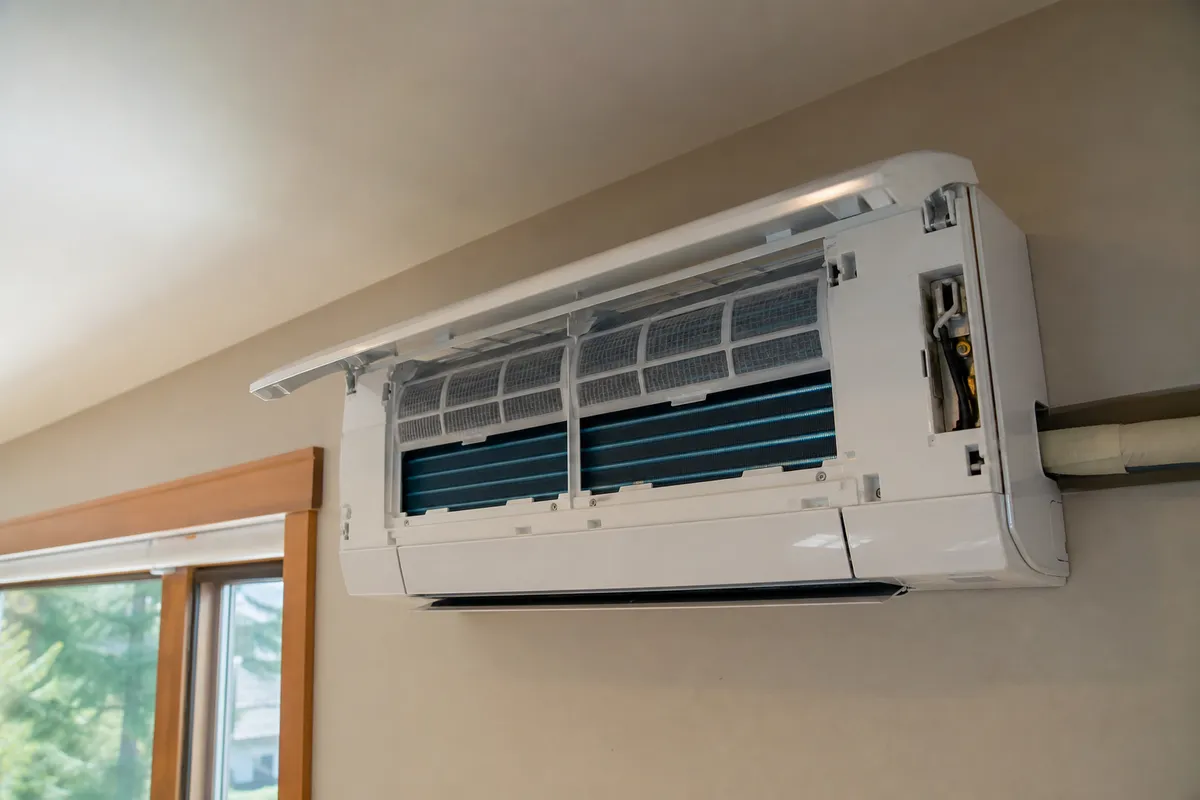
Last month I installed a two-zone mini-split in a 1948 house in Edmonds. The owners had lived there for eleven years with electric baseboards and a box fan in the bedroom window every July. The house had no ductwork at all — like most homes of that era around Puget Sound — so every central-air quote they’d gotten started with “first we tear open your ceilings.” When I showed them that the entire refrigerant connection between the outdoor unit and the bedroom head was a three-inch hole in the wall, the husband actually walked outside to double-check I wasn’t hiding a duct somewhere.
I get that reaction a lot. Mini-splits look too simple to do what they do: heat the whole house in January, cool it in an August heat wave, and cut the electric bill while doing both. So let me walk you through what’s actually happening inside one — the same explanation I give homeowners standing next to me in the driveway.
TL;DR
- A mini-split is a heat pump: one outdoor unit, one or more indoor “heads,” connected by a slim refrigerant line set — no ducts anywhere.
- It both heats and cools by moving heat, not making it, which is why it’s so efficient in our mild marine climate.
- The inverter compressor speeds up and slows down continuously instead of slamming on and off, so temperatures stay steady and bills stay lower.
- Installed cost in the Seattle area typically runs $3,800–$9,500 depending on zones and line-set complexity.
- Modern cold-climate units heat fine through Puget Sound winters — the “heat pumps quit below freezing” myth is decades out of date.
What are the actual parts of a mini-split?
There are only three, and each has one job.
The outdoor unit holds the compressor, a coil, and a fan. This is the workhorse, mounted on a pad or wall brackets beside the house.
The indoor head is the unit you see on the wall (or ceiling, or recessed into a soffit). It holds a second coil and a very quiet blower. No burner, no element in most setups — the coil does everything.
The line set connects the two: a pair of insulated copper refrigerant lines, a power cable, and a condensate drain, all bundled together and typically run through a single 3-inch penetration. This is the part that replaces an entire duct system, and it’s why we can install these in 1920s–1960s houses, additions, and backyard ADUs without demolition. Ducts are the single biggest obstacle in older Puget Sound homes; the line set simply sidesteps them.
Refrigerant circulates through this loop, absorbing heat at one coil and releasing it at the other. In summer, heat is grabbed indoors and dumped outside. In winter, a reversing valve flips the direction — the outdoor coil pulls heat out of cold outside air (yes, even cold air holds heat) and delivers it inside. That’s why a mini-split is, mechanically, a heat pump: same refrigeration cycle, run in either direction.
Why does the inverter compressor matter so much?
A conventional AC or furnace is binary: full blast or off. The house overshoots the setpoint, the system shuts down, the house drifts, the system slams back on. You feel it as temperature swings; the equipment feels it as wear.
An inverter compressor is variable-speed. It might sprint at 100% to recover after you’ve been away, then settle into a 30% cruise that exactly matches the heat leaking through your walls. Three things fall out of that:
- Steadier comfort. The room holds within about a degree instead of sawing back and forth.
- Lower bills. Running slow and steady is more efficient than repeated hard starts, the same way highway cruising beats stop-and-go traffic.
- Longer equipment life. Fewer starts, less mechanical stress. My colleague wrote about the mirror-image problem — oversized on/off systems short-cycling — in our AC sizing guide.
Our mild climate is the best-case scenario for this. A mini-split in Kirkland spends most of the year loafing at low speed in its most efficient range, because the outdoor temperature is usually within 25 degrees of your setpoint. The same unit in Minnesota or Phoenix works far harder.
Do I need one head per room?
Not necessarily, and this is the biggest design decision in any quote.
A single-zone system is one outdoor unit feeding one indoor head — perfect for an ADU, a garage conversion, a primary bedroom, or an open-plan main floor. It’s the cheapest and most efficient configuration because the equipment is matched exactly to one space.
A multi-zone system runs two to five heads off one larger outdoor unit. Each head has its own remote and setpoint, so the kids’ rooms can sit at 68 while the home office holds 72. The trade-offs: a multi-zone outdoor unit costs more, and heads that are grossly oversized for small bedrooms can cycle inefficiently. Sometimes two single-zone systems beat one multi-zone on both price and performance — it depends on the floor plan, which is exactly what a site visit is for. For whole-house projects where ductwork already exists, a ducted heat pump installation is often the better tool; here’s our full mini-split vs. central comparison.
Realistic installed pricing around King and Snohomish counties:
| Configuration | Typical installed cost | Best for |
|---|---|---|
| Single-zone, simple line run | $3,800–$5,200 | ADU, addition, one problem room |
| Single-zone, long/complex line run | $4,800–$6,500 | Head far from feasible outdoor location |
| Dual-zone | $6,500–$8,200 | Main floor + primary bedroom |
| 3–4 zone | $8,000–$9,500 | Whole small house, no ducts |
Electrical work (many older homes need a new 240V circuit) and permit costs are the usual variables inside those ranges.
Will it really heat my house in a Puget Sound winter?
This is the myth I spend the most time debunking, so let me be direct: yes.
The old reputation came from 1990s-era heat pumps that lost capacity quickly below 40°F. Modern cold-climate mini-splits use enhanced vapor injection and better compressors to deliver strong heat output well below 0°F — and Puget Sound winter design temperatures are in the 20s. A January cold snap here is a mild day for equipment rated for Ottawa.
I installed a single-zone unit in a Mill Creek ADU two winters ago and the owner texted me during that 18°F stretch specifically to say the unit hadn’t blinked. The outdoor unit will run defrost cycles on cold, damp mornings — a few minutes of steam coming off the coil is normal, not a malfunction. What you should not expect is furnace-style blasts of very hot air; a mini-split delivers a continuous, moderate stream of warm air instead. Different feel, same warm house, much smaller bill than baseboards. If you’re keeping a gas furnace as backup in a larger home, that’s a valid hybrid setup too — we handle furnace repair and can tell you honestly whether yours is worth keeping.
Is a mini-split the right fit for my home? A quick checklist
You’re a strong candidate if several of these apply:
- Your house has no ductwork (electric baseboard, radiators, wall heaters) — common in homes built 1920–1960 around Everett, Edmonds, and north Seattle.
- You have an addition, bonus room, or ADU that the existing system doesn’t reach.
- You have one chronically hot or cold room — usually upstairs south-facing.
- You’re on electric heat and want to cut winter bills; heat pumps deliver 2–4 units of heat per unit of electricity.
- You want cooling added to a house that has none, without installing ducts — the alternative being a full central AC installation at $5,500–$12,500 if ducts exist.
- You care about zoning — heating only the rooms you’re actually using.
- You qualify for utility rebates — PSE and Snohomish PUD both pay meaningful incentives for ductless heat pumps, which can knock four figures off the numbers above.
“Half the homes we visit on the Eastside were built before central air was even a thing, and the owners assume cooling means tearing the house apart. A properly sized ductless system solves it in one or two days with a couple of three-inch holes. The technology fits this housing stock better than anything else on the market.”
— Sergei Petrov, Founder & Lead HVAC Technician at SPS Pro Services
Frequently asked questions
How long does a mini-split installation take?
A single-zone system with a straightforward line run is typically done in one day, including vacuum-testing the lines and commissioning. Multi-zone systems usually take two days. Add time if an electrical panel circuit needs to be added.
How long do mini-splits last?
Plan on 15–20 years with basic care. The two habits that matter most: rinse the indoor unit’s washable filters monthly during heavy-use seasons, and keep leaves and shrubs a couple of feet clear of the outdoor unit. An annual professional cleaning of the indoor coil and blower wheel keeps efficiency from quietly eroding.
Are mini-splits noisy?
The indoor heads run around 19–30 dB on low — quieter than a library. The outdoor unit is in the 50s dB, noticeably quieter than a conventional AC condenser, because the inverter compressor rarely runs at full speed. Placement still matters; we avoid mounting outdoor units under bedroom windows.
Sources
- U.S. Department of Energy — Energy Saver
- ENERGY STAR — Air-Source Heat Pumps
- Puget Sound Energy — Rebates
Curious what a ductless system would cost for your floor plan? Call SPS Pro Services at (206) 427-8907 or start with our mini-split installation page for a free assessment, and see the heat pump installation side if you want ducted options priced too.