
Three years ago, almost nobody in Lake City or Shoreline asked me about air conditioning. Now I get three calls a week during the first real heat wave of the summer, and the question is always the same: mini-split or central AC? I run the numbers on both every time, and the answer isn’t the same for every house. Here’s the comparison I actually give clients, kilowatt-hours and dollars included.
TL;DR
- Mini-splits (ductless heat pumps) cost less to install in most Seattle-area homes without existing ductwork and heat your house too, not only cool it.
- Central AC needs a duct system already in place; if your ducts are old or leaky, you’re paying to cool your attic.
- For a typical 1,500 sq ft King County home, mini-splits run roughly $4,500-$9,000 per zone depending on how many heads you need; central AC add-ons to an existing furnace run $6,000-$11,000.
- Mini-splits win on efficiency in our mild summers - most units hit SEER 20+ and cost $15-$35/month to run July through August in this climate.
- If you already have ducts and a furnace nearing end of life, a full heat pump system tied into the existing ductwork can make more sense than piecemeal mini-splits.
Why This Question Even Exists in Seattle
For decades, nobody here needed cooling. Marine air off Puget Sound kept summers mild, and most houses built before the 1990s - which is a lot of King and Snohomish County housing stock - were never built with AC in mind. That means no ducts, or ducts sized only for heating airflow, not cooling.
Then summers changed. We’ve had multiple stretches above 90°F in the last several years, including the 2021 heat dome that pushed Seattle past 100°F. Homes in Everett, Bellevue, and inland Seattle neighborhoods that never needed cooling suddenly did. That’s the gap mini-splits filled fast, because you don’t need to tear open walls to install one.
“In Pacific Northwest housing stock the deciding factor is almost always the ducts. Post-1975 house with sound, sized ductwork? Central system makes sense. A 1920s Craftsman with radiators or a 1960s ranch with undersized runs? The mini-split wins before we even talk efficiency, because duct surgery costs more than people expect.”
— Sergei Petrov, Founder & Lead HVAC Technician at SPS Pro Services
Mini-Split vs. Central AC: The Real Differences
Ductwork. Central AC uses your existing duct system. If you don’t have one, you’re not simply adding an AC unit, you’re adding an entire duct network, which is expensive and invasive. Mini-splits skip this entirely with a small conduit line running through a 3-inch hole in the wall.
Zoning. A mini-split system lets you cool (and heat) room by room. Central AC cools the whole house evenly, which is great if your house is small and open, less great if you’ve got a finished basement in Everett that never gets used in July but a top-floor bedroom in Bellevue that turns into a sauna.
Heating, not only cooling. This is the one homeowners forget. A mini-split is a heat pump. It heats your home efficiently down to very low outdoor temps with modern cold-climate models, which means it can replace or supplement your furnace. Central AC only cools; your furnace still does all the winter heating work, which matters for your gas or electric bill from November through March.
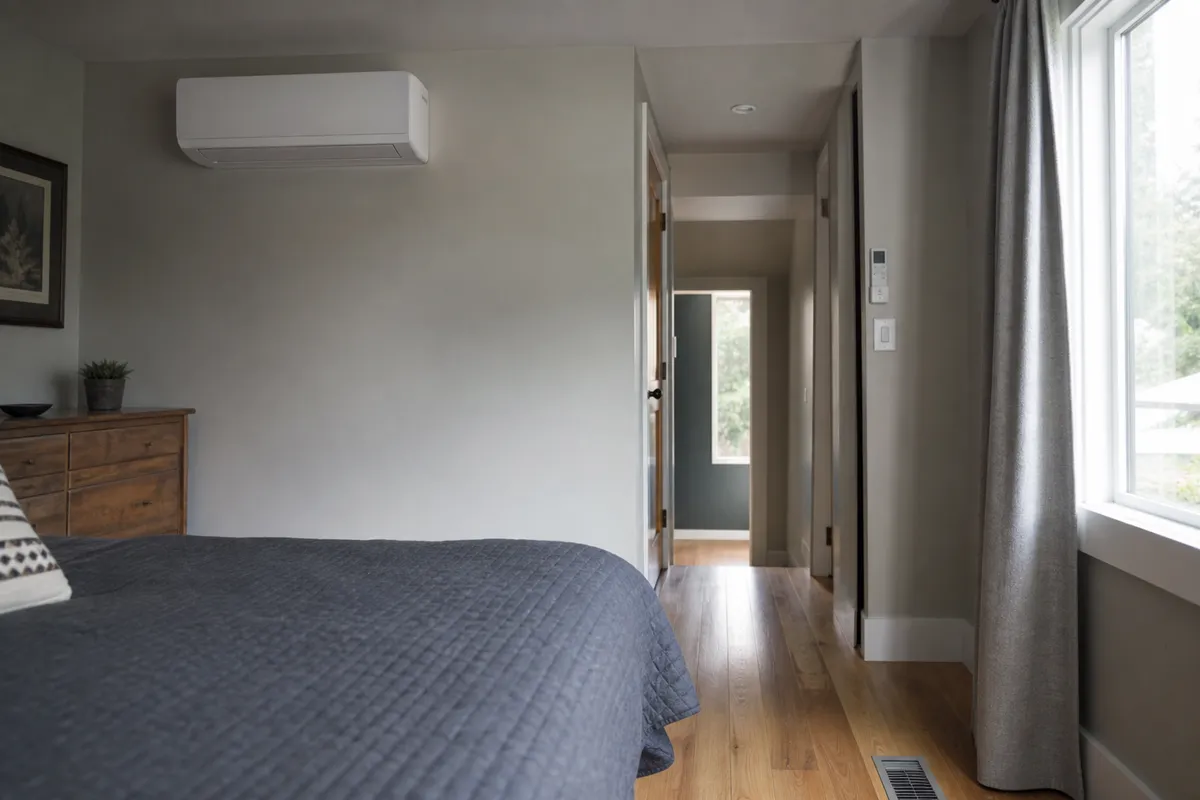
Look and noise. Central AC hides everything in the attic or basement with vents in each room. Mini-splits have a visible indoor head on the wall or ceiling in each zone, which some homeowners love and others don’t.
Efficiency in our climate. Because Puget Sound summers are mild (most days topping out in the mid-80s, not the 100s), mini-splits rarely run at full capacity, and their variable-speed compressors sip power at partial load. That’s where the real PSE and Snohomish PUD savings show up.
Cost Comparison: Seattle-Area Numbers
| Item | Mini-Split (Ductless) | Central AC (Add-On to Existing Furnace) |
|---|---|---|
| Single-zone install | $4,500 - $6,500 | N/A |
| Multi-zone (3-4 rooms) | $9,000 - $16,000 | N/A |
| Whole-house system (new ducts required) | $14,000 - $22,000 | $16,000 - $26,000 |
| Add-on to existing ductwork | N/A | $6,000 - $11,000 |
| Average monthly cooling cost (July-Aug, 1,500 sq ft) | $15 - $35 | $35 - $60 |
| Typical equipment lifespan | 15-20 years | 12-18 years |
These ranges assume standard residential installs in King and Snohomish counties, not luxury builds or homes needing structural work. Actual quotes depend on your square footage, insulation, electrical panel capacity, and how many zones you want.
The Electrical Panel Question Nobody Asks First
Here’s something homeowners in older Ballard bungalows and Everett rambler-style houses run into constantly: a mini-split or heat pump system needs dedicated circuits, and older 100-amp panels are often maxed out already, especially if there’s an electric water heater or dryer on the same panel. Before you commit to any heat pump quote, it’s worth having someone check your panel capacity. If you’re already thinking about an EV charger down the road, this is the moment to handle both at once rather than paying for two separate electrical visits. We handle electrical panel upgrades and EV charger installation together with heat pump projects for exactly this reason.
When Central AC Still Makes Sense
I’m not going to tell you mini-splits are right for everyone, because they’re not. If your Bellevue home already has a well-sealed, properly sized duct system and a furnace that’s got a decade of life left in it, adding a central AC coil to that existing system is often cheaper per square foot of coverage than installing five mini-split heads. It’s also less visually intrusive if you don’t want wall units in every room. The catch is duct quality: if your ducts leak more than about 15-20 percent (common in homes over 30 years old), you’re paying to cool your crawlspace or attic, and no AC efficiency rating fixes that.
A Practical Checklist Before You Decide
- Do you have existing, well-sealed ductwork? If no, mini-split wins on install cost.
- Is your furnace over 15 years old? Consider pairing a full heat pump system replacement instead of bolting AC onto a dying furnace. See our heat pump installation page for how that works.
- Do you need heating help too, or just summer cooling? Mini-splits do both; central AC does not.
- What’s your panel amperage? 100-amp panels often need an upgrade before adding heat pump circuits.
- How many rooms actually need conditioning? Don’t pay for zones you won’t use.
- Are you also planning an EV purchase in the next few years? Bundle the electrical work.
- Is your current furnace or water heater already acting up? A failing furnace or water heater changes the math on timing - check furnace repair or water heater repair before you commit new equipment on top of old, failing systems.
What I Tell Neighbors in Seattle, Bellevue, and Everett
Housing stock varies a lot across our service area. Seattle bungalows and craftsman homes built before 1950 almost never have ducts, so mini-splits are usually the practical answer. Newer construction in Bellevue and parts of Redmond often has ducts already sized for cooling, making central AC add-ons more competitive. Everett and Snohomish County homes are a mix, older mill-town houses without ducts alongside newer developments that do. There’s no universal answer, which is exactly why an in-person load calculation matters more than a quote over the phone.
Mini-FAQ
Can a mini-split really replace my furnace entirely? For many homes, yes, especially cold-climate heat pump models rated to perform down to 5°F or lower. Some homeowners keep a furnace as backup for the coldest nights, but many in our service area run mini-splits as their primary heat source year-round.
Will a mini-split raise my PSE or Snohomish PUD bill more than my furnace saves? Usually not. Because heat pumps move heat rather than generate it, they typically use less electricity per BTU than baseboard heat or resistance heating, and cooling loads in our climate are light compared to hotter states.
Do I need a permit for a mini-split install in King or Snohomish County? Yes, electrical and mechanical permits are standard for these installs, and a licensed contractor should pull them as part of the job, not leave it to you.
If you’re weighing mini-split against central AC installation for your Seattle, Bellevue, or Everett home, call SPS Pro Services at (206) 427-8907 and we’ll walk your house with you before you spend a dollar.