
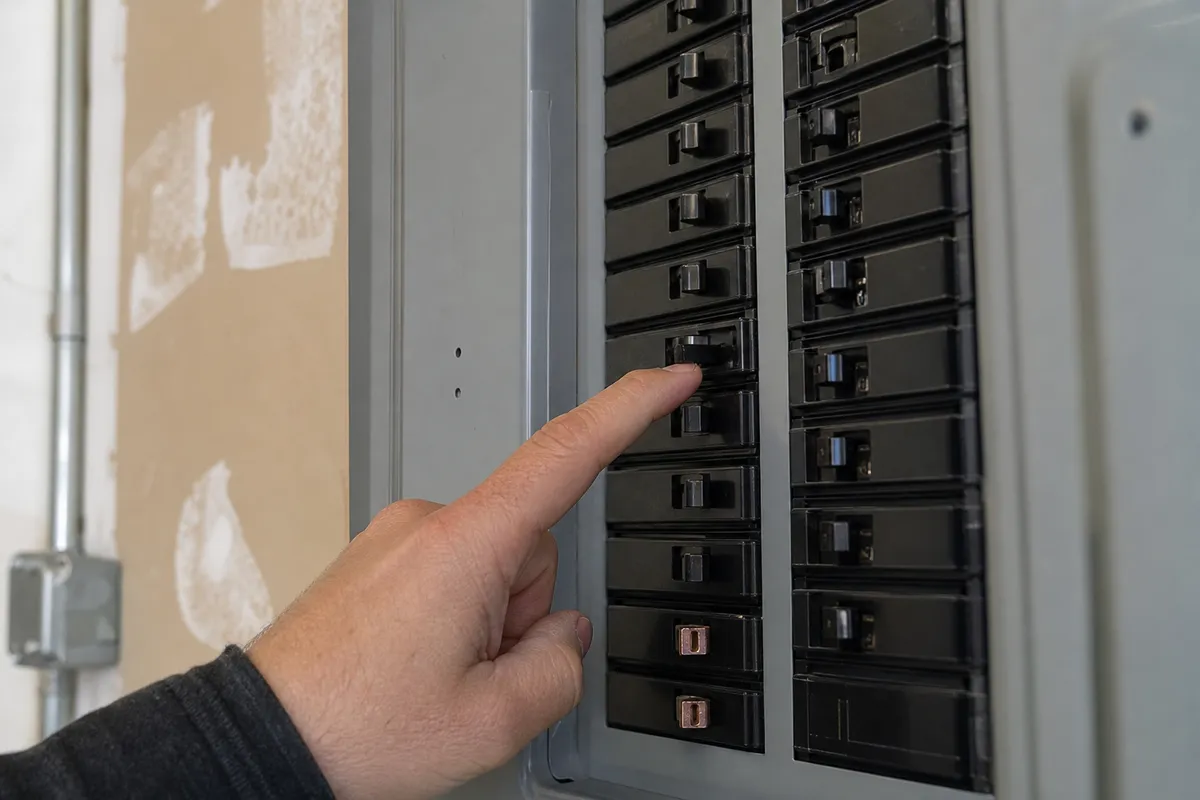
In January I got a call from a couple in Renton whose bedroom circuit had tripped four nights running, always around 10 p.m. The husband had “solved” it by resetting the breaker each night — and when that got old, by holding the handle closed to “help it catch.” That detail is why I moved the appointment up. Holding a breaker closed while it’s trying to open overrides the one device standing between an overloaded wire and a fire inside your wall.
The cause was ordinary: a 1,500-watt space heater on a nightstand, sharing a 15-amp circuit with a TV, two chargers, and — the fun part — the kitchen microwave on the other side of the wall, all on one breaker since the 1970s. Nothing was broken. The circuit was carrying more than it was built for, and the breaker was doing its job with great persistence.
But not every tripping breaker is that benign. After twenty years in panels around Seattle, Shoreline, and Burien, here’s how I sort harmless from serious.
TL;DR
- A trip seconds or minutes after reset under load is usually an overload; an instant snap is usually a short circuit — treat the second as serious.
- The space heater is the number one cause of winter breaker trips in this region, full stop.
- Reset a tripped breaker once. If it trips again, stop resetting and start unplugging. Never hold a breaker closed.
- AFCI breakers have real nuisance-trip causes, but repeated trips on the same circuit deserve investigation, not annoyance.
- Zinsco and Federal Pacific panels, and aluminum wiring, need a professional’s eyes regardless of symptoms.
- Chronic tripping in a house adding a heat pump or EV charger often means an undersized panel; upgrades run $2,200–$4,500.
What is my breaker trying to tell me?
Breakers trip for four distinct reasons, and each behaves differently.
Overload is the common one: the circuit carries more than its rating, the breaker warms internally, and after seconds or minutes it opens. The signature is delay — things run fine for a bit, then click — and it correlates with what’s running.
Short circuit is a hot wire touching neutral or another hot — current spikes enormously and the breaker slams open instantly. The signature is immediacy: reset it and it snaps back off at once, sometimes with a pop or a burnt smell. Not a “keep resetting it” situation.
Ground fault is current escaping to ground through a damaged wire, moisture, or a failing appliance. It can look like a short but is often intermittent and moisture-correlated: trips when it rains, trips when the dishwasher drains.
A failing breaker is the diagnosis of last resort but a real one. Breakers are mechanical; they wear out, and a tired one can trip below its rating — or worse, fail to trip at all. If a circuit trips with almost nothing running and the panel is decades old, the breaker itself is a suspect — a call to make with a meter, not a guess.
Is it just my space heater?
In winter, probably. A typical space heater draws 12.5 amps on high — 83 percent of a 15-amp circuit from one device, when electricians size continuous loads to 80 percent. Add a TV and a lamp, and the breaker trips exactly as designed. November through February, space heaters are the most common cause of the tripping-breaker calls we run.
The fix costs nothing: run the heater on low, keep it off circuits with other big loads, never two heaters on one circuit. If you lean on space heaters because the house’s heating can’t keep up, that’s the real problem worth solving — whether that’s furnace repair or a heat pump installation that heats the whole house for less than the heaters cost to run.
How do I safely figure out which device is causing it?
Here’s the sequence I walk homeowners through on the phone. It’s safe, and it finds the cause more often than not:
- Note exactly what was running when it tripped — including things on the same circuit in other rooms.
- Unplug everything on the affected circuit.
- Reset the breaker once: push the handle fully to OFF (you’ll feel it click), then to ON.
- If it trips immediately with nothing plugged in, stop. That’s a wiring fault or a failing breaker — call us.
- If it holds, plug devices back in one at a time, a minute or two apart, until you find the trigger.
- Try the trigger device on a different circuit. Trips there too? The device is faulty. Holds? The original circuit is overloaded.
- Whatever happens: never hold a breaker closed, and never swap in a bigger breaker.
If the trip won’t localize, or the breaker feels warm, or you smell anything burnt at the panel, that’s the end of DIY. An electrical troubleshooting call starts at $149 and includes the diagnosis.
My AFCI breaker trips randomly — is that a real problem?
Arc-fault (AFCI) breakers detect the signature of arcing — the fire-starting kind, like a chewed wire behind a wall — and current code requires them in most living areas. They earned an early reputation for nuisance tripping, partly deserved: older vacuums, treadmills, some dimmers, and cheap power supplies produce noise that first-generation AFCIs read as arcing.
My rule: an AFCI that trips only when one specific appliance runs is probably reacting to that appliance — try it elsewhere, and consider a newer-generation breaker. An AFCI that trips at random times with different loads gets investigated. I’ve traced “nuisance” AFCI trips to a nail through a cable, an arcing backstabbed outlet, and rodent damage in a crawl space. The breaker was the only witness to a real problem.
“Every fall the pattern repeats in our scheduling: the first cold week hits, space heaters come out of closets, and tripping-breaker calls triple within days. If your breakers survived summer fine and started tripping the week the weather turned, tell us on the phone — it usually means a load problem, and we can often talk you through it before booking anything.”
— Alina Kovalenko, Service Coordinator & Comfort Advisor at SPS Pro Services
When is a tripping breaker actually dangerous?
A few situations take this out of the troubleshooting category entirely:
Zinsco or Federal Pacific (FPE) panels. A lot of 1950s–1970s housing around Puget Sound still carries these brands, and both have documented failure patterns — breakers that don’t trip when they should, bus connections that overheat. In these panels, frequent tripping isn’t the scary sign; the scary version is the breaker that never trips at all. If your panel door says Zinsco or Federal Pacific Stab-Lok, have it evaluated regardless of symptoms — more in our panel upgrade signs guide.
Aluminum branch wiring. Homes wired roughly 1965–1973 may have aluminum wiring on ordinary circuits. Aluminum connections loosen over years, and loose connections make heat. Flickering, warm outlet covers, and intermittent trips in a home of that vintage are a well-known pattern worth an electrical inspection.
Signs of heat. A warm breaker, a warm panel cover, melted or discolored anything, a fish-like burning smell. Stop resetting, shut the circuit off, call.
Does chronic tripping mean I need a panel upgrade?
Sometimes — and increasingly, the honest answer is that the panel was fine for the house it was built for and the house has changed. A 100-amp panel from 1975 was generous for a home with a gas furnace and one TV. Add a heat pump, an electric water heater, and a Level 2 EV charger ($899–$2,500 installed), and the same panel has no headroom left — the tripping is arithmetic, not malfunction. A generator installation hits the same wall. Washington requires permits and inspection for this work through Labor & Industries — an inspected upgrade is documented for insurance and resale.
How the costs typically land in King and Snohomish counties:
| Service | Typical cost | When it’s the right fix |
|---|---|---|
| Diagnostic service call | from $149 | Any repeated tripping you can’t localize |
| Single breaker replacement | $150–$350 | One worn or wrong-type breaker, panel otherwise healthy |
| AFCI/GFCI breaker upgrade | $250–$450 | Nuisance-prone first-gen AFCI, adding protection |
| Dedicated circuit added | $400–$900 | Chronic overload from one big appliance |
| Full panel upgrade (200A) | $2,200–$4,500 | Zinsco/FPE, undersized service, electrification plans |
Frequently asked questions
How many times can I safely reset a breaker?
Once. A second trip means the problem is still there, and repeated resetting gives a short or loose connection repeated chances to make heat. Unplug, isolate, then reset — or call.
Why does my breaker trip only at night?
Because loads cluster at night: space heaters, electric blankets, EV charging schedules. Map what turns on around the trip time and you’ve usually found it. Truly random nighttime trips with no load pattern — especially on an AFCI — deserve investigation.
Is it OK to replace a 15-amp breaker with a 20-amp one so it stops tripping?
No — this is the one that causes fires. The breaker’s rating is matched to the wire gauge in the wall, and a bigger breaker lets the wire carry more current than it can shed as heat. If a circuit genuinely needs more capacity, the fix is a new circuit with appropriately sized wire.
Sources
If a breaker in your home keeps tripping and you’ve run out of things to unplug, call SPS Pro Services at (206) 427-8907 — diagnosis starts at $149, and if the panel itself is the problem, we handle panel upgrades end to end.