
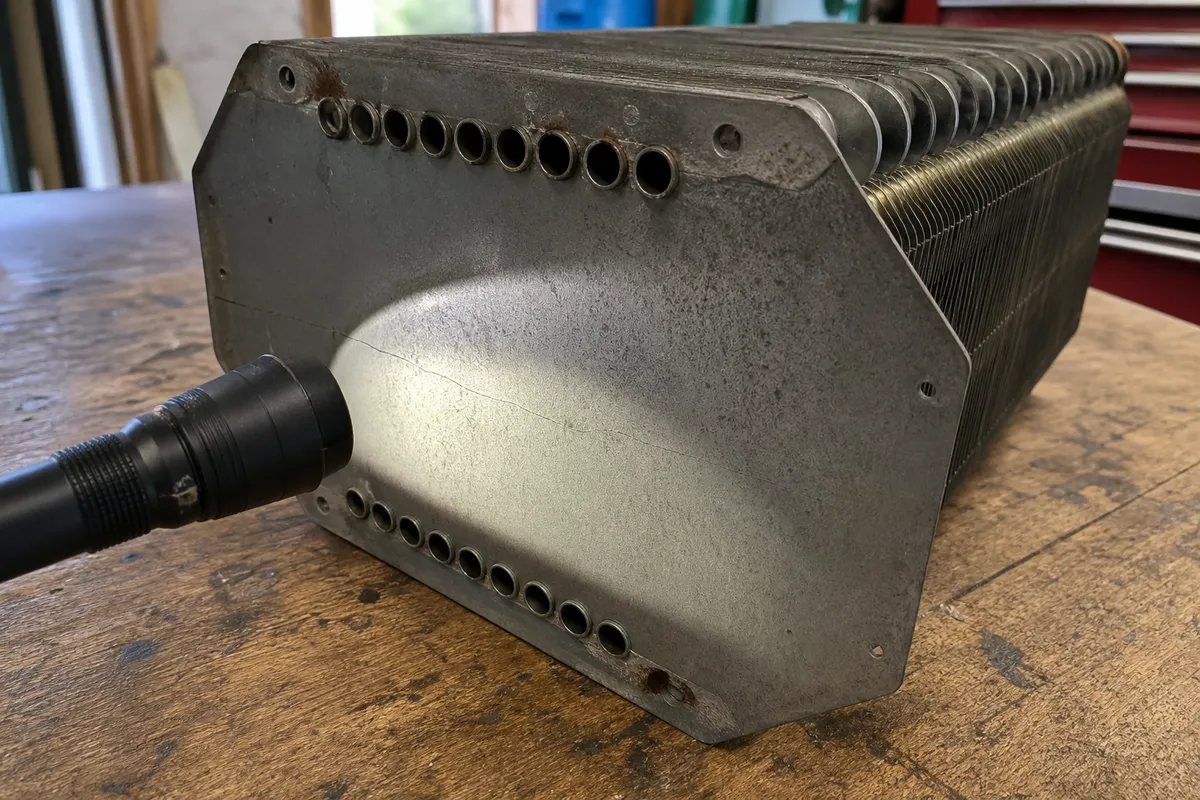
Last month a homeowner in Ballard called me for a second opinion. Another company had red-tagged her furnace, shut off the gas, and told her the heat exchanger was cracked and the house wasn’t safe. She was scared, skeptical, and about to sign a $12,000 replacement quote just to make the problem go away. I scoped the exchanger with a camera, ran a combustion analysis, and found… a crack. The first company was right. But she deserved to see it on the camera screen herself and get a quote that wasn’t priced for panic. She spent about $7,000 with us instead, calm and informed.
The week before, same story in Lake City, opposite ending: the “crack” a door-to-door tune-up outfit found was a manufacturing seam. That furnace is still running today. The heat exchanger is the one component that decides whether a furnace lives or dies. Here’s what it is, why it cracks, what the real risk is, and how to handle the day someone tells you yours is done.
TL;DR
- The heat exchanger is the sealed metal barrier that keeps combustion gases separate from the air blowing into your rooms.
- Cracks come from metal fatigue: 15+ years of heating and cooling cycles, made worse by clogged filters, weak airflow, and short-cycling.
- A crack can let combustion byproducts, including carbon monoxide, mix into household air. Real risk, manageable with working CO detectors and prompt action.
- Verification should be visual (camera scope) plus combustion analysis. Ask to see the evidence.
- Exchanger replacement rarely pencils out on an older furnace; a new furnace runs $4,800-$9,800. And yes, getting a second opinion is completely fair.
What does a heat exchanger actually do?
A gas furnace makes heat by burning fuel, and burning fuel produces exhaust: water vapor, carbon dioxide, and, when combustion is imperfect, carbon monoxide. You can’t blow that mixture into your bedrooms. So the burners fire into sealed metal passages called the heat exchanger. Exhaust travels through the inside and out the flue; household air blows across the hot outside, picks up heat, and heads into the ducts.
That’s the whole job: transfer heat through the metal wall while keeping the two air streams absolutely separate. Every winter, that metal cycles hundreds of times between several hundred degrees and room temperature, expanding and contracting each time. In our damp region, add slow corrosion to the fatigue. Condensing furnaces (95%+ AFUE) add a second exchanger that condenses water out of the exhaust: great for efficiency, one more part that can eventually fail.
Why do heat exchangers crack?
Metal fatigue is the baseline cause, accumulating from day one. Three accelerants decide whether the crack shows up at year 25 or year 12:
Clogged filters and weak airflow. When a matted filter or crushed duct starves the blower, less air moves across the exchanger and the metal runs hotter than design on every cycle. Hotter cycles mean faster fatigue. This is the number one preventable cause, and it’s why filters lead our fall furnace maintenance checklist.
Short-cycling. An oversized furnace, or one with a failing limit switch, fires and shuts down every few minutes. Each ignition is a thermal shock; a short-cycling furnace packs twenty years of expansion cycles into ten.
Age and corrosion. Past 15 years, even a well-treated exchanger is on borrowed time. Crawlspace furnaces around Everett and Shoreline corrode from the outside while fatiguing from the inside.
Filthy ductwork feeds the airflow problem too; it’s one reason we sometimes pair duct cleaning with a repair rather than pitching it as an upsell.
How dangerous is a crack, really?
Let me thread this carefully, because this topic gets weaponized by salespeople and dismissed by skeptics, and both are wrong.
The genuine risk: a crack or rusted-through spot can let combustion gases mix into the air your blower distributes through the house, and dirty combustion can include odorless, dangerous carbon monoxide.
The context: a small crack in a furnace with clean, well-tuned combustion often releases little to no CO, because the combustion isn’t producing much. That’s why a cracked exchanger is a “shut it down and plan replacement promptly” situation, not usually an “evacuate” one. The layered defense is simple: working CO detectors near sleeping areas (the EPA’s indoor air guidance covers CO basics), annual inspection so cracks get found early, and taking a red tag seriously without letting it stampede you.
If your CO detector is alarming, that’s different: get everyone out, call the gas utility or 911, then call us for an emergency furnace repair visit. A found crack with silent detectors means you have time to make a good decision. Use it.
How does a technician actually verify a crack?
“I saw a crack” should come with evidence. A proper verification includes:
Visual inspection with a scope. Modern exchangers can’t be fully seen with a flashlight and a mirror. We run a borescope camera into the exchanger cells and show you the screen. Seams and welds can fool a quick glance; an actual crack has depth and displacement you can see on camera.
Combustion analysis. A calibrated analyzer measures CO and oxygen in the flue gases and, critically, whether readings shift when the blower kicks on. CO numbers that jump when household air pressure hits the exchanger are classic evidence of a breach.
Flame observation. Burner flames that dance or lift when the blower starts suggest air is pushing through an opening. Suggestive on its own, not conclusive.
A tech who condemns a furnace without a camera image or analyzer numbers is asking you to take an expensive claim on faith. Our furnace repair techs show you both; the diagnostic fee is credited toward whatever work follows.
“When a customer calls me shaken because someone red-tagged their furnace, I book the second-opinion diagnostic and tell them to ask for the camera footage from the first company. How that company reacts to the question usually tells us a lot before our tech even arrives.”
— Alina Kovalenko, Service Coordinator & Comfort Advisor at SPS Pro Services
Why does a cracked exchanger usually mean a new furnace?
On paper, a heat exchanger is a replaceable part, sometimes covered by a 20-year parts warranty. In practice, the labor is brutal (the furnace essentially comes apart around it) and the rest of the furnace is the same age as the part that just failed. The math on a typical 16-year-old furnace:
| Option | Typical cost | What you get |
|---|---|---|
| Exchanger replacement, parts + labor | $2,000 - $3,500 | Same 16-year-old furnace, new core |
| Exchanger under parts warranty (labor only) | $1,000 - $1,800 | Same furnace; only worth it under ~12 years old |
| New gas furnace, installed | $4,800 - $9,800 | New 15-20 year lifespan, better AFUE, new warranty |
| Heat pump conversion, installed | $6,500 - $15,500 | Heating + cooling, current PSE/PUD offers may apply |
Spending $3,000 to put a new core into a machine whose blower, board, and inducer are all 16 years old is the classic bad repair. The exception is a young furnace with a valid parts warranty, where labor-only replacement can make sense. Otherwise that money belongs in a furnace replacement or, if you also want cooling, a heat pump installation. Pricing is broken down in how much a new furnace costs.
What should I do if a tech condemns my furnace?
Keep this list for the stressful day:
- Don’t sign anything on the spot. A cracked exchanger justifies urgency, not same-hour contracts.
- Ask to see the evidence: camera footage and combustion analyzer readings. A legitimate finding survives being shown.
- Verify your CO detectors work. If any alarm sounds, leave and call for help.
- Leave the furnace off until the finding is confirmed. Space heaters bridge a few days fine.
- Get a second opinion. We say this as the company that often is the second opinion, and sometimes confirms the first company was right. Either result is worth the diagnostic fee.
- If confirmed, get replacement quotes with a proper sizing calculation rather than a same-model swap. Oversizing is how the next exchanger cracks early.
- Ask every bidder about heat pump options and current incentives before defaulting to another gas furnace.
Homeowners anywhere from Seattle to Everett can have us out for that second look, usually within a day or two even in winter.
Frequently asked questions
Can a cracked heat exchanger be welded or patched?
No. The metal is thin, the temperatures are extreme, and no manufacturer or code authority sanctions field repairs. An offer to weld one is an offer to hide a problem.
My furnace is only 8 years old and the exchanger cracked. Why?
Almost always an installation or airflow problem: oversized equipment short-cycling, undersized ductwork, or years of clogged filters. Check your parts warranty first, and fix the root cause during the repair or you’ll repeat this at year 16.
Will my CO detector catch a cracked heat exchanger?
Not reliably. Detectors alarm at concentrations that threaten people; a crack can exist long before CO reaches those levels, or without producing much CO at all. Detectors are the safety net; annual inspection is how cracks actually get found.
Sources
Been told your heat exchanger is cracked, or just want it inspected before winter? Call SPS Pro Services at (206) 427-8907 or book a furnace repair diagnostic and we’ll show you exactly what we find.