
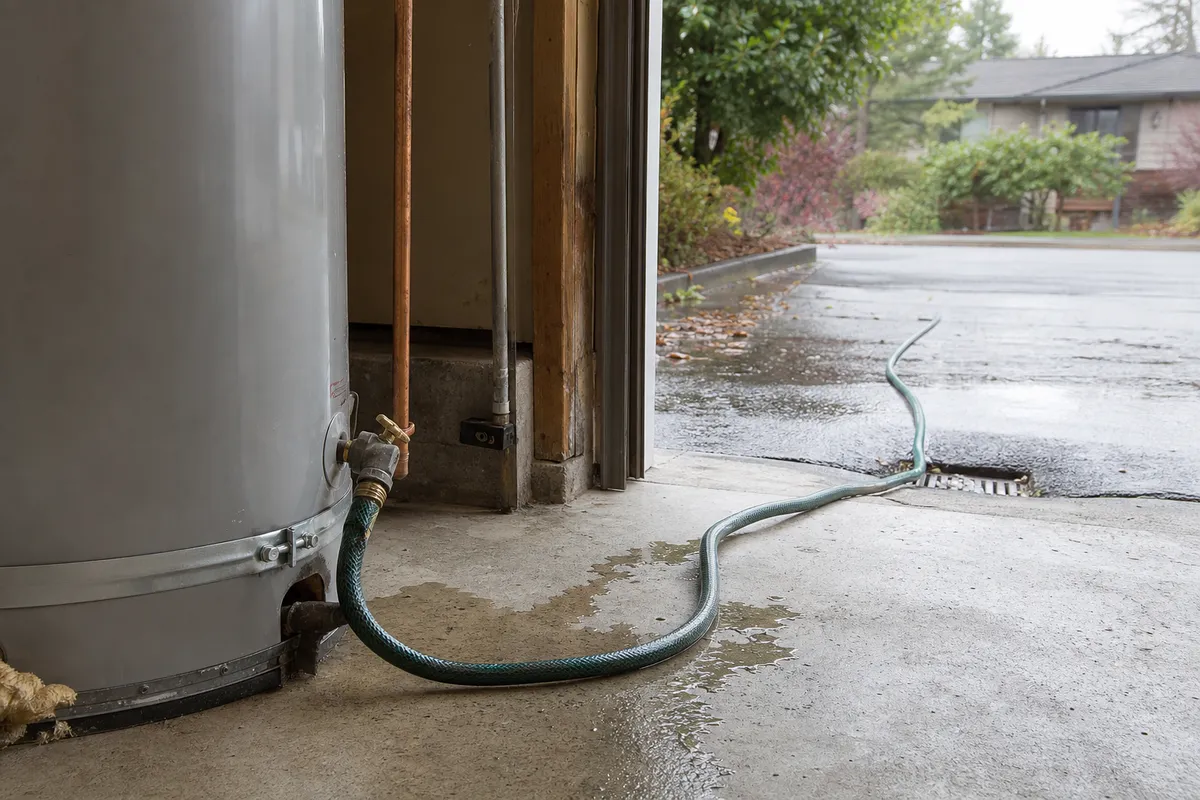
Last month I flushed a 40-gallon tank in Lake City that hadn’t been touched since Obama’s second term. Client thought his water heater was dying. It wasn’t dying — it was drowning in eight years of sediment, and the popping noise he heard every morning was water boiling under a crust of mineral scale at the bottom of the tank. Twenty minutes with a garden hose and he saved himself $1,400 on a replacement he didn’t need.
That’s the thing about flushing a water heater. Half the homeowners who call me think it’s a scary plumbing project. The other half think it’s always a DIY job that never needs a pro. Both are wrong, depending on the tank.
TL;DR
- Flushing a water heater once a year removes sediment, restores efficiency, and can add years to the tank’s life.
- Seattle water is relatively soft compared to most of the country, so buildup is slower here than in, say, Phoenix or Denver — but it still happens, especially in homes with older galvanized plumbing.
- Basic flush: shut off power or gas, connect a hose to the drain valve, run it until the water clears.
- Skip the DIY if your tank is over 8 years old, the drain valve is corroded, or you smell gas anywhere near the unit — call a pro instead.
- Most flush service calls in the Seattle area run in the same range as a basic diagnostic visit; full replacement is a different number entirely.
Why Flush at All? The Sediment Problem
Every water heater tank collects mineral sediment from your incoming water supply. It’s not a defect — it’s physics. Hot water can’t hold minerals in suspension the way cold water can, so calcium and magnesium drop out and settle at the bottom.
In Seattle and most of King County, our water comes from the Cedar and Tolt River watersheds, and it’s soft — low in dissolved minerals compared to cities on well water or Colorado River supply. That’s good news for your tank. Homes in Snohomish County served by Snohomish PUD generally see similar water quality, though older neighborhoods in Everett with original galvanized piping can still get flaky sediment from the pipes themselves, not only the tank.
Bottom line: you won’t get the thick, cement-like scale I see on service calls in Arizona. But sediment still builds a layer over years, and that layer does three things:
- Insulates the bottom of the tank from the burner or element, so your unit works harder and burns more gas or electricity to heat the same water.
- Causes that popping, rumbling noise as water boils under the sediment layer and bubbles push through.
- Traps water against the tank floor, accelerating rust-through on the tank itself.
A flush doesn’t fix everything. If your heating element is already failing or the thermostat is drifting, that’s a different conversation — see our page on water heater repair for the symptoms that mean repair, not maintenance.
“Customers ask me if flushing is really worth the hassle. In our service area the water is fairly soft, so once a year is genuinely enough for most tanks — but the customers who’ve never done it in eight years are the ones whose drain valve clogs with sediment the first time they try. Start the habit early, or have us do it during a maintenance visit.”
— Alina Kovalenko, Service Coordinator & Comfort Advisor at SPS Pro Services
How to Drain and Flush It Yourself
If your tank is under 6-8 years old, the anode rod hasn’t been ignored for a decade, and the drain valve isn’t crusted shut, this is a reasonable weekend project.
Step 1: Kill the power or gas. Electric units — flip the breaker. Gas units — turn the gas valve to “pilot” or off, per the label on the unit.
Step 2: Shut off the cold water supply at the valve on top of the tank.
Step 3: Let it cool for at least 30 minutes if you’ve used hot water recently. 130-degree water through a garden hose onto your foot is not a good Tuesday.
Step 4: Connect a garden hose to the drain valve near the bottom of the tank and run the other end to a floor drain, outside, or a large bucket.
Step 5: Open a hot water tap somewhere in the house to break the vacuum, then open the drain valve.
Step 6: Let it run until clear. Cloudy or gritty water at first is normal. If it doesn’t clear after a full drain, open the cold supply briefly with the drain valve still open to stir up remaining sediment, then drain again.
Step 7: Close the drain valve, remove the hose, refill the tank with the cold supply valve before turning power or gas back on. Never fire the heating element or burner on an empty tank — that’s how electric elements burn out in about four minutes flat.
When Flushing Isn’t the Answer
Here’s where I earn my keep as someone who’s been under enough sinks and crawlspaces since 2017 to know when a $150 flush is a waste of your Saturday.
The drain valve won’t budge or leaks after you close it. Plastic drain valves on tanks over 5 years old are notorious for this. Forcing it can crack the valve, and now you’ve got an active leak on a full tank with no easy shutoff. Call it in.
The tank is over 8-10 years old. At that point, sediment is often the least of its problems. The anode rod is likely spent, and once that happens, the tank steel itself starts corroding. Flushing an old tank sometimes reveals a leak that was being plugged by sediment — you drain it, and now it weeps from the bottom seam. I’ve seen this exact scenario four times this year alone, twice in Bellevue and twice in Seattle proper.
You smell gas, or the pilot won’t stay lit. Not a DIY afternoon. That’s a combustion safety issue, and it’s the same logic we use on furnace repair calls — don’t troubleshoot gas appliances by trial and error.
No shutoff valve, or a shutoff that doesn’t fully close. Common in homes built before the 1990s in older Seattle neighborhoods and parts of Everett. If you can’t isolate the cold supply, you can’t safely drain the tank without risking a bigger mess.
Cost Comparison: Flush vs. Repair vs. Replacement
| Service | Typical Scope | Estimated Cost Range (Seattle area) |
|---|---|---|
| Professional tank flush | Drain, flush, inspect anode rod and valve | Most jobs land between $125 and $220 |
| Water heater repair | Element, thermostat, valve, or minor leak fix | Most jobs land between $200 and $650 |
| Full tank replacement (40-50 gal) | New unit, haul-away, code updates | Most jobs land between $1,800 and $3,600 |
| Upgrade to heat pump water heater | New unit, venting/electrical changes | Most jobs land between $3,200 and $5,500 |
These are estimates based on typical calls across King and Snohomish counties — your exact number depends on tank size, access, and whether code requires updates like an expansion tank or new venting.
Quick Pre-Flush Checklist
- Confirm tank age (check the serial number sticker — first four digits are usually the manufacture date).
- Locate and test the cold water shutoff before you start, not during.
- Have a garden hose long enough to reach a drain or the outside.
- Turn off power/gas and let the tank cool at least 30 minutes.
- Inspect the drain valve for corrosion before opening it.
- If anything looks rusted, cracked, or you’re not 100% sure of the gas shutoff, stop and call a tech.
A Word on Efficiency and Bigger Projects
If you’re already draining the tank and it’s pushing 10 years old, this is a good moment to think ahead rather than reacting to a failure at 6 a.m. on a Sunday. A lot of homeowners in /seattle/ and /bellevue/ are switching to heat pump water heaters when the old tank goes — see heat pump installation for how that pairs with a home’s existing electrical setup. If you’re adding a heat pump water heater, an EV charger, or both, it’s worth checking whether your panel has room; we cover that on electrical panel upgrade. And if you’re just trying to figure out whether it’s your water heater or your AC making your energy bill spike this summer, our AC repair page walks through the usual culprits.
FAQ
How often should I flush my water heater? Once a year is standard for most homes in King and Snohomish counties, given our relatively soft water. If you’re on well water or have a whole-house softener malfunctioning, twice a year is safer.
Can flushing damage an old water heater? Yes, occasionally. Sediment can be plugging a small leak at the bottom seam. Draining it sometimes reveals that leak. This isn’t the flush’s fault — it’s the tank telling you it was already near the end.
Is it cheaper to repair or replace a 9-year-old tank? Usually replace. Most tanks are rated for 8-12 years, and a repair on a unit that old is a bet against the anode rod and the tank shell both failing soon after. I’ll tell a customer straight up when a repair isn’t worth the money — that’s the whole point of the visit.
If your water heater is rumbling, leaking, or just old enough that you’re nervous about it, call SPS Pro Services at (206) 427-8907 and we’ll tell you honestly whether it needs a flush, a repair, or a replacement.