
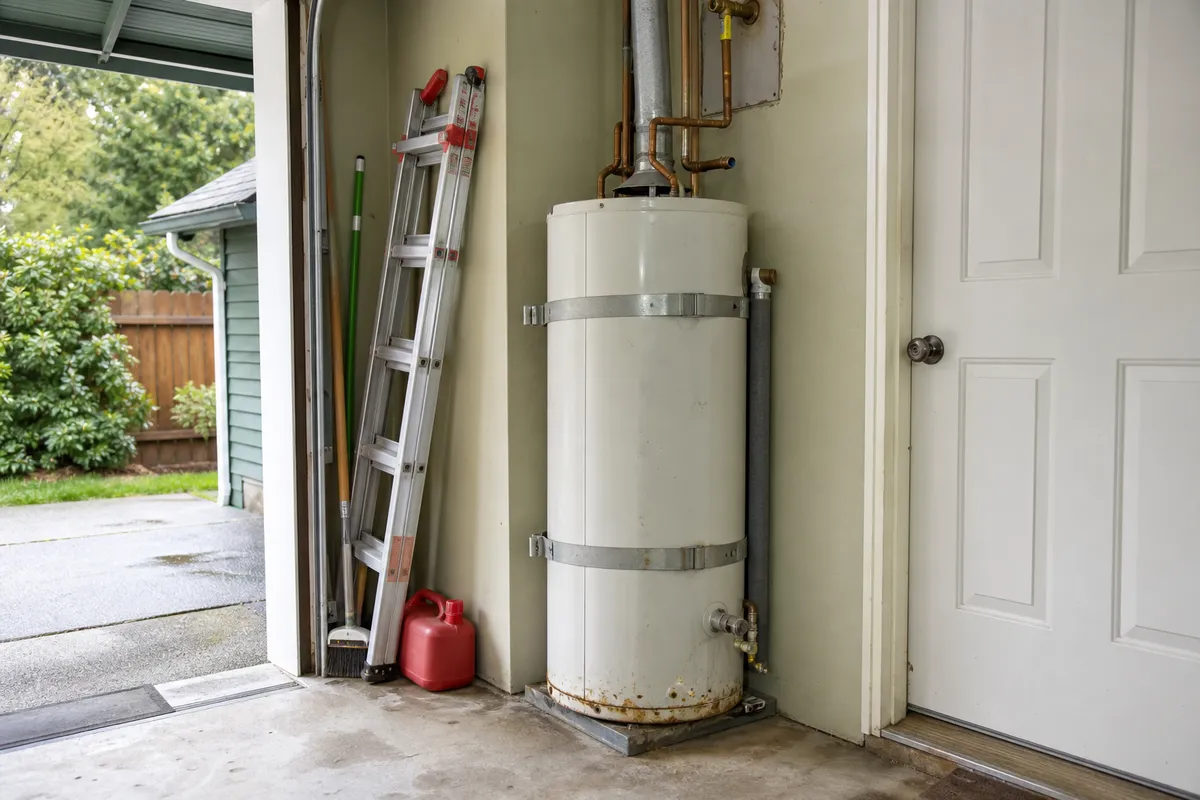
I get this call at least once a week: “My water heater is making noise” or “water’s not hot enough anymore, is it dying?” Usually the homeowner already knows the answer before I show up — they just want someone to confirm it. So let’s skip the guessing. I’ll give you the real numbers I see on service calls across Seattle, Bellevue, and Everett, and tell you honestly when a repair makes sense and when it’s throwing money at a dead unit.
TL;DR
- Standard tank water heaters in our region last 8-12 years; tankless units last 15-20 years with regular flushing.
- Our soft municipal water (low mineral content) is actually kinder to tanks than most of the country — but sediment still builds up over time.
- Rust-colored water, popping/rumbling sounds, or a tank older than 10 years are the three signs I take most seriously.
- Repair usually makes sense under year 8; after that, replacement is almost always the better financial call.
- Anode rod replacement around year 4-5 is the cheapest way to add years to a tank.
Why Water Heaters Here Actually Last Longer Than National Averages
Seattle and Snohomish County water comes from surface reservoirs (Cedar River and Tolt River for Seattle Public Utilities, Spada Lake for Everett), and it’s soft — low in calcium and magnesium compared to water in places like Arizona or Texas. Less mineral content means less scale buildup inside the tank, which is the number one killer of water heaters in hard-water regions.
That said, I still see plenty of tanks fail early, and it’s rarely about the water. It’s almost always one of these:
- The anode rod was never replaced and the tank rusted from the inside out.
- The unit sits in an unconditioned garage or crawlspace and takes more thermal stress.
- Sediment settled at the bottom because nobody flushes the tank, so the burner or lower element works overtime.
I’ve pulled 9-year-old tanks out of older homes in Ballard and Wallingford that looked like they’d been swimming in rust, right next to a 14-year-old unit in a Bellevue home that still had a clean anode rod because someone actually serviced it. Maintenance matters more than the calendar.
“The calls I hate booking are the Friday-night emergencies: tank let go, garage flooded, and now it’s an after-hours rate plus water damage. If your tank is past year ten, replacing it on your schedule instead of the tank’s schedule is genuinely cheaper — you get to compare quotes instead of taking whoever can come tonight.”
— Alina Kovalenko, Service Coordinator & Comfort Advisor at SPS Pro Services
Tank vs. Tankless: Real Lifespan Comparison
| Type | Typical Lifespan | Average Install Cost (estimate) | Annual Maintenance |
|---|---|---|---|
| Standard 40-50 gal gas tank | 8-12 years | Most jobs land between $1,800-$3,200 | Flush yearly, anode check at year 4-5 |
| Standard 40-50 gal electric tank | 10-13 years | Most jobs land between $1,500-$2,800 | Flush yearly, anode check at year 4-5 |
| Tankless (gas) | 15-20 years | Most jobs land between $3,500-$6,500 | Descale annually, especially if on well water |
| Heat pump water heater | 12-15 years | Most jobs land between $2,800-$4,800 | Clean air filter, check condensate drain |
Heat pump water heaters are worth a mention here because I’m installing more of them every year, especially for homeowners who already looked into a heat pump for space heating. If you’re weighing that decision for your whole house, it’s worth reading about heat pump installation at the same time — the systems complement each other well in our mild climate, and PSE offers rebates on both in many cases.
Signs Your Water Heater Is on Borrowed Time
Rust-colored water from the hot tap only. Cold tap runs clear, hot tap runs rusty — that’s the tank corroding, not your pipes. This is close to end of life, especially past year 8.
Popping or rumbling sounds during heating. That’s sediment at the bottom of the tank, hardening and trapping water underneath it, which then boils and pops. A flush can help if caught early. If it’s been years, a flush sometimes just loosens rust and causes a leak.
Water heater is leaking from the tank itself, not a fitting. Fittings can be tightened or replaced. A tank seam leak means the steel has failed. That’s a replace, no debate.
Inconsistent temperature or lukewarm water. Could be a failing heating element, a bad thermostat, or sediment insulating the burner from the water. This is one of the more common calls I get where a repair genuinely makes sense — see the next section.
When Repair Makes Sense (And When It Doesn’t)
I’ll be straight with you: I don’t upsell replacements when a repair will do the job. Here’s my rough rule of thumb from the field:
- Under 6 years old: Repair almost always makes sense. Thermostats, heating elements, thermocouples, and gas valves are all replaceable parts that cost a fraction of a new unit.
- 6-9 years old: Depends on the failure. A $150 thermocouple repair on an 8-year-old tank? Fine, do it. A $600 gas valve replacement on the same tank? I usually tell homeowners to put that money toward a new unit instead.
- 10+ years old: I rarely recommend repair here unless it’s something trivial like a pressure relief valve, which is a cheap part regardless of tank age. Anything bigger, and you’re gambling on borrowed time with an old tank. If you need diagnostics to make that call with confidence, our water heater repair page walks through what we check on a service visit.
One case that sticks with me: a homeowner in Everett had a 13-year-old tank with a failed lower element. Replacing the element would’ve been about $280 in labor and parts. I told her not to do it — the tank had visible rust at the base and would likely fail at the seam within a year or two anyway. She went with a new unit. Eight months later her neighbor with a similar-age tank tried to save money on the same repair and ended up with a flooded utility closet. Sometimes the cheaper fix isn’t actually cheaper.
A Quick Note on Panels and Permits
If you’re upgrading to a tankless or heat pump water heater, check your electrical panel capacity first, especially in homes built before the 1990s in Seattle, Shoreline, or older parts of Everett. A lot of these panels are maxed out already, particularly if you’ve also got an EV charger or are planning one. We handle both — if your panel’s tight, look at electrical panel upgrade before you commit to a new water heater install, and if an EV charger is also on your list, EV charger installation is worth planning at the same time so you’re not paying for two separate electrical visits.
Maintenance Checklist to Stretch the Life of Your Water Heater
- Flush the tank once a year to clear sediment (twice a year if you’re on well water or have a water softener).
- Check the anode rod at year 4-5; replace if more than 50 percent corroded.
- Test the pressure relief valve annually — lift the lever briefly and confirm water discharges, then stops.
- Keep the area around the unit clear for airflow and easy service access.
- Set the thermostat to 120°F — hot enough for comfort, cool enough to reduce mineral scale and scald risk.
- For tankless units, schedule a descaling flush annually, especially in areas with slightly harder water like parts of Snohomish County.
- Watch for rust at the base or around fittings during your annual furnace or AC check — it’s an easy thing to glance at while a tech is already in the mechanical room.
Mini FAQ
Does the climate in Seattle or Bellevue affect water heater lifespan? Not directly through temperature — our mild climate is easier on equipment than regions with hard freezes or extreme heat. Where it matters is installation location: units in unheated garages or crawlspaces work a bit harder in winter than ones in conditioned utility closets.
Is it worth switching to tankless when my tank finally fails? Often yes, if you have the gas line capacity and want the extra 5-8 years of lifespan, but it depends on your household’s hot water demand and existing venting. We look at all of that during an on-site estimate rather than guessing over the phone.
Can a bad water heater affect my furnace or AC system? Not directly, but if your water heater is old and inefficient, it’s usually a sign the rest of your mechanical systems are due for a look too. If your furnace is acting up around the same time, it’s worth checking out furnace repair, and if your AC hasn’t been serviced in a while, AC repair covers what we typically find on those calls.
If your water heater is over 8 years old or acting up, call us at (206) 427-8907 and we’ll help you figure out honestly whether it’s a repair or replacement situation.