
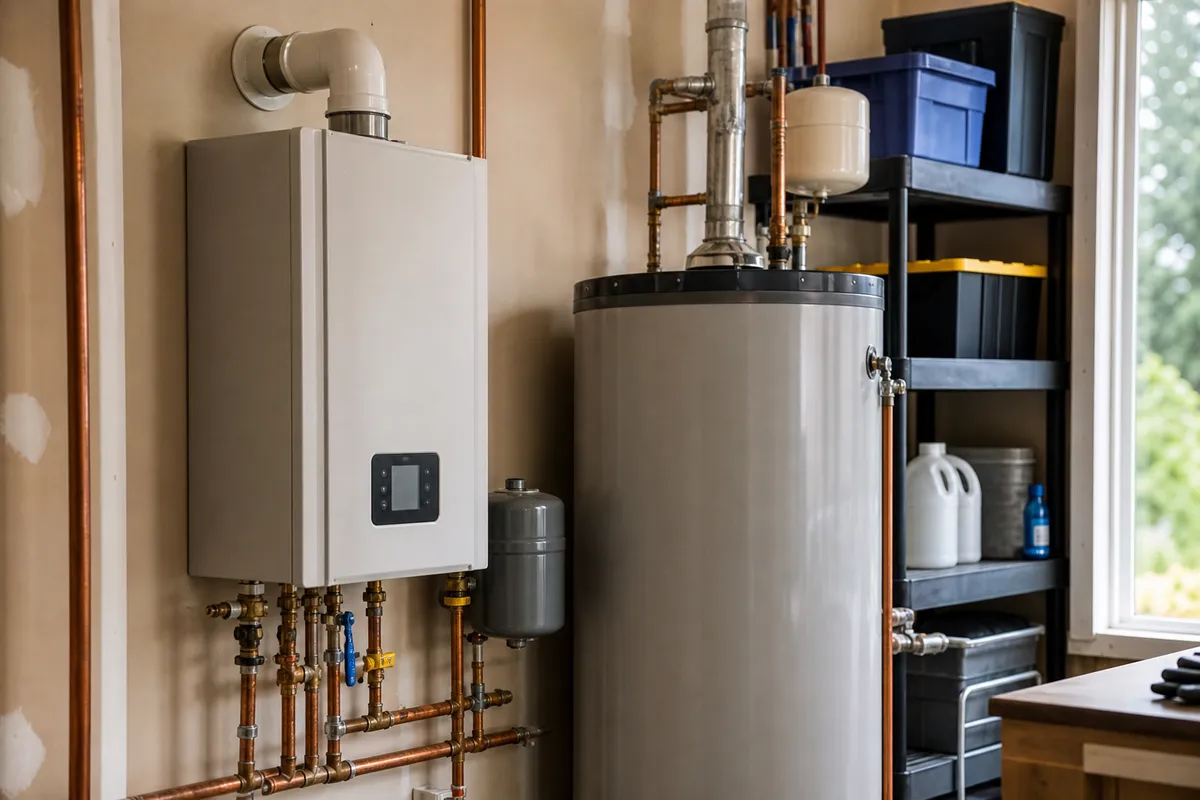
Last month I did back-to-back water heater calls in Ballard and Bellevue. Same problem — a 12-year-old 50-gallon tank starting to weep from the bottom seam — and both homeowners opened with the same question: “Should I go tankless?” One of them should have. The other one absolutely should not have, and a different contractor had already quoted him a tankless swap without ever looking at his gas meter.
That second visit is why I’m writing this. Tankless water heaters are good equipment. I install them regularly across Seattle, Bellevue, and Everett. But “tankless is always the upgrade” is a sales line, not an engineering conclusion, and in a lot of Puget Sound houses the hidden costs eat the entire benefit. Here’s how I actually walk customers through the decision.
TL;DR
- A straight tank-for-tank replacement is the cheapest, fastest fix: typically $1,650–$2,900 installed for a standard 40–50 gallon unit.
- A gas tankless conversion usually lands at $3,200–$4,800 once you count venting and gas line work — sometimes more if your gas meter needs upsizing.
- Whole-house electric tankless is almost never practical here: it can demand 100+ amps by itself, which means a panel conversation before a plumbing conversation.
- Seattle-area water is unusually soft, which is genuinely good news for tankless longevity.
- Endless hot water is real; “huge energy savings” are modest for most families — think 10–25% on the water heating portion of the bill, not the whole bill.
- If your tank still has life in it, a water heater repair at $189–$800 often buys you years to plan instead of deciding in a panic.
The Honest Cost Picture
These are the ranges I’m seeing on SPS Pro Services invoices in mid-2026 across King and Snohomish counties. Your venting layout, gas service, and panel capacity move the number — that’s not fine print, that’s usually the whole story.
| Factor | Standard Tank (40–50 gal) | Gas Tankless (Whole-House) |
|---|---|---|
| Typical installed cost | $1,650 – $2,900 | $3,200 – $4,800 |
| Common surprise costs | Expansion tank, seismic strapping, pan | Gas line upsizing, new venting, condensate drain |
| Hot water supply | 40–50 gallons, then recovery wait | Continuous at rated flow (typically 4–7 GPM here) |
| Typical lifespan | 8–12 years | 15–20 years with maintenance |
| Space required | Full closet or garage corner | Wall-hung, roughly a carry-on suitcase |
| Standby heat loss | Yes, constant | Essentially none |
| Repair costs when things fail | $189 – $500 typical | $300 – $800 typical (parts cost more) |
Read the lifespan line and the cost line together. A tankless unit that costs 60–80% more but lasts 60–80% longer is roughly a wash on hardware — the real deciding factors are the installation surprises and how your household actually uses hot water.
“Tankless is a great product that gets sold to the wrong houses. It needs gas line capacity and venting the old tank never had, and that retrofit cost is what kills the payback. Where it shines: households that genuinely run out of hot water, and remodels where the gas and venting are being touched anyway.”
— Danil Sokolov, Heat Pump & Mini-Split Specialist at SPS Pro Services
The Gas Line Problem Nobody Mentions on the Phone
Here’s the case from that second call I mentioned. A standard 50-gallon gas tank burns around 40,000 BTU per hour. A whole-house gas tankless unit fires at 150,000–199,000 BTU because it has to heat water instantly instead of slowly. That’s a four-to-five-fold jump in gas demand, and a lot of older Seattle homes have a half-inch gas line feeding the water heater that simply cannot deliver it.
Upsizing the gas run — and occasionally the meter itself, which involves PSE — can add $500–$1,500 to the project. On top of that, tankless units can’t use the old atmospheric vent; they need dedicated stainless or PVC venting to an exterior wall, plus a condensate drain for condensing models. None of this is a reason to say no. It’s a reason to get the gas line and venting scoped before you sign, not discovered on install day. When I quote a tankless water heater installation, the gas capacity check happens on the first visit, every time.
Electric Tankless: The Panel Math Usually Kills It
Every few weeks someone asks me about whole-house electric tankless because their house has no gas service. I get the appeal — no venting, no combustion. But the electrical demand is brutal: a unit sized for a Pacific Northwest winter (our incoming groundwater runs around 45–50°F in January) needs 27–36 kW, which means 112–150 amps of breaker capacity dedicated to one appliance.
On a 200-amp service with an electric range, a dryer, and maybe an EV charger, that math doesn’t work. On a 100-amp service it’s not even a conversation. You’d be looking at an electrical panel upgrade at $2,200–$4,500 — or a full service upsizing — just to make the water heater possible. For all-electric homes, I usually steer people toward a heat pump water heater instead: it sips power rather than gulping it, and it pairs naturally with the same electrification plan as a heat pump installation for the house itself.
The One Place Seattle Genuinely Favors Tankless
In Phoenix or Texas, the number one tankless killer is scale — hard water minerals coating the heat exchanger. Seattle’s water comes from the Cedar River and Tolt River watersheds and is some of the softest municipal water in the country. That means the descaling maintenance that’s mandatory elsewhere is a light-duty job here, and heat exchangers routinely go the distance.
Snohomish County systems vary a bit more, but nothing in our service area approaches genuinely hard water. If you were on the fence because you’d read horror stories about annual flushes and dead heat exchangers at year eight — those stories mostly come from hard-water regions.
When Tankless Doesn’t Pay — Cases From My Van
I’ll talk a customer out of tankless in any of these situations, because I’ve seen how the math ends:
- One or two people in the house. A couple using 30–40 gallons a day will save maybe $8–15 a month over a decent tank. Against a $1,500–$2,500 cost premium, that payback stretches past a decade.
- The tank is under 8 years old and repairable. A failed thermocouple, gas valve, or heating element is a $189–$800 water heater repair, not a replacement trigger.
- You’re selling within a few years. Tankless adds modest resale appeal, but you will not recover the conversion cost in the sale price of a typical King County home.
- The gas line quote comes back ugly. If line upsizing pushes the total past $5,500, a high-efficiency tank or a heat pump water heater almost always pencils better.
- You want it for “energy savings” alone. Water heating is maybe 15–18% of a typical household energy bill. Cutting that slice by 20% is real money, but it’s $60–$120 a year for most families, not a life-changing number.
When Tankless Clearly Wins
- Big households. Four-plus people, teenagers, back-to-back showers, a soaking tub — the “endless hot water” benefit is worth the premium on quality of life alone.
- Space is money. In Seattle townhomes and small-lot houses, reclaiming a water heater closet is a genuine win.
- You’re staying 10+ years. The longer lifespan and lower operating cost get time to work.
- Your gas line already has capacity. Some homes — especially ones with newer 3/4-inch runs or previous remodels — need little or no gas work. When the install is clean, the price gap narrows fast.
- Your old tank sits somewhere leak damage would be catastrophic. A wall-hung unit with no 50-gallon reservoir removes the burst-tank flood scenario entirely.
Checklist Before You Decide
- Note your current tank’s age (check the serial number) and whether it’s leaking from a fitting (repairable) or the tank body (terminal).
- Count your household’s realistic peak demand: simultaneous showers, laundry, dishwasher.
- Find your gas line size at the water heater and your meter’s capacity — or have us check on a quote visit.
- If you’re considering electric anything, get your panel capacity confirmed first. A quick electrical inspection ($250–$500) answers this and usually flags anything else lurking.
- Get both quotes side by side — tank and tankless — with gas/vent work itemized, not bundled into one mystery number.
- Ask about heat pump water heaters if your home is all-electric or headed that way.
Mini-FAQ
How long does a tankless conversion take? A straight tank swap is a half-day job. A tankless conversion is typically a full day, sometimes a day and a half if we’re running new gas line and venting. Plan on being without hot water for one working day.
Do I need a permit for a water heater in Washington? Yes — plumbing permits apply for water heater replacement in Seattle and most surrounding jurisdictions, and gas work is inspected. A contractor who offers to skip the permit is telling you something about the rest of their work.
Will a tankless unit keep up in January when the incoming water is cold? If it’s sized for it, yes. Winter groundwater here drops the effective flow rate of every tankless unit — a heater rated “9 GPM” at a 35°F rise delivers closer to 5 GPM at our winter conditions. Sizing to the winter number, not the brochure number, is the whole trick.
If your water heater is on its way out — or already gone — call SPS Pro Services at (206) 427-8907. We’ll check your gas line, your panel, and your actual usage before recommending anything, anywhere from Seattle to Bellevue to Everett.