
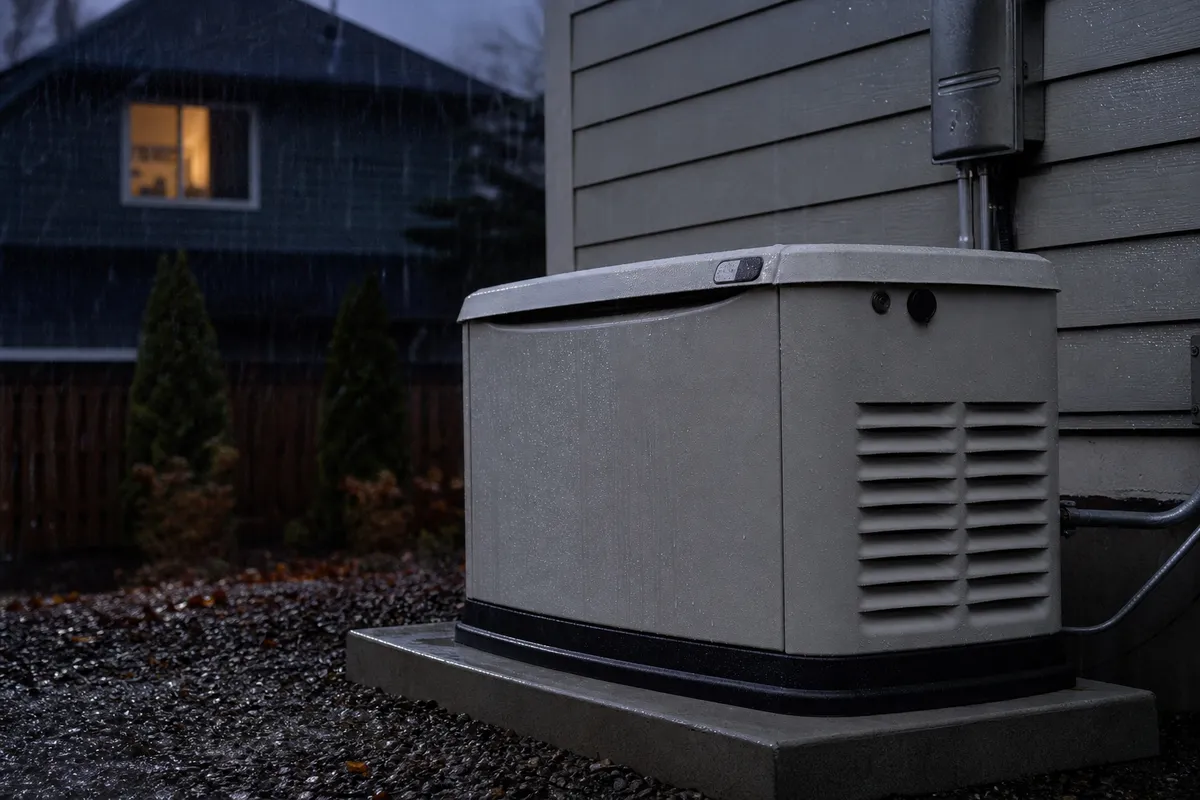
When the wind picks up off Puget Sound and the lights flicker for the third time in an hour, most homeowners aren’t thinking about watts and amps — they’re thinking about the fridge full of groceries and the sump pump that just stopped running. I’ve wired enough standby systems after windstorms in Everett, Lynnwood, and Marysville to know the question isn’t “do I need a generator,” it’s “what size, and how do I connect it without breaking code or burning down my house.”
I’m Marcus Reed, senior electrician at SPS Pro Services. Here’s how I actually size a generator for a Snohomish County home, without the sales pitch.
TL;DR
- Snohomish County PUD and PSE both report multi-day outage events most winters, mostly from wind and falling trees, not equipment failure.
- A 5,000–7,500-watt portable generator covers a fridge, sump pump, furnace blower, and some lighting — not central AC or an electric water heater.
- Whole-house standby units run 16,000–26,000 watts and need a properly sized transfer switch installed under a permit, per NEC Article 702.
- Backfeeding a generator into your panel without an interlock or transfer switch is illegal under Washington L&I electrical code and dangerous to utility linemen.
- If your panel is older than 100 amps, size the generator conversation around a panel upgrade first.
Why Snohomish County Loses Power More Than You’d Think
Snohomish County PUD serves most of the county, with PSE covering pockets in the south end near Bothell and parts of south Snohomish. Both utilities deal with the same problem every fall and winter: mature Douglas fir and cedar trees over aging distribution lines. Add wet soil from Pacific storms, and root failure takes down lines that otherwise never see stress. That’s different from, say, a Phoenix outage caused by grid demand — here it’s almost always physical, and physical damage takes hours or days to fix, not minutes.
Homes built before the 1990s, common in older neighborhoods, also tend to run smaller electrical services — 100 amps was standard for decades. That matters for generator sizing because you can’t push more backup power through a panel than the panel and its wiring were rated to handle safely.
“Sizing a generator starts with an honest list of what you actually need running during an outage — not everything in the house. Around here the furnace fan, the fridge, and the well pump if you have one set the floor. A right-sized 8–12 kW standby unit with a transfer switch beats an oversized one that guzzles propane at quarter load.”
— Sergei Petrov, Founder & Lead HVAC Technician at SPS Pro Services
Start With a Load List, Not a Generator Ad
Every generator sizing job starts the same way at SPS Pro Services: a load list. I walk the house and note the starting watts (the surge when a motor kicks on) and running watts (steady draw) for each essential circuit.
Typical Snohomish County household loads:
- Refrigerator: 800 running / 1,200 starting watts
- Sump pump: 1,000 running / 2,200 starting watts
- Furnace blower motor: 800 running / 2,350 starting watts
- Well pump (if on a private well): 1,000 running / 3,000 starting watts
- Sump pump plus furnace running together is common during a winter storm, and that combination trips undersized generators constantly.
This is also where I flag furnace issues before winter hits — if your blower motor is already struggling, a storm outage is the worst time to find out. Worth a look at furnace repair if your furnace has been short-cycling or making noise before the season starts.
Generator Size Comparison
| Generator Size | Typical Watts | What It Realistically Runs | Estimated Installed Cost |
|---|---|---|---|
| Small portable | 3,000–4,000W | Fridge, some lights, phone charging, sump pump alone | Most jobs land between $600–$1,200 (unit plus basic interlock) |
| Mid-size portable | 5,000–7,500W | Fridge, sump pump, furnace blower, lighting circuits | Most jobs land between $1,200–$2,500 (unit plus transfer switch install) |
| Small standby (air-cooled) | 12,000–16,000W | Most circuits except large electric water heater and central AC simultaneously | Most jobs land between $6,500–$11,000 installed |
| Whole-house standby | 20,000–26,000W | Full home including HVAC, electric water heater, EV charger | Most jobs land between $11,000–$18,000 installed |
These ranges reflect equipment plus licensed electrical labor for transfer switch and gas line coordination, not generator hardware alone. Site conditions, panel age, and gas versus propane fuel supply all move the number.
The Interlock vs. Transfer Switch Question
This is where I see the most dangerous DIY mistakes. Homeowners sometimes run a generator cord to a dryer outlet backfed into the panel with no interlock plate. That’s a direct violation of NEC 702.5, and it energizes the utility’s lines outside your home — a real hazard for line crews restoring power. Washington L&I electrical inspectors will red-tag this on sight, and for good reason.
There are two code-compliant paths:
Interlock kit: A mechanical plate that physically prevents the main breaker and the generator breaker from being on at the same time. Less expensive, works fine for portable units, and satisfies NEC 702.6 when installed correctly.
Automatic or manual transfer switch: Required for standby systems, and mandatory if you want the generator to start automatically when utility power drops. This isolates your home’s wiring completely from the utility feed.
Either way, this is permitted electrical work under Washington L&I rules. If a contractor offers to skip the permit “to save time,” that’s a red flag, not a discount.
Panel Capacity Changes the Whole Conversation
I’ve been called out to homes in Everett and Marysville where the customer wanted a 20,000-watt standby generator on a 100-amp panel that’s already at capacity with an electric range, heat pump, and a newly installed EV charger. The math doesn’t work without upgrading the service. If you’re already considering an electrical panel upgrade, it makes sense to size that upgrade with future generator capacity in mind rather than doing it twice.
The same logic applies if you’re adding an EV charger installation or a heat pump installation in the next year or two. Sizing a generator without accounting for those future loads means you’ll undersize it and have to redo the transfer switch calculation later.
Fuel Source Matters More Than People Expect
Natural gas standby units are common in Seattle and Bellevue neighborhoods with existing gas service, since they never run out of fuel during a multi-day outage. Propane works well in more rural parts of Snohomish County without gas mains. Gasoline portables are the cheapest entry point but require you to store and rotate fuel safely, which most homeowners underestimate — old gas gums up carburetors and causes no-start situations exactly when you need the unit most.
A Quick Myth Check
Myth: “A bigger generator is always safer.” Oversizing wastes fuel and money, and a lightly loaded standby unit can actually run less efficiently. Size to your real load list, with 20-25 percent headroom for motor starting surge, not double your needs.
Myth: “Any electrician can install a transfer switch.” Under Washington L&I rules, this work requires a licensed electrical contractor, and larger standby installations often require both electrical and gas permit sign-off. Ask for the permit number, not only a verbal promise.
Myth: “Portable generators are fine indoors or in the garage.” Carbon monoxide from portable generator exhaust has killed people in enclosed garages during Pacific Northwest storms. Always run portables outdoors, away from windows and doors, per manufacturer clearance specs.
Practical Sizing Checklist
- Walk your home and list every circuit you consider essential: fridge, sump pump, furnace blower, medical equipment, a few lighting circuits.
- Add up running watts, then check the highest single starting watt draw against your generator’s surge rating.
- Confirm your panel’s amperage and whether it has spare capacity for future loads like an EV charger or heat pump.
- Decide between interlock (portable) and transfer switch (standby) based on whether you want automatic restart.
- Get a permit pulled before installation — Washington L&I will not sign off on backfed panels without one.
- Plan fuel source: natural gas for uninterrupted runtime, propane for off-grid areas, gasoline only with a rotation plan.
Mini FAQ
Can I just plug a portable generator into my dryer outlet? Only if a code-compliant interlock kit is installed first. Without it, you risk backfeeding the grid, which endangers utility workers and violates NEC 702.5.
How long can a standby generator run during a multi-day outage? A natural gas unit tied to your home’s gas line can run indefinitely as long as gas service holds. Propane and gasoline units are limited by tank size and require refueling every 8-24 hours depending on load.
Does a whole-house generator affect my central AC or heat pump? Yes — larger standby units are sized specifically to handle AC compressor starting loads. If your AC has been underperforming, it’s worth checking AC repair before finalizing generator size, since a failing compressor draws more starting current than a healthy one.
If you’re weighing generator size for a home in Everett, Lynnwood, or anywhere in Snohomish or King County, call SPS Pro Services at (206) 427-8907 and we’ll run the load calculation with you before you buy anything.
Sources
- WA Labor & Industries — Electrical Permits, Fees & Inspections
- U.S. Department of Energy — Energy Saver