
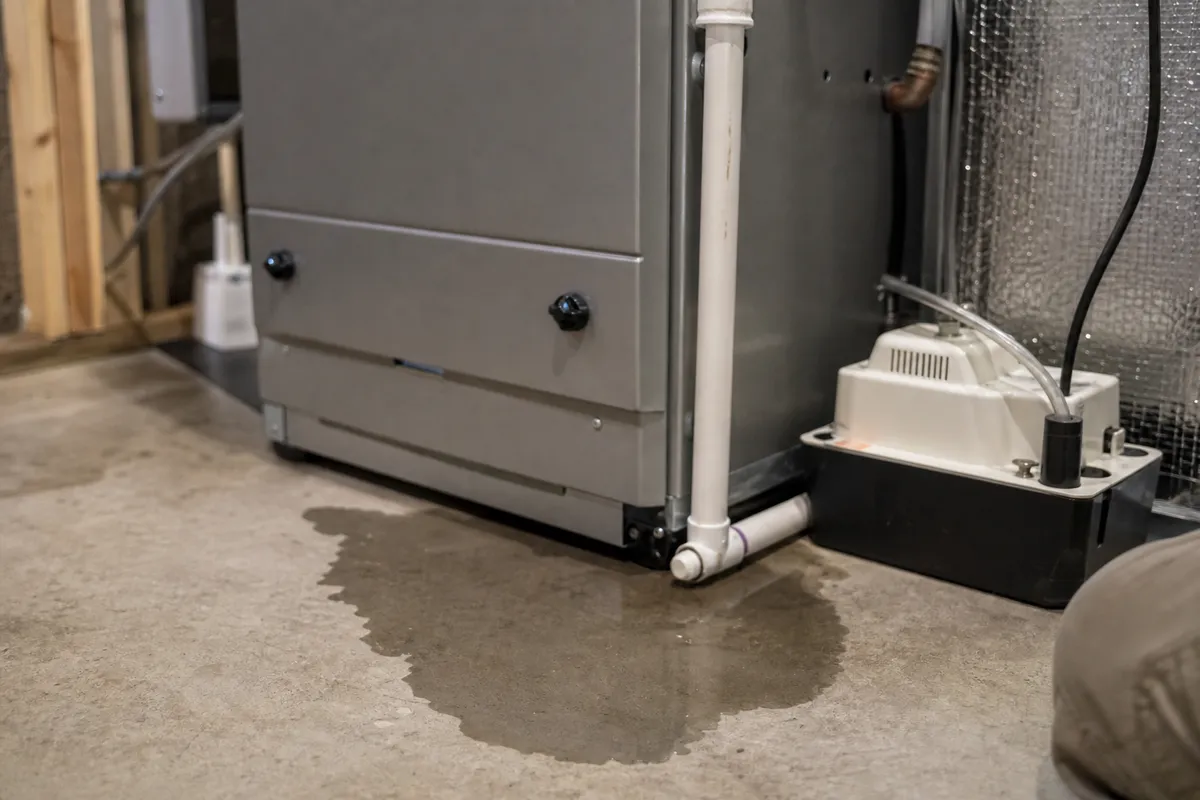
A puddle under the furnace scares people more than a strange noise does. I get it — water and a gas appliance sitting in the same closet feels wrong. Most of the time it’s not dangerous, but it’s not something to ignore either, because the same leak that stains your carpet today can crack a heat exchanger or fry a control board next winter. I’ve been pulling apart furnaces in Lynnwood, Shoreline, and Kirkland basements since 2017, and the water-leak call is one of the top five reasons we get dispatched between October and March.
TL;DR
- A leaking furnace is almost always condensate drainage, a cracked heat exchanger, or a clogged evaporator drain shared with the AC coil.
- High-efficiency (90%+) furnaces produce condensate water constantly during heating season — a blocked drain line or trap is the #1 cause here.
- Older 80% furnaces shouldn’t produce condensate at all; water there usually means a cracked heat exchanger, which is a safety issue, not a maintenance item.
- Most drain-line fixes run $150–$350; heat exchanger replacement often costs more than a new furnace, so we usually recommend replacing the unit instead.
- If you smell anything odd near the furnace along with the leak, shut it off and call — don’t wait for a scheduled visit.
First, figure out what kind of furnace you have
This changes everything about the diagnosis. High-efficiency condensing furnaces (90% AFUE and up) have a second heat exchanger that cools exhaust gas down until it condenses into water — that’s normal, expected, and drains out through a PVC pipe into a floor drain, condensate pump, or utility sink. If your furnace has PVC intake/exhaust pipes running through the wall or roof, you have one of these.
Older 80% AFUE furnaces vent through a metal flue and shouldn’t produce liquid water as part of normal operation. If you’re seeing water under one of these units, the water is coming from somewhere it shouldn’t be — condensation forming inside a cracked heat exchanger, or the shared AC coil above it.
“Water under a high-efficiency furnace is almost always the condensate path — a clogged drain line or a cracked trap — and it’s a cheap fix. The mistake is ignoring it: that same water ends up in the secondary heat exchanger or the control board, and now a $250 repair is a $1,500 one.”
— Danil Sokolov, Heat Pump & Mini-Split Specialist at SPS Pro Services
The most common causes, ranked by how often we actually see them
1. Clogged condensate drain line or trap. This is the call we get the most, especially in homes around Bothell and Everett with furnaces installed 5–8 years ago. Condensate is mildly acidic and slightly slimy — over a few heating seasons it builds up algae and sediment inside the 3/4-inch PVC line, especially at low points and traps. Water backs up, overflows the drain pan, and drips down the cabinet.
2. Cracked or clogged condensate trap/drain pan. Plastic traps get brittle with age and can crack at the seams. Cheap plastic drain pans crack too, particularly if a previous tech overtightened a hose clamp.
3. Failed condensate pump. If your furnace is in a basement or utility room without a floor drain nearby, it likely has a small condensate pump. These have a float switch and a tiny motor, and both fail — usually from mineral buildup or debris.
4. Frozen condensate line. Common on furnaces where the drain runs through an unheated garage or crawlspace before reaching a drain. Once it freezes solid, water has nowhere to go but back into the unit.
5. Cracked heat exchanger. Less common, but the one you don’t want. Metal fatigue lets flue gas condensation collect inside the exchanger, and it can leak both water and combustion byproducts. This shows up more often in furnaces 15+ years old.
6. AC evaporator coil drain, not the furnace at all. If your air handler shares a cabinet with the AC coil, a clogged coil drain pan in summer looks exactly like a furnace leak. We see this constantly in Bellevue homes with combined heating and cooling systems — worth ruling out before you assume the furnace itself is the problem, and it’s a case where a quick AC repair visit solves what looked like a heating issue.
What we check on a service call
- Furnace type and age — 80% vs 90%+ AFUE changes the whole diagnosis.
- Condensate line routing — length, slope, any low spots, whether it runs through unconditioned space.
- Trap and drain pan condition — cracks, algae buildup, disconnected fittings.
- Condensate pump operation, if present — float switch, motor hum, discharge flow.
- Blower door gasket and cabinet seams — sometimes it’s not condensate at all, just humid air condensing on a cold cabinet.
- Heat exchanger inspection with a camera and combustion analyzer if the furnace is 80% AFUE and shouldn’t be making water in the first place.
Cost table: typical Seattle-area repair ranges
| Issue | Typical Fix | Estimated Cost |
|---|---|---|
| Clogged condensate line | Clear line, add cleanout tee | $150–$300 |
| Cracked drain trap or pan | Replace trap/pan | $175–$350 |
| Failed condensate pump | Replace pump | $250–$450 |
| Frozen line in unconditioned space | Reroute/insulate line | $300–$600 |
| Cracked heat exchanger | Replace exchanger (older furnace) | $1,200–$2,200 |
| Cracked heat exchanger (furnace 12+ years old) | Replace furnace instead | $4,500–$8,500 |
These are estimates based on jobs we’ve run around King and Snohomish counties; exact pricing depends on furnace brand, access, and whether ductwork needs modification. For any furnace issue beyond a simple drain clear, it’s worth having someone look at the whole system through furnace repair rather than guessing from a symptom list.
When repair doesn’t make sense
Here’s where I’ll be blunt, because a lot of contractors won’t tell you this part. If your furnace is 12–15+ years old and the heat exchanger has cracked, replacing that part alone often costs 60–80% of a new furnace. You’d be putting a new expensive component into an old cabinet with an aging blower motor and control board that are also approaching end of life. In that situation we almost always recommend replacement over repair — and a lot of homeowners in Seattle and Bellevue use that moment to switch to a heat pump instead of another gas furnace, since a heat pump handles both heating and cooling in our mild Pacific Northwest climate. If that’s a route you’re considering, heat pump installation walks through what that switch actually involves.
A quick checklist before you call anyone
- Turn off the furnace if you smell gas, see scorch marks, or notice soot — that’s not a DIY situation.
- Check if the leak only happens during heating cycles (condensate/drain issue) or constantly (pump or line problem).
- Look at the drain line for obvious kinks, disconnected joints, or ice if it runs through a garage or crawlspace.
- Note whether the AC has run recently — a summer leak might be the coil, not the furnace.
- Check your home’s electrical panel age if you’re leaning toward replacement — older 100-amp panels sometimes need an upgrade to support a new high-efficiency furnace or heat pump, which is worth knowing before quoting the job; electrical panel upgrade covers what that involves.
- Take a photo of the water location and the furnace model tag before your appointment — it speeds up diagnosis significantly.
A note on homes around here
A lot of the furnace-leak calls we get come from houses built in the 1970s–1990s in areas like Seattle, Bellevue, and Everett where the original 80% AFUE furnace has since been swapped for a 90%+ unit without updating the condensate drain routing. The line gets snaked through an unheated crawlspace or attic because that’s where the old flue used to run, and it freezes or clogs faster as a result. If you’re in PSE territory versus Snohomish County PUD, that doesn’t change the mechanics of the leak, but it does factor into what we recommend for heat pump efficiency if you’re weighing a full system replacement.
Mini-FAQ
Is a small puddle of water under my furnace an emergency? Usually not, but don’t ignore it for weeks. A clogged condensate drain can trip a safety switch and shut the furnace off entirely, or it can keep leaking and damage the cabinet, control board, or flooring underneath.
Can I fix a clogged condensate line myself? Clearing a simple external clog with a wet/dry vac at the outdoor termination is reasonable for a comfortable DIYer. Anything involving opening the furnace cabinet, the trap, or the pump is worth having a technician handle, since reassembly errors can cause bigger leaks or safety issues.
My water heater is leaking too — is that related? Usually not connected to the furnace, but if both are in the same mechanical closet, check that you’re not confusing the two sources. A separate water heater leak needs its own look — see water heater repair rather than assuming it’s furnace condensate.
If you’ve got water pooling near your furnace and aren’t sure what’s causing it, call SPS Pro Services at (206) 427-8907 and we’ll get a technician out to diagnose it properly.