
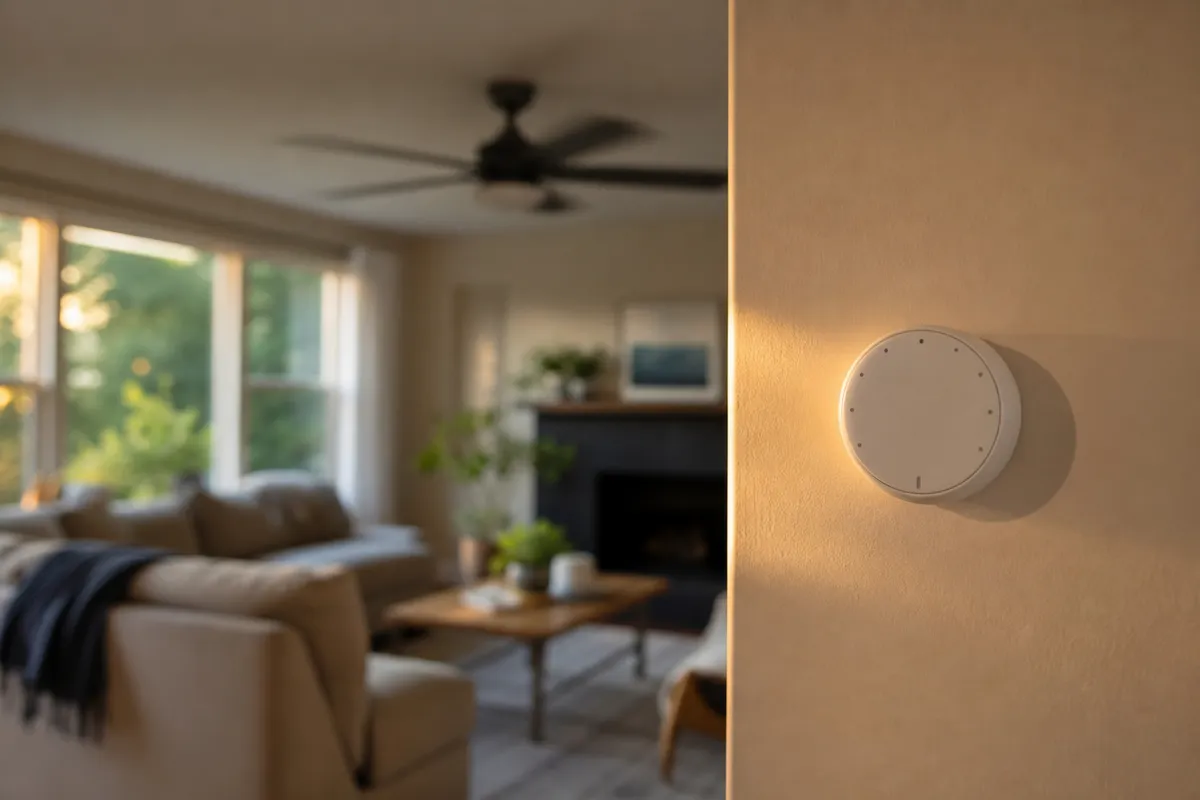
Every heat wave, my phone turns into a confessional. Last July a woman in Everett called, and before she even told me what her AC was doing, she said: “I keep it at 72 and my husband says I’m bankrupting us. What’s the right temperature?” She sounded genuinely stressed about it — like there was an official number and she’d been breaking the rules for years.
I schedule hundreds of service calls a year, and I promise you this question comes up more than any repair question. People have read that the government says 78°F, they’ve tried 78, they were sweaty and miserable, and now they feel guilty at 74. So let me give you the answer I gave her: there is no morally correct thermostat setting. There’s a trade you’re making between comfort and cost, and once you can see the price of each degree, you can make that trade on purpose instead of feeling bad about it.
And around Puget Sound, we have a cheat code most of the country doesn’t: our nights. More on that below.
TL;DR
- The Department of Energy suggests higher setpoints like 78°F to save energy — honest truth: many people find 78 warm, and that’s okay.
- Each degree you lower the setpoint adds roughly 1–3% to your cooling cost. That’s the whole trade, in one number.
- Most families we work with land happily at 75–78°F when home, with setbacks when away and asleep.
- A ceiling fan lets you raise the setpoint 2–3 degrees and feel the same — fans cost pennies to run.
- Puget Sound nights almost always cool into the 50s and low 60s. Free cooling, every night, if you use it.
What temperature do most people actually set?
Here’s what I hear across a year of calls: most comfortable-and-not-shocked-by-the-bill households in the Seattle area settle between 75 and 78 when they’re home. Below 74, bills start to sting. Above 78, someone in the house usually stages a protest.
The DOE’s guidance leans toward 78°F when you’re home and awake, and the energy math behind that is real. But I’d rather be straight with you: 78 with still air and a little humidity feels warm to a lot of people, especially anyone working from home all day. If 78 works for you, wonderful — you’re saving real money. If it doesn’t, don’t white-knuckle it. Drop to 76 and use the other tricks in this article to close the gap.
The reason each degree matters is simple: the smaller the difference between inside and outside, the less heat leaks into your house, and the less work your AC does. So every degree warmer you can comfortably tolerate is roughly 1–3% off the cooling portion of your bill. Going from 72 to 76 isn’t a rounding error — over a hot month it’s real money.
One caveat from the scheduling desk: if your AC runs constantly and still can’t hold 76 on an ordinary 85-degree day, the setpoint isn’t your problem. That’s a system that needs attention — low refrigerant, a dirty coil, or a sizing issue. That’s an AC repair call (typically $189–$1,200 depending on what we find), and my colleague wrote a whole piece on why oversized systems misbehave.
How should I set it when I’m away or asleep?
This is where the painless savings live, because you’re paying to cool rooms nobody is feeling.
| Situation | Suggested setpoint | Why |
|---|---|---|
| Home, awake | 75–78°F | Your comfort zone; use fans to sit at the top of the range |
| Away (work, errands, 4+ hours) | 83–85°F | House drifts warm; recovery costs less than holding cool all day |
| Sleeping | 76–80°F | Bodies cool at night; a bedroom fan covers the difference |
| Vacation | 85°F or off | Nothing to protect at reasonable summer temps here |
Two things people worry about, from real calls:
“Doesn’t it cost more to re-cool the house than to hold the temperature?” No — this is the most persistent myth I deal with. A warm house absorbs heat more slowly than a cold one, so letting it drift while you’re gone genuinely saves energy. The AC works hard for a burst when you return, but less in total than holding 75 all day.
“I don’t want to come home to a hot house.” Fair, and that’s exactly what schedules are for. A smart thermostat starts cooling 30–45 minutes before you arrive, so you get the savings and walk into a comfortable house. Several models qualify for utility rebates too — here’s our smart thermostat guide for Seattle homes.
Do ceiling fans really let me raise the temperature?
Yes, and this is my favorite trick because it costs almost nothing. Moving air evaporates moisture off your skin, which makes you feel 2–4 degrees cooler than the thermometer says. So a room at 78 with a fan feels like 75 — and the fan draws about as much power as a light bulb, while every one of those degrees was costing you 1–3% on the AC.
The rule that matters: fans cool people, not rooms. Turn them off when you leave — a fan spinning in an empty room is just a tiny heater.
“Air movement is the cheapest comfort upgrade there is. The evaporative effect off your skin is worth two or three degrees, which is why a mini-split’s gentle continuous airflow at 77 often feels better than a conventional system blasting to 74. Buy comfort with airflow first and compressor run-time second — airflow is nearly free.”
— Danil Sokolov, Heat Pump & Mini-Split Specialist at SPS Pro Services
How do I survive a heat wave here — with or without AC?
Most Puget Sound heat waves are short — two to four days — and our nights almost always drop into the 50s and 60s even when afternoons are brutal. That shapes the whole strategy.
If you have AC: set it a bit warmer than usual (say 77–78) and let it run steadily rather than chasing 72. During extreme heat, systems are working at their limit; a steady moderate target keeps the house livable without flogging the equipment. Close blinds on south and west windows by mid-morning — sunlight through glass is a space heater you’re paying to fight.
If you don’t have AC — and thousands of homes here still don’t — the night is your air conditioner:
- Evening flush: the moment outside is cooler than inside (usually 8–9 pm), open windows on opposite sides of the house and put a box fan in one, blowing out. It’ll pull cool air through all night.
- Seal up by 8 am: close every window and blind before the day heats up. You’re storing last night’s cool air.
- Shade the glass: exterior shade beats interior; even a bedsheet over a west window helps.
- Move low, sleep low: heat stratifies — the basement or ground floor can be 10 degrees cooler than upstairs.
- Cool the body, not the house: cold water on wrists and neck, damp sheet, fan on the bed.
- Know your limit: if indoor temps stay above the mid-80s overnight, especially for older folks or babies, go somewhere cooled — library, mall, a friend’s place.
If you ended this last heat wave swearing “never again,” you have two paths: central AC installation ($5,500–$12,500) if you have ducts, or a ductless mini-split ($3,800–$9,500) if you don’t — the mini-split also replaces your heating. Here’s how the two compare for our region.
Frequently asked questions
What’s the best AC temperature for sleeping?
Sleep researchers generally point to cooler rooms, but you don’t need to pay for 68. Most people sleep fine at 76–78 with a fan providing airflow, since your core temperature drops naturally at night. In our climate, an open window plus a fan often beats the AC entirely after 10 pm.
Does closing vents in unused rooms save money?
Mostly no, and it can backfire. Closing vents raises pressure in the ductwork, which increases leakage and strains the blower. Close one rarely used room if you like, but shutting half the house’s vents makes the system work worse, not cheaper. Zoning is a design feature, not a DIY vent trick.
Why does 76 feel fine some days and sticky other days?
Humidity. On muggy days your sweat evaporates slower, so the same temperature feels warmer. A longer-running, properly sized AC removes moisture as it cools; a system that blasts and shuts off leaves the air cool but damp. If “cold but clammy” describes your house, mention it when you call — it’s a diagnostic clue, not your imagination.
Sources
- U.S. Department of Energy — Energy Saver
- ENERGY STAR — Smart Thermostats
- Puget Sound Energy — Rebates
Ready to stop dreading heat waves? Book AC maintenance before the next hot stretch, call SPS Pro Services at (206) 427-8907, or explore AC installation options for your home.