
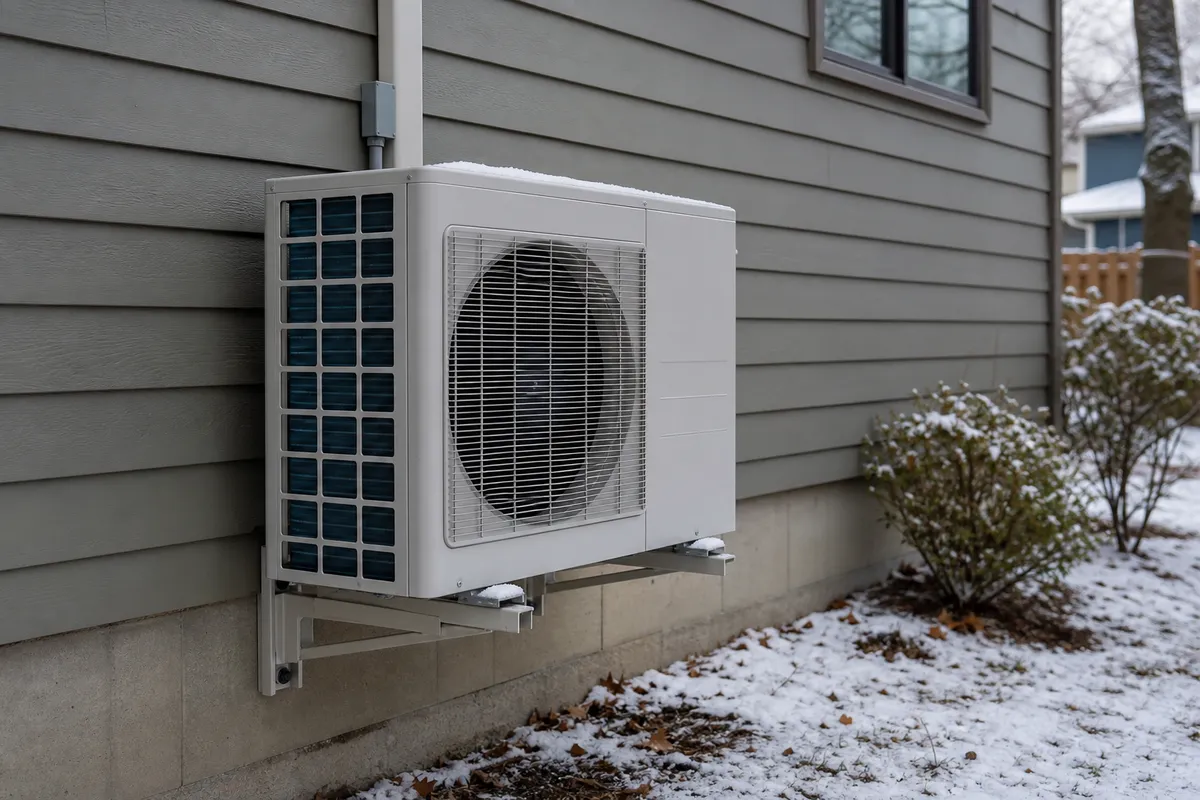
Last January I was on a service call in Shoreline when it hit 22°F overnight — cold for us, but nothing compared to what a house in Spokane deals with. The homeowner’s ten-year-old heat pump was blowing lukewarm air and the backup strip heat was running nonstop, eating electricity like crazy. A cold-climate heat pump would have kept pumping real heat at that temperature without breaking a sweat. That’s the whole story in one call.
I get asked about this term almost every week now, so let’s break down what it actually means, what it costs, and whether your house in the Seattle area actually needs one.
TL;DR
- A cold-climate heat pump is built to keep producing meaningful heat down to 5°F, sometimes lower, without leaning hard on backup electric strips.
- Standard heat pumps start losing capacity around 35–40°F and can struggle below 25°F.
- Puget Sound winters rarely drop below 20°F, but when they do, the difference in comfort and your electric bill is real.
- Cold-climate models cost roughly $1,500–$3,500 more installed than standard heat pumps, but that gap often pays for itself in five to eight winters through lower PSE or SnoPUD bills.
- If your panel is maxed out or your home still runs on an aging gas furnace, plan those upgrades into the same project.
What Actually Makes a Heat Pump “Cold-Climate”
Standard heat pumps and cold-climate heat pumps use the same basic idea — pull heat out of outdoor air and move it inside, even when that air feels cold to us. The difference is in the compressor and refrigerant circuit.
A cold-climate unit uses a variable-speed compressor, usually a two-stage or fully inverter-driven scroll or rotary design, plus an enhanced vapor injection cycle. That extra step lets the refrigerant absorb more heat energy from air that’s already low on it. The result: the unit keeps delivering 70-80% of its rated heating capacity at 5°F, where a standard heat pump might be down to 40-50% capacity and leaning on backup heat strips to make up the difference.
Brands that do this well in our market: Mitsubishi’s Hyper-Heat line, Daikin’s Aurora series, and Bosch’s IDS Ultra. All three are rated to keep producing usable heat at -13°F, which is overkill for Seattle but tells you how much margin you have on a normal 25°F January morning.
“For King and Snohomish counties, a standard heat pump already covers almost every hour of the year — cold-climate models buy you margin for the rare arctic blast and better efficiency at the temperatures we actually see. I spec them for exposed sites and homes without backup heat; for most others it’s an option, never a must.”
— Sergei Petrov, Founder & Lead HVAC Technician at SPS Pro Services
Do You Actually Need One in King or Snohomish County
Here’s the honest answer: probably not for survival, but often yes for your wallet and comfort.
Seattle, Bellevue, and most of the Puget Sound lowlands sit in a mild maritime climate. We rarely see sustained temperatures below 20°F. Compare that to Wenatchee or Yakima, where cold-climate units are close to mandatory. But “rarely” isn’t “never” — we get at least one or two arctic outflow events every winter where temps drop into the teens for a few nights, usually tied to cold air pushing down from the Fraser Valley into Everett and north Snohomish County first.
During those events, a standard heat pump kicks on its electric resistance backup heat, which is basically a giant toaster coil. That backup heat can cost three to four times more per hour to run than the compressor alone. A cold-climate heat pump avoids most of that backup runtime because the compressor keeps working efficiently at those temperatures.
If you live in a well-insulated newer home in Bellevue or the Eastside, you might get by fine with a standard heat pump. If you’re in an older, leakier house — a lot of Seattle’s housing stock dates to the 1920s through 1950s and wasn’t built with modern insulation standards — the extra headroom of a cold-climate unit matters more.
Real Cost Numbers: PSE and SnoPUD Rates
I ran these numbers for a typical 1,800–2,200 sq ft home based on current PSE and SnoPUD residential rates. These are estimates, not quotes — your actual bill depends on insulation, thermostat settings, and duct condition.
| Heating Source | Outdoor Temp | Approx. Monthly Cost (Jan, PSE electric ~$0.12/kWh) | Approx. Monthly Cost (Jan, SnoPUD electric ~$0.10/kWh) |
|---|---|---|---|
| Older gas furnace (80% AFUE) | 25-40°F | $140-$190 | $140-$190 (gas rate same) |
| Standard heat pump, no backup issues | 35-45°F | $110-$150 | $95-$130 |
| Standard heat pump, backup strip running | 15-25°F | $220-$280 | $190-$240 |
| Cold-climate heat pump | 15-25°F | $130-$170 | $110-$150 |
The gap between “standard heat pump on backup heat” and “cold-climate heat pump” during a cold snap is where the real savings show up. Over a full winter with two or three cold weeks, that’s often $150-$300 saved, which chips away at the higher upfront equipment cost year after year.
Installed Cost Range for Cold-Climate Systems
For a typical single-zone or multi-zone heat pump installation in the greater Seattle area, most cold-climate ducted systems land between $9,500 and $16,000 depending on tonnage, ductwork condition, and zoning. Ductless cold-climate mini-splits for one or two rooms typically run $4,500-$8,500 per zone. These are estimates — exact pricing depends on your home’s layout and electrical situation.
Checklist: Is a Cold-Climate Heat Pump Right for Your Home
- Your current system is a gas furnace over 15 years old and you’re already budgeting for a change — check furnace repair costs against replacement before deciding.
- Your home is in Snohomish County or a higher-elevation pocket near Everett where cold outflow events hit harder and last longer.
- You’ve noticed your existing heat pump’s backup heat running a lot during cold snaps — a sign it’s undersized or not cold-climate rated.
- Your electrical panel is 100-amp or older. Many cold-climate heat pumps plus a future EV charger or induction range will need more capacity — get your electrical panel upgrade evaluated at the same time.
- You’re also planning an EV charger installation in the next few years. Bundling panel work now saves a second service call later.
- Your ducts are original to a home built before 1990 and haven’t been inspected — leaky ducts waste 20-30% of any system’s output, heat pump or not.
- Your air conditioning is also aging out — a cold-climate heat pump replaces both your furnace and your AC repair calls with one system that heats and cools.
- You want a single system instead of separate heating and cooling equipment, especially if you’re also due for a water heater repair and are thinking about heat pump water heaters down the line too.
What I Tell Homeowners in Seattle
If you’re in the city proper or close to the water — most of Seattle fits this — your winters are milder than people think, and a well-sized standard heat pump often does the job fine. Once you get into Snohomish County, higher elevations, or areas that catch more of that continental cold air, I lean toward recommending the cold-climate models even though they cost more upfront. The comfort difference on those handful of brutal nights is noticeable — no cold air blowing from the vents, no backup heat roaring away, and a lower bill the next month.
Mini-FAQ
Does a cold-climate heat pump still need backup heat? Most installs include a small backup source for extreme or emergency situations, but it runs far less often than with a standard heat pump. Many homeowners never notice it kicking on at all in a typical Seattle winter.
Can I keep my existing furnace as backup instead of electric strips? Yes, this is called a dual-fuel or hybrid system. It works well if your furnace is still in good shape, and it can lower your backup heat cost compared to electric strips.
How long does installation take? A single ducted system swap usually takes one to two days. Ductless multi-zone setups with new line sets can take two to three days depending on how many indoor units you’re adding.
Call SPS Pro Services at (206) 427-8907 and we’ll figure out whether a cold-climate heat pump makes sense for your specific house and budget.