
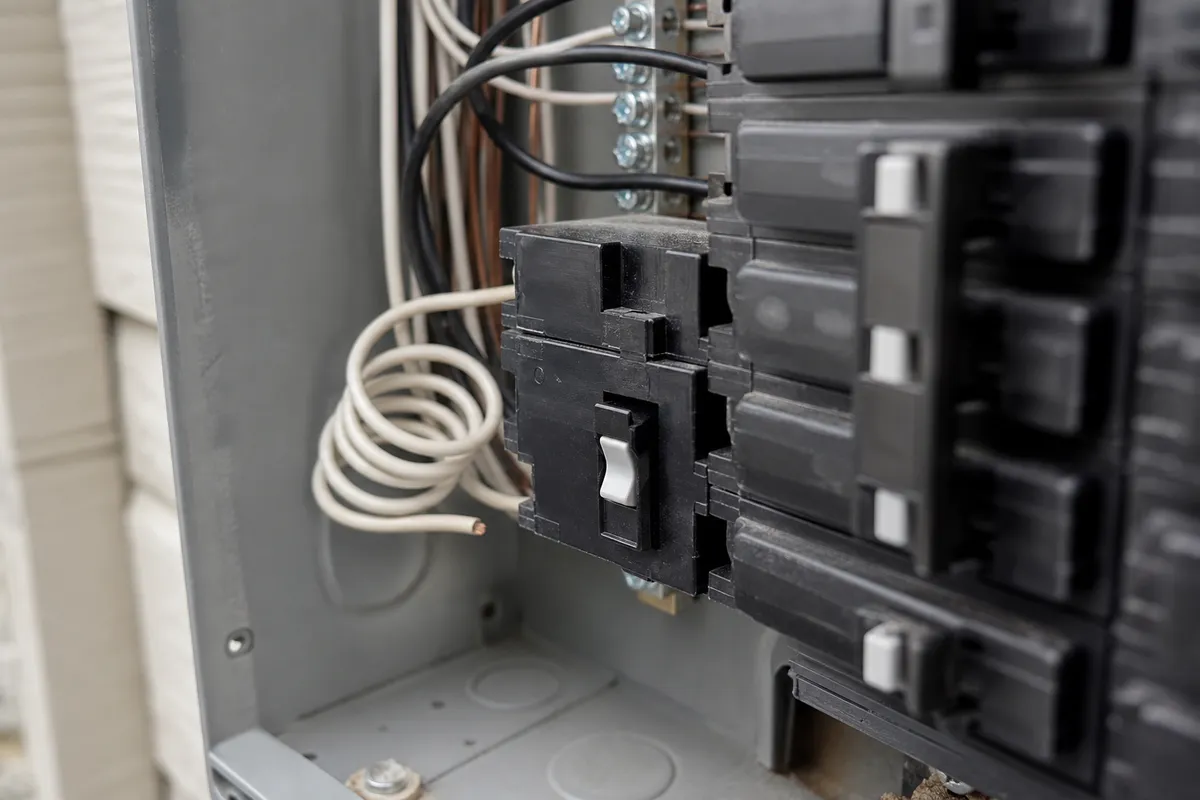
I get the same call a few times a month: a homeowner in Wedgwood or Lake City resets a breaker, it trips again ten minutes later, and they’re convinced their panel is defective. Nine times out of ten, it’s an AFCI breaker doing exactly what it’s designed to do. It just doesn’t come with an instruction manual.
Arc-fault circuit interrupters have been quietly reshaping residential electrical work since the early 2000s, and most homeowners never hear the term until one trips. Let’s fix that.
TL;DR
- AFCI breakers detect dangerous arcing in wiring and shut the circuit down before it starts a fire.
- They’re required by the National Electrical Code (NEC) for most living areas in new construction and major remodels.
- A tripping AFCI is not always a bad breaker — it’s often a sign of loose connections, worn insulation, or an appliance issue.
- Older Seattle-area homes (pre-1990s wiring) benefit the most from adding AFCI protection during a panel upgrade.
- If your panel trips repeatedly with no clear cause, get an electrician out before you just keep resetting it.
What an AFCI Breaker Actually Does
A standard breaker protects against overload and short circuits — too much current flowing through a wire. An AFCI breaker does something different. It watches the electrical waveform for the irregular pattern created by arcing, which happens when electricity jumps a small gap instead of flowing through a solid connection.
Arcing happens at a loose wire nut, a nail driven through a cable behind drywall, a cracked outlet terminal, or a chewed extension cord. That arc can hit temperatures over 10,000 degrees Fahrenheit in a fraction of a second — hot enough to ignite wood framing or insulation. Most house fires traced to electrical causes start this way, not from a wire simply overheating.
The AFCI chip samples the current waveform thousands of times per second, compares it against known arcing signatures, and trips the breaker before that heat has time to build.
“AFCI protection earns its keep in exactly the housing stock we work in — mid-century homes where cables have been stapled, spliced and buried behind three generations of remodels. The nuisance-trip complaints mostly trace to shared neutrals or worn appliances, and finding that is a methodical hour, never a guess.”
— Sergei Petrov, Founder & Lead HVAC Technician at SPS Pro Services
Why Your Panel Has Them (NEC and L&I Requirements)
If your home was built or rewired after 2014, you’re required to have AFCI protection in most areas people actually live in: bedrooms, living rooms, dens, sunrooms, closets, hallways, laundry areas. NEC 210.12 lays this out, and Washington State’s Department of Labor & Industries enforces the NEC as adopted state code — L&I electrical inspectors check for this on any permitted job in King and Snohomish counties.
That’s why, when we do an electrical panel upgrade in Seattle or Bellevue, we don’t simply swap breakers one-for-one. Any circuit feeding those living spaces gets AFCI protection as part of bringing the panel up to current code. It’s not optional on a permitted job, and honestly, I wouldn’t want it to be. I’ve pulled cover plates off outlets in 1962 Ballard bungalows and found aluminum-to-copper splices held together with electrical tape. AFCI protection catches trouble in wiring like that long before it becomes a hazard.
Common Myths I Hear on Job Sites
“AFCI breakers are just oversensitive and trip for no reason.” Almost never true. Every trip has a cause. Sometimes it’s a genuine arc fault. Sometimes it’s a borderline connection that hasn’t fully failed yet. Sometimes it’s a specific appliance with a worn motor brush or damaged cord — vacuum cleaners and space heaters are frequent offenders. The breaker isn’t guessing.
“If it trips once and resets fine, I don’t need to worry about it.” A one-time trip during a lightning storm or a power blip, fine. Repeated trips on the same circuit, even if resetting works, means something in that circuit is degrading. I’ve traced repeat trips back to a single loose wire nut in an attic junction box more times than I can count.
“AFCI and GFCI are the same thing.” Different jobs entirely. A GFCI protects people from shock by detecting current leaking to ground — that’s why they’re required near sinks, in bathrooms, garages, and outdoors. An AFCI protects the structure from fire by detecting arcing. Since 2020, NEC has required some circuits to have both protections combined in a single dual-function breaker.
“Older homes are grandfathered in forever, so I don’t need this.” Existing wiring generally doesn’t have to be upgraded until you do renovation work or a panel replacement that triggers a permit. But “grandfathered” doesn’t mean “safe.” A lot of homes in Everett and Shoreline built before 1985 still have wiring that’s never seen an AFCI, and that’s exactly the wiring most prone to the loose connections and insulation breakdown that cause arcing.
What Trips an AFCI Breaker in Real Life
From actual service calls this year:
- A hair dryer cord with a hairline crack near the plug, invisible until we bent it under a light.
- A ceiling fan with a failing motor winding.
- A staple through a cable in a finished basement in Renton, installed by a previous owner doing DIY work.
- Backfeed from an extension cord run under a rug for years, insulation worn thin from foot traffic.
- A string of older holiday lights with brittle wiring.
Notice how few of these are the breaker’s fault.
Panel Upgrade Cost Comparison (Seattle Area Estimates)
| Service | Typical Scope | Estimated Cost Range |
|---|---|---|
| Single AFCI breaker replacement | One circuit, existing panel | $180 – $350 |
| Partial panel update | 4–6 circuits converted to AFCI/GFCI dual-function | $900 – $1,800 |
| Full panel upgrade (100A to 200A) | New panel, full code-compliant breaker set | $2,800 – $4,500 |
| Panel upgrade with EV charger circuit added | 200A panel plus dedicated 240V circuit | $3,800 – $6,200 |
These are estimate ranges based on typical King and Snohomish county jobs — actual pricing depends on panel condition, permit fees, and whether your home needs a service line upgrade too. If you’re adding a heat pump installation or EV charger installation, it’s often smart to combine that with a panel upgrade rather than doing them separately, since you’re already paying for the electrician’s time and the permit.
Checklist: Is Your Home’s AFCI Protection Where It Should Be
- Panel installed or updated before 2002: almost certainly no AFCI protection on any circuit.
- Panel installed 2002–2014: partial protection, usually bedrooms only.
- Panel installed after 2014: should have broad AFCI/GFCI coverage per code at time of install.
- Any breaker trips more than once a week: stop resetting it and call for a diagnostic.
- Planning a remodel, finished basement, or room addition: those circuits will need AFCI protection to pass inspection.
- Adding major electrical load (EV charger, hot tub, heat pump): good time to evaluate whole-panel capacity and protection together.
A Word on Combustion Appliances and Panels
I bring this up because homeowners sometimes lump every home safety system together. Your furnace repair technician deals with gas leaks and carbon monoxide. Your AC service handles refrigerant and airflow — see our AC repair page for that side of things. Your water heater repair folks handle thermostats and heating elements. AFCI protection is strictly an electrical safety layer, and it doesn’t interact with any of those systems directly, but a healthy panel supports all of them.
FAQ
Can I just replace an AFCI breaker with a standard one if it keeps tripping? No. That’s a code violation and it removes fire protection from that circuit. It also won’t fix the underlying issue — the wiring or appliance problem is still there, you’ve just stopped getting warned about it.
Do I need AFCI protection in my kitchen or garage? Kitchens and garages are typically GFCI territory due to shock risk near water and grounded equipment, though current code has expanded dual-function requirements in some areas. It depends on your specific layout and when the space was last permitted.
How long does it take to add AFCI protection during a panel upgrade? A full panel upgrade in Seattle, Bellevue, or Everett typically takes one full day for the electrical work, plus scheduling time for the L&I inspection afterward.
If your breaker keeps tripping or your panel predates 2002, call SPS Pro Services at (206) 427-8907 and we’ll take a look before it becomes a bigger problem.