
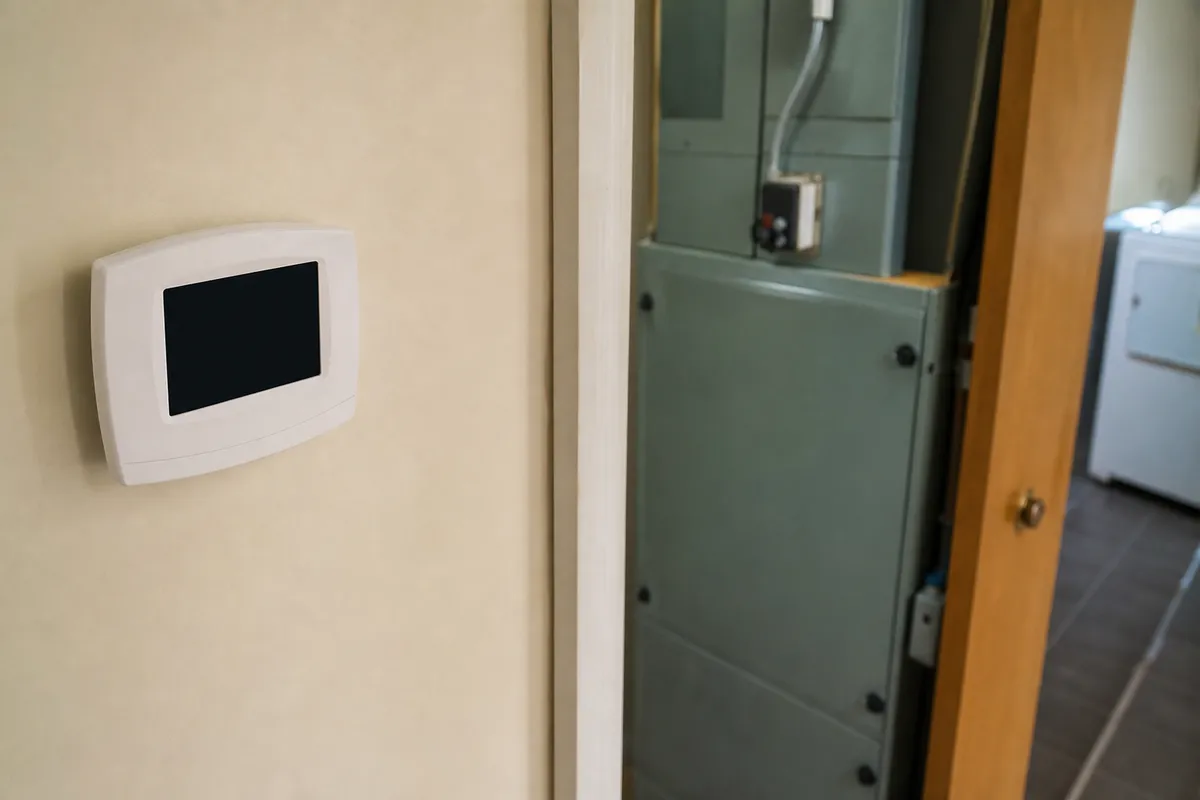
Last winter I got a call from a homeowner in Lake City who was ready to buy a whole new heating system because her thermostat “just died.” Turned out to be two AA batteries that cost $4 at the QFC down the street. I’ve also had the opposite call — blank screen, homeowner sure it was just batteries, and we found a scorched transformer on the furnace board that could have started a bigger electrical problem if left alone. A blank thermostat screen tells you almost nothing on its own. You have to work through it in order, cheap and easy first, then up the ladder.
I’ve been doing this in the Seattle area since 2017, and this is one of the most common service calls we get, right up there with furnace repair calls in the first cold snap of the year. Here’s how I walk through it on a job, and how you can do the same before you call anyone.
TL;DR
- Dead or corroded batteries cause more blank screens than anything else — check this first, always.
- A tripped breaker or blown fuse is the second most common cause, especially after a storm or power blip.
- Loose or disconnected low-voltage wiring at the thermostat base is common in older homes with wiring nobody’s touched since the Reagan administration.
- A blown 3-amp fuse on the furnace control board is a $10 part but means something else is drawing too much current.
- A failed 24-volt transformer is a bigger repair and usually means the furnace board needs a look too.
- If your panel is old or undersized, thermostat trouble can be one symptom of a bigger electrical panel upgrade need.
Cause 1: Dead or Corroded Batteries
Most thermostats made in the last 15 years run on batteries, even ones wired into the system, because the batteries back up the display and memory. Nest, Ecobee, and most digital thermostats use AA or AAA batteries. If they’ve been in there three or four years, they’re done.
Pop the thermostat off its base. Look for white or greenish crust on the battery contacts — that’s corrosion, and it’ll block power even with fresh batteries in. A pencil eraser or a bit of fine sandpaper on the contacts fixes it in under a minute. Put in fresh batteries, snap it back on, and give it 30 seconds to boot.
This fixes the problem more than half the time. I’m not exaggerating.
“A blank thermostat is a low-voltage circuit telling you it lost its 24 volts — and the float switch shutoff is the version I like, because it means the safety did its job. What I check before anything else: the furnace door switch. It’s the HVAC equivalent of ‘is it plugged in,’ and it saves a surprising number of service calls.”
— Marcus Reed, Senior Electrician at SPS Pro Services
Cause 2: Tripped Breaker or Blown Fuse
Your furnace, air handler, or heat pump has its own breaker in the electrical panel, usually labeled “furnace” or “HVAC.” If that breaker tripped, the low-voltage transformer that powers your thermostat has no power to work with, so the screen stays blank.
Go to your panel and look for a breaker that’s not fully in line with the others — it’ll sit slightly toward “off” even if it doesn’t look fully tripped. Flip it fully off, then back on. If it trips again right away, don’t keep resetting it. That’s a sign of a short somewhere, and repeatedly flipping a tripping breaker is how house fires start.
Homes built before the 1990s around Seattle and Everett sometimes still have 100-amp panels that are stretched thin, especially once someone adds an EV charger or a heat pump. If your breakers trip often across different circuits beyond the furnace one, that’s worth a real conversation about your panel rather than your thermostat.
Cause 3: Loose or Disconnected Wiring at the Base
I see this a lot in houses where a previous owner did their own thermostat swap. The wires — usually labeled R, C, W, Y, G — connect to screw terminals, and those screws back out over time from vibration and temperature swings. If the R wire (that’s your 24-volt power wire) isn’t seated, the screen goes dark even though everything else is fine.
Pull the thermostat off the wall plate and check that every wire is snug in its terminal and that the copper strand isn’t frayed or falling out. If a wire looks like it’s just barely making contact, that’s your answer. This is a five-minute fix if you’re comfortable with a small screwdriver. If you’re not sure which wire goes where, take a photo before you touch anything.
Cause 4: Blown Low-Voltage Fuse on the Furnace Board
Inside your furnace or air handler is a small circuit board with a fuse on it, usually a 3-amp automotive-style fuse, sometimes even smaller. This fuse blows when something downstream pulls too much current — a short in the thermostat wire, a bad relay, sometimes even a mouse chewing on wire insulation in the attic (I’ve pulled evidence out of ductwork more than once in Snohomish County crawlspaces).
You can replace this fuse yourself for about $5 to $10 if you know where the board is and have a multimeter to test it. But here’s the honest part: if it blew once, something caused it, and if you just replace the fuse without finding the cause, it’ll blow again, sometimes within days. If it blows a second time, stop guessing and get a tech to trace it properly.
Cause 5: Failed 24-Volt Transformer
The transformer steps your home’s 120 or 240 volts down to the 24 volts your thermostat and controls actually use. Transformers fail from age, from a short circuit that overloaded them, or sometimes just from 15-20 years of heat cycling inside the furnace cabinet. When it fails, your thermostat gets zero power, full stop, no batteries in the world will fix that.
Testing a transformer needs a multimeter and knowing where to put the probes without shorting something else out. This isn’t a great DIY step unless you already do electrical work — tracing a dead 24-volt circuit is exactly what an electrical repair visit is for. Replacement parts run $30 to $60, but labor and diagnostic time are where the real cost is, because you want someone checking why it failed before installing a new one.
Cause 6: Bigger Electrical or Panel Issues
Every so often the thermostat is the messenger, not the problem. If you’re seeing blank screens alongside flickering lights, buzzing outlets, or breakers that trip for no clear reason, the issue may be upstream in your panel. This shows up more in homes built before 1985 in older neighborhoods around Bellevue and north Seattle, where panels were sized for a smaller electrical load than modern households actually use — especially once you add central AC, an EV charger, or a heat pump.
What It Typically Costs to Fix
| Cause | DIY Possible? | Typical Part Cost | Typical Total With a Tech |
|---|---|---|---|
| Dead/corroded batteries | Yes | $4-$8 | $0 if you do it yourself |
| Tripped breaker | Yes (reset only) | $0 | $0-$150 if breaker itself is bad |
| Loose wiring at thermostat | Yes, carefully | $0 | $95-$180 service call |
| Blown low-voltage fuse | Sometimes | $5-$10 | $120-$220 with diagnosis |
| Bad transformer | No | $30-$60 part | $180-$350 installed |
| Panel-related issue | No | Varies | $2,200-$4,500 for panel upgrade |
These are rough Seattle-area ranges based on jobs we’ve run — your exact number depends on furnace brand, panel age, and access.
Quick Checklist Before You Call Anyone
- Swap the batteries, even if they “look fine.”
- Clean the battery contacts with a dry cloth or eraser.
- Check your electrical panel for a tripped breaker.
- Pull the thermostat and check wire terminals are snug.
- Note if lights or other circuits are also acting up.
- If you’ve reset a breaker twice and it trips again, stop and call for help.
Mini FAQ
My thermostat screen is blank but the furnace still runs on its own schedule. What’s going on? That’s unusual, but it can happen if the thermostat display fails while the relay circuit stays engaged. It usually means the display itself, not the power supply, is the failure point. Worth a diagnostic visit rather than guessing.
Can a blank thermostat mean my AC is also affected? Yes, if your thermostat controls both heating and cooling off the same low-voltage circuit, which most do. If your AC also stopped responding, check out our notes on AC repair troubleshooting too, since the causes overlap.
Is it worth replacing an old thermostat instead of repairing it? If the thermostat itself is more than 10 years old and non-smart, and you’re already paying for a service call, a new smart thermostat is often $150 to $250 installed and gives you better scheduling and, in some cases, better compatibility with a future heat pump installation. If the transformer or wiring is the real problem, though, a new thermostat alone won’t fix it.
If you’ve gone through this list and you’re still staring at a dark screen, or you’d rather skip straight to someone with a multimeter, call us at (206) 427-8907 and we’ll get it sorted.