
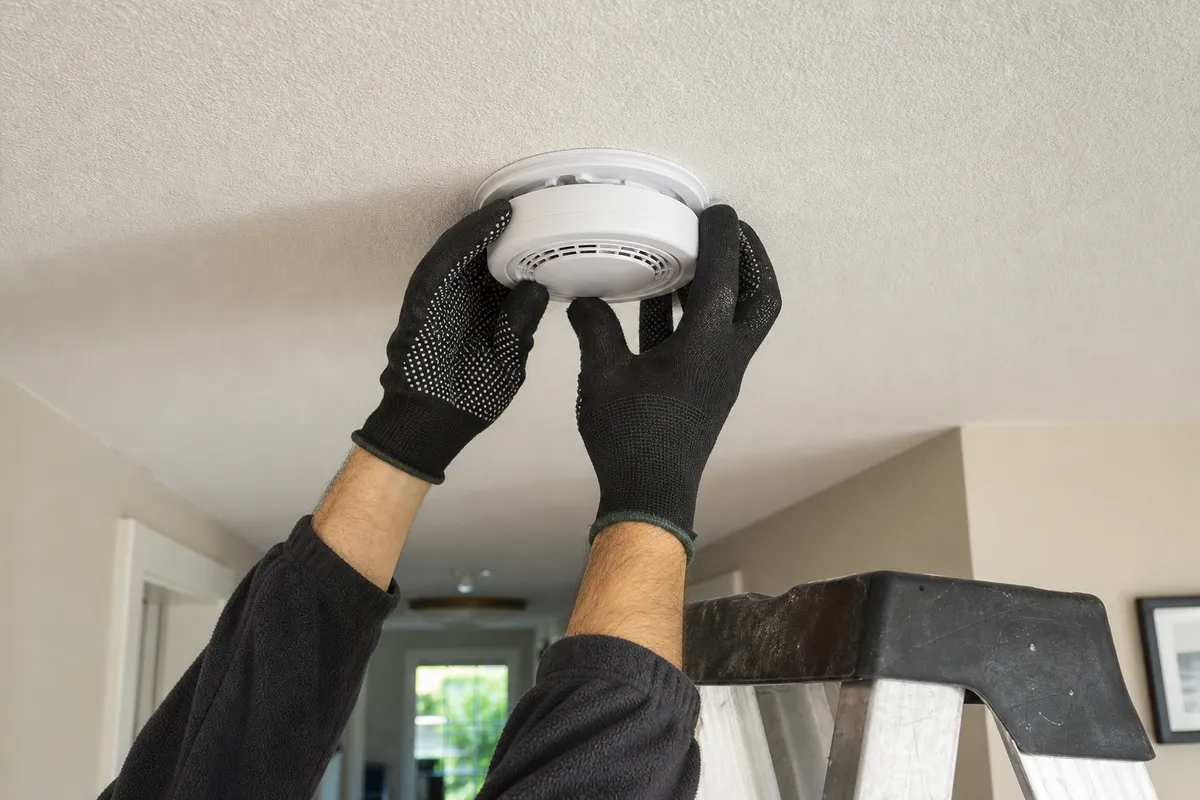
I’ve pulled more dead nine-volt batteries out of ceiling-mounted smoke detectors than I can count, sitting in homes from Ballard bungalows to newer builds in Bothell. Most homeowners assume a working detector is enough. Washington law and the electrical code ask for more than that, and the gap between what people have and what’s actually required is where people get hurt, or get flagged during a home sale inspection. Let’s go through what the state actually requires, where the myths come from, and what it costs to get a house up to code.
TL;DR
- Washington requires smoke alarms in every bedroom, outside sleeping areas, and on every level of the home, per the International Residential Code (IRC) as adopted by the state.
- Homes built or significantly renovated after 1993 generally need hardwired, interconnected smoke alarms with battery backup, wired per NEC rules.
- Carbon monoxide alarms are separately required (RCW 19.27.530) in any home with a fuel-burning appliance, fireplace, or attached garage.
- Battery-only detectors are legal in many older homes but are not a substitute for hardwired systems where code requires them, and they are the leading cause of “detector didn’t work” fire investigation findings.
- Any hardwired smoke detector work is electrical work under Washington L&I rules — it requires a permit and, in most cases, a licensed electrician.
- Combination smoke/CO units and whole-house upgrades typically run a few hundred to under two thousand dollars depending on how many rooms need coverage.
What Does Washington State Actually Require?
Washington adopts the International Residential Code (IRC) with state amendments through the State Building Code Council, and that’s where residential smoke alarm placement rules live — not the electrical code itself. Under IRC Section R314, homes need a smoke alarm:
- Inside every bedroom
- Outside each separate sleeping area, in the immediate vicinity
- On every level of the home, including basements
- Interconnected so that when one sounds, they all sound (required in new construction and most alterations)
If your house was built before smoke alarms were mandated statewide (roughly the early 1980s for basic alarms, early 1990s for interconnected hardwired systems), you may still have older battery units grandfathered in. But the moment you do a permitted remodel, add a bedroom, or in many jurisdictions sell the house, code officials in King and Snohomish counties will typically require an upgrade to current placement and interconnection standards.
“When we do electrical work in older homes, bringing smoke alarms up to current placement rules is the cheapest life-safety upgrade on the invoice. Hardwired, interconnected, with battery backup — when one goes off, they all go off. NFPA’s data is blunt: most home fire deaths happen in homes with no working alarm.”
— Sergei Petrov, Founder & Lead HVAC Technician at SPS Pro Services
The NEC’s Role: Why Placement Is Only Half the Job
The IRC tells you where alarms go. The National Electrical Code, adopted statewide and enforced through Washington L&I electrical inspection programs, governs how they’re wired. Hardwired smoke detectors have to be:
- Connected to a dedicated circuit or a general lighting circuit with no switch that could accidentally cut power
- Equipped with battery backup so they still work during a power outage
- Interconnected with a dedicated signaling conductor or a listed wireless interconnection method
- Installed by someone who understands circuit loading, because tying alarms into an overloaded or outdated circuit is a real problem in homes with older panels
This is also why smoke detector wiring often surfaces panel issues. If your electrical panel is from the 1970s or 80s and already maxed out, adding hardwired, interconnected alarms sometimes means it’s time to look at an electrical panel upgrade before we can safely tie in new circuits. I see this constantly in older housing stock around Seattle and Everett, where 100-amp panels were adequate in 1978 but aren’t keeping up with today’s electrical loads, let alone a new EV charger or heat pump down the line.
Myth-Busting: What Homeowners Get Wrong
Myth: “My battery smoke detector is fine because it still beeps during the test.” A working test doesn’t mean the sensor is reliable. Photoelectric and ionization sensors degrade over 8-10 years regardless of battery condition. Washington code and NFPA both recommend full unit replacement, not only the battery, at that mark.
Myth: “I only need one detector for the whole floor.” Code requires alarms in every bedroom plus the hallway outside sleeping areas, not one per floor. A single hallway unit on a floor with three bedrooms doesn’t meet the requirement.
Myth: “Carbon monoxide detectors are optional.” They’re not, under RCW 19.27.530, if your home has any fuel-burning appliance such as a gas furnace, gas water heater, or fireplace, or an attached garage. This applies whether you own or rent. I get this question a lot from homeowners scheduling furnace repair visits who are surprised CO detection is a legal requirement, not a nice-to-have.
Myth: “Any handyman can wire in a hardwired detector.” Because it’s low-voltage tied into your home’s electrical system, this work falls under L&I’s licensed electrical contractor requirements in Washington State, and it needs an electrical permit in most municipalities, including Seattle, Bellevue, and Everett.
Myth: “Interconnected wireless alarms don’t need to be code-compliant.” Wireless interconnection is allowed under current code, but only using listed, compatible devices installed per manufacturer specifications. Mixing brands or using consumer-grade units not rated for interconnection voids that compliance.
Comparison: Detector Types and Realistic Costs
| Detector Type | Code Status in WA | Typical Installed Cost (Seattle area) |
|---|---|---|
| Battery-only smoke alarm | Legal only in older, non-renovated homes | $30-$60 per unit (DIY) |
| Hardwired, non-interconnected | Not code-compliant for new work | Not recommended for new installs |
| Hardwired, interconnected smoke alarm | Required for new construction/remodels | $150-$250 per unit installed |
| Combination smoke/CO hardwired unit | Meets both smoke and CO requirements | $180-$300 per unit installed |
| Whole-house interconnected upgrade (6-8 units) | Brings older home to current code | $900-$1,800 for the full job |
These are general estimates for typical single-family homes in King and Snohomish counties; older knob-and-tube wiring, plaster ceilings, or panel capacity issues can push costs higher.
Practical Checklist for Homeowners
- Count your bedrooms and confirm there’s a smoke alarm inside each one
- Confirm there’s an alarm in the hallway or common area outside each sleeping zone
- Check that every level of the home, including the basement, has at least one alarm
- Test interconnection: if one alarm sounds, do the others sound too
- Replace any smoke alarm older than 10 years, regardless of whether it passes a battery test
- Confirm CO detectors are installed near sleeping areas if you have a gas furnace, gas water heater, or attached garage
- If your panel is original to a home built before 1990, have it evaluated before adding new hardwired alarms or other loads like EV charger installation
Where This Fits Into Bigger Electrical Decisions
Smoke and CO detector compliance often comes up alongside other home systems. If you’re scheduling a water heater repair and have a gas unit in a closet near bedrooms, that’s a spot to double-check CO coverage. Homes getting a heat pump installation or new AC repair work sometimes need panel capacity reviewed at the same time, which is a good moment to also verify smoke alarm circuits are properly protected and not sharing an overloaded breaker. We handle detector wiring, panel evaluations, and full electrical safety checks across our Seattle, Bellevue, and Everett service areas as part of standard electrical visits, not as a separate add-on service.
FAQ
Do I need a permit just to replace an existing hardwired smoke detector with the same type? Straight like-for-like replacement often doesn’t require a new permit, but adding units, rewiring interconnection, or converting from battery to hardwired typically does in King and Snohomish county jurisdictions. When in doubt, ask before starting.
Can I install hardwired smoke detectors myself in Washington? Homeowners can perform electrical work on their own primary residence in Washington State but must obtain the appropriate permit and pass inspection. Given the interconnection and circuit requirements involved, most homeowners choose a licensed electrician to avoid failed inspections.
How often should smoke and CO detectors actually be replaced? Smoke alarms: every 10 years from the manufacture date, not the install date. CO alarms: every 5 to 7 years, depending on the manufacturer’s stamped expiration date on the unit itself.
If you’re not sure whether your home meets current Washington smoke and CO detector code, call SPS Pro Services at (206) 427-8907 and we’ll walk through it with you.