
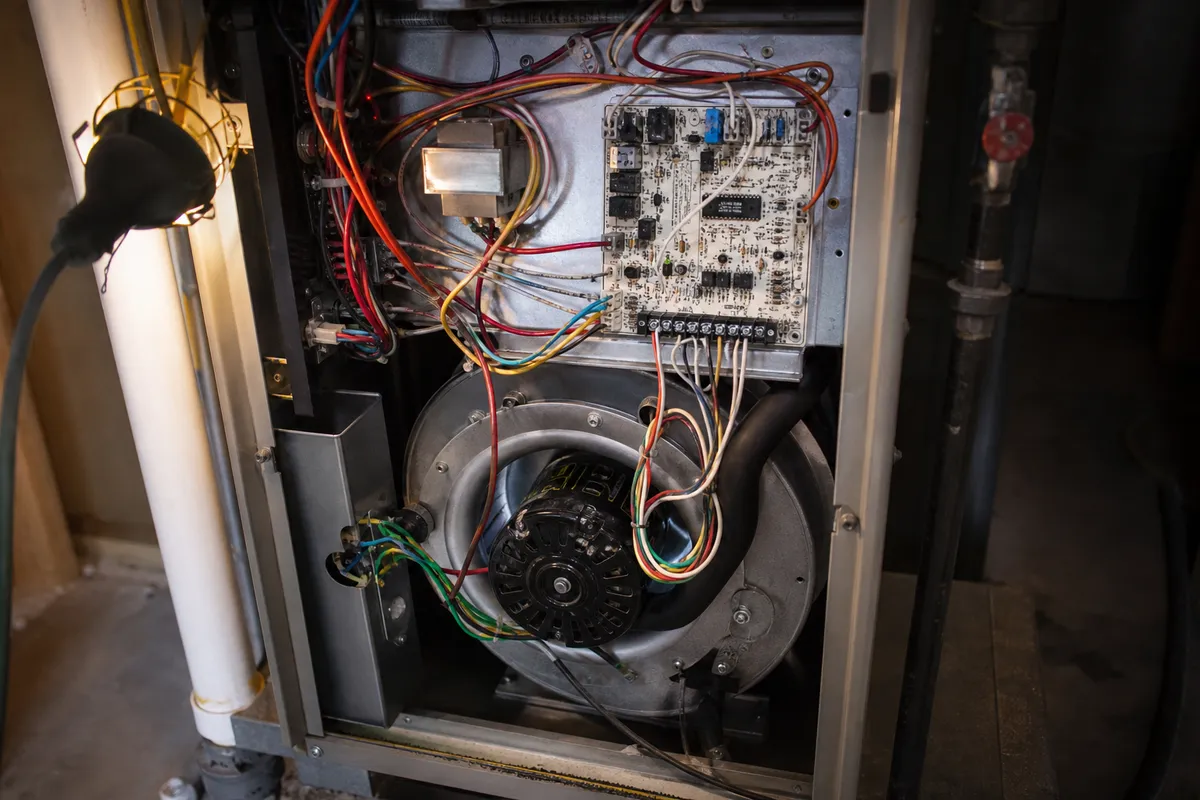
I had a customer in Lake Forest Park last winter tell me his single-stage furnace “sounds like a jet taking off” every time it kicks on. His neighbor has a variable-speed unit he barely notices. Same street, same weather, completely different living rooms. That difference comes down to one thing: how the furnace ramps up heat.
I’ve installed and repaired all three types across King and Snohomish counties for going on nine years now. Here’s what actually separates them, what they cost, and when spending more is worth it.
TL;DR
- Single-stage furnaces run at full blast or off. Cheapest to buy, loudest, least efficient on mild days.
- Two-stage furnaces run at a low setting most of the time and kick to high only when it’s really cold. Better comfort, moderate cost bump.
- Variable-speed furnaces adjust output in small increments, often 35%-100% capacity. Quietest, most efficient, best for homes with uneven room temperatures.
- Most homeowners in our area land in the two-stage range for the best balance of cost and comfort.
- If your ductwork is undersized or leaky, upgrading the furnace stage won’t fix the real problem.
What Does “Stage” Actually Mean?
Stage refers to how many levels of heat output the furnace’s gas valve and blower can produce. A single-stage furnace has one gas valve position: full fire. It’s either running at 100% or it’s off. Two-stage adds a second, lower firing rate, usually around 65% of capacity, that the furnace uses for most of the heating season. Variable-speed (sometimes called modulating) furnaces can adjust output across a much wider range, often in 1% increments, matching heat output to what the house actually needs at that moment.
Think of it like driving. Single-stage is stomping the gas pedal to the floor, then letting off completely, over and over. Two-stage is having a cruise control with two speeds. Variable-speed is adaptive cruise control that’s constantly making small adjustments.
“Staging matters most in our shoulder seasons — those four months of 45-degree drizzle where a single-stage furnace slams on and off all day. Variable-speed equipment runs long and low, which is quieter, easier on parts, and steadier room to room. It’s the same reason inverter heat pumps feel so different from on/off systems.”
— Danil Sokolov, Heat Pump & Mini-Split Specialist at SPS Pro Services
How Much Does Each Type Cost Installed in the Seattle Area?
Prices vary by brand, home size, and ductwork condition, but here’s what I’ve seen quoted and installed across Seattle, Bellevue, and Everett over the past two years.
| Furnace Type | Typical AFUE Rating | Installed Cost Estimate | Noise Level | Comfort Consistency |
|---|---|---|---|---|
| Single-stage | 80%-96% | $3,800 - $6,200 | Noticeable on/off cycling | Temperature swings of 3-5 degrees |
| Two-stage | 90%-97% | $5,200 - $8,000 | Moderate, quieter low-speed operation | Swings of 1-2 degrees |
| Variable-speed | 96%-98.5% | $7,500 - $11,500 | Very quiet, near-continuous low hum | Holds within 1 degree |
These are estimates, not quotes. Your actual furnace installation number depends on furnace size (measured in BTUs), whether your existing ductwork needs modification, and permit costs in your specific city. If your furnace is paired with AC, that changes things too, and it’s worth having someone check your cooling system at the same time. We cover that separately under AC repair.
When Is Single-Stage the Right Call?
I’m not going to tell you everyone needs a variable-speed furnace. If you’ve got a smaller home, under 1,800 square feet, decent insulation, and you’re not overly sensitive to noise or temperature swings, single-stage does the job. It’s also the right pick for rental properties or homes you’re planning to sell in the next few years. No point spending an extra $3,000 on comfort features the next owner didn’t ask for.
I replaced a dead single-stage unit in a Shoreline rambler last spring with another single-stage furnace. The homeowner asked if he should “upgrade” to two-stage. I told him honestly: his ducts were original from 1978, undersized for anything fancier, and his house is 1,400 square feet. Spending more on staging would have meant more noticeable performance, sure, but the payback on efficiency gains wasn’t there for his usage pattern. He saved the money and put it toward attic insulation instead, which made a bigger comfort difference.
When Two-Stage Makes Sense
Two-stage is where most of my installs land these days, especially in homes between 1,800 and 3,200 square feet. It handles the shoulder seasons, our long stretches of 45-55 degree days from October through April, without the constant hard cycling that wears out components faster and spikes your gas bill.
A family in Bellevue called me two winters ago because their single-stage furnace was cycling 12-15 times a day and their PSE gas bill had jumped noticeably. I swapped it for a two-stage 96% AFUE unit. Their furnace now runs on low stage roughly 80% of the time during typical Puget Sound winter weather, only kicking to high stage during actual cold snaps below freezing. Their bill dropped and the house feels more even room to room.
When Variable-Speed Is Worth the Premium
Variable-speed shines in larger homes, homes with multiple stories, or houses where certain rooms always run colder or hotter than others. The blower motor adjusts airflow constantly, which also helps with air filtration and humidity control since air moves through the filter and any attached equipment more consistently.
I did one in an Everett home earlier this year, a two-story colonial near Everett with a bonus room over the garage that was always five degrees colder than the rest of the house. The homeowner had tried everything, dampers, extra insulation. The variable-speed furnace, combined with some duct rebalancing, finally evened things out. That’s the honest case for variable-speed: it solves an airflow distribution problem, where a plain swap of the old unit would have changed nothing.
If you’re also considering a heat pump for supplemental heating or cooling, variable-speed furnaces pair well with dual-fuel setups. That’s a longer conversation, and if you want details on heat pump options for our climate, check heat pump installation.
The Part Nobody Tells You: Ductwork Matters More Than Stage
Here’s where I have to be blunt. A $10,000 variable-speed furnace connected to leaky, undersized ductwork will underperform a $4,000 single-stage furnace on properly sized ducts. I’ve measured static pressure on more “premium” installs than I can count where the previous contractor sold the fanciest furnace but never checked if the ducts could actually deliver that airflow.
Before you decide on furnace stage, get your ductwork evaluated. If your home was built before 1990 in Seattle’s older neighborhoods, there’s a decent chance the ducts haven’t been touched since installation. That’s a bigger factor in comfort than which furnace badge you pick.
Electrical Considerations Before You Upgrade
Variable-speed furnaces draw differently than single-stage units, and if your panel is older or already near capacity, especially in homes that also have an EV charger or are considering one, it’s worth a look before installation day. We handle both electrical panel upgrade work and EV charger installation if you’re planning multiple upgrades at once. Bundling electrical and HVAC work in one visit often saves on separate service call fees.
Quick Decision Checklist
- Home under 1,800 sq ft, standard layout, budget-conscious: single-stage is reasonable.
- Home 1,800-3,200 sq ft, want better comfort without top-tier cost: two-stage.
- Home over 3,200 sq ft, multi-story, or specific rooms run hot/cold: variable-speed.
- Ductwork older than 20 years or never inspected: get it evaluated before choosing furnace stage.
- Electrical panel over 15 years old or already loaded: have it checked before installation.
- Furnace paired with AC or considering a heat pump: plan both systems together, not separately.
Mini FAQ
Is a two-stage furnace worth the extra cost over single-stage in Seattle’s climate? For most homes over 1,800 square feet, yes. Our winters have long stretches of moderate cold rather than extreme cold, and two-stage furnaces are built for exactly that pattern.
Will a variable-speed furnace lower my PSE or Snohomish PUD bill significantly? It depends on your current setup. If you’re replacing an old, inefficient single-stage furnace, expect a real drop. If you’re already on a newer two-stage unit, the jump to variable-speed saves less than people expect.
How long do these furnaces typically last? Single-stage and two-stage furnaces both typically run 15-20 years with regular maintenance. Variable-speed units have more electronic components, so staying on top of annual service matters more for hitting that same lifespan. If something’s already acting up on your current unit, it’s worth a look before winter rather than after; see furnace repair for what we check during a service call.
If you want someone to look at your actual ductwork and house before recommending a stage, call SPS Pro Services at (206) 427-8907 and we’ll walk through it with you, no upsell script.