
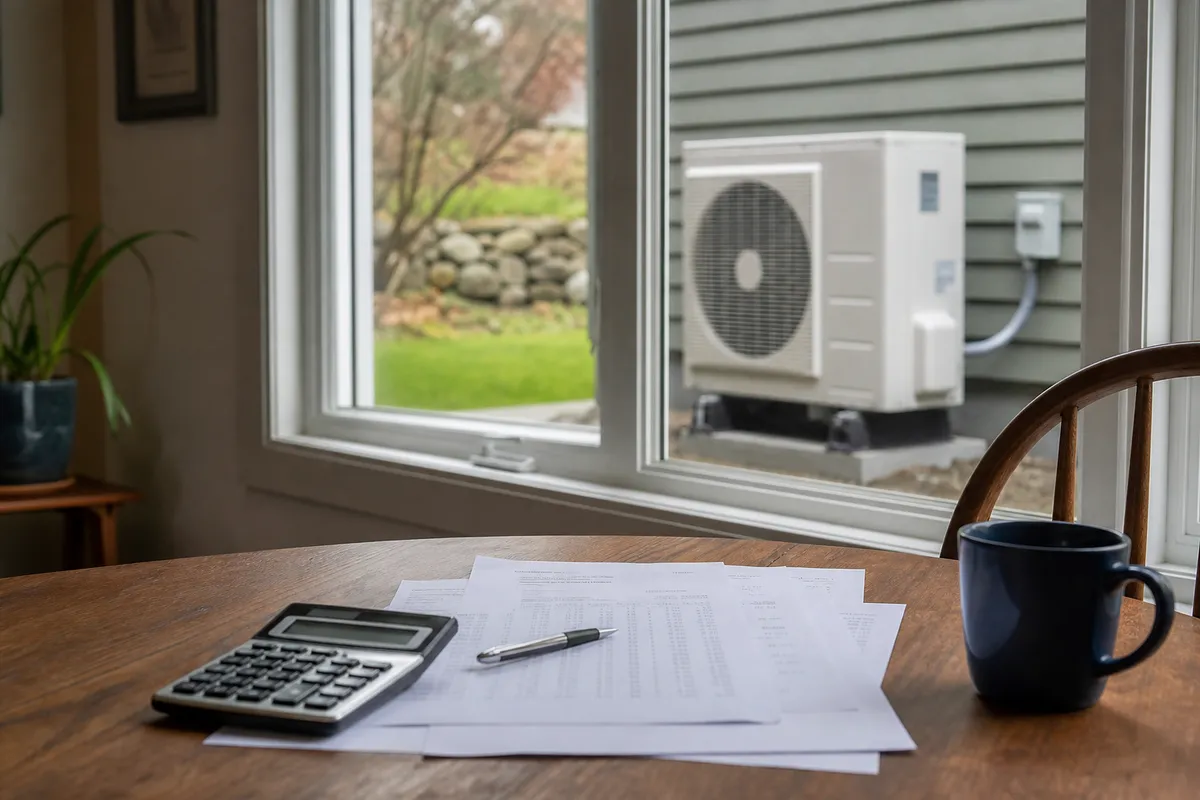
The hardest call I take at SPS Pro Services isn’t a technical one. It’s the homeowner whose furnace died on a Friday night in January, who has three kids and a house dropping one degree an hour, and who just heard the replacement number for the first time. Nobody makes their best financial decisions in that moment — and the whole point of this guide is to make sure you’re never in it.
I coordinate scheduling, rebates, and financing every day, so I see how people in Seattle, Bellevue, and Everett actually pay for this stuff — not how a brochure says they should. Here’s the honest version: what things cost, where the real rebate money is in 2026, which financing fits which situation, and why the calendar might be your biggest discount.
TL;DR
- Full system replacements in our area run roughly $4,800–$9,800 for a furnace and $6,500–$15,500 for a heat pump installation — but almost nobody pays sticker out of pocket in one go.
- Utility rebates are the most reliable money on the table: PSE and Snohomish County PUD both run heat pump incentive programs, with amounts that vary by program year and equipment — always confirm current offers before you sign.
- The federal 25C tax credit that covered up to $2,000 for qualifying heat pumps was scheduled to end for equipment installed after December 31, 2025 — do not budget around it for a 2026 install without checking with a tax professional first.
- Contractor financing, credit union loans, and HELOCs each fit different situations; the same-as-cash promo periods are great only if you actually pay them off in time.
- Replacing on your schedule in the shoulder season instead of during a January breakdown can save real money — and a $189 furnace repair that buys you six months of planning time is often the smartest dollar you’ll spend.
Start With the Real Numbers
Before any talk of rebates, here’s what the projects themselves cost in the Seattle metro as of mid-2026. These are our working ranges — every house moves the number a bit.
| Project | Typical range (installed) | Common add-ons |
|---|---|---|
| Furnace replacement | $4,800 – $9,800 | Duct repairs, thermostat |
| Heat pump installation | $6,500 – $15,500 | Panel upgrade $2,200 – $4,500 |
| AC installation | $5,500 – $12,500 | Electrical circuit work |
| Water heater installation | $1,650 – $4,800 | Expansion tank, gas line work |
One thing I flag up front: if your home has 100-amp service, check the panel line in that table. Discovering a needed electrical panel upgrade after you’ve set your budget is the most common unpleasant surprise in this process — we check capacity on the first visit.
“Financing is a tool, not a trap — but read the term, not the monthly payment. Twelve months same-as-cash works great if you actually clear it in twelve months. Where people get hurt is deferred-interest plans they didn’t finish paying. Pair the financing with every rebate you qualify for and the loan principal drops before interest ever matters.”
— Sergei Petrov, Founder & Lead HVAC Technician at SPS Pro Services
Where the Rebate Money Actually Is in 2026
Utility rebates come first, because they’re the most dependable and they come off the project cost fastest.
- Puget Sound Energy (PSE): if PSE supplies your electricity (much of King County outside Seattle proper), PSE has run ongoing rebate programs for qualifying heat pumps, ductless systems, and heat pump water heaters. Amounts change by program year and depend on what you’re replacing — switching from electric resistance heat historically earns more than switching from gas. Expect “up to” amounts from several hundred to a couple thousand dollars, and confirm the current offer before signing.
- Snohomish County PUD: if you’re in Everett or elsewhere in SnoPUD territory, the PUD has its own rebate program for heat pumps and heat pump water heaters, with rebates for qualifying equipment installed by a registered contractor. Same rule: verify the current amount.
- Seattle City Light: customers in Seattle proper should check City Light’s current electrification offers as well.
A note on how this works in practice: for most utility programs, the equipment model has to be on a qualifying list and the paperwork filed correctly. That’s part of my job when you book with us — a rejected rebate application over a model number typo is a heartbreak I try hard to prevent.
Federal tax credits: proceed carefully in 2026. For the last few years, the federal 25C Energy Efficient Home Improvement Credit was the headline number — up to $2,000 for qualifying heat pumps, plus smaller credits for panel upgrades and high-efficiency furnaces. But federal law changed in 2025, and the 25C credit was scheduled to terminate for property placed in service after December 31, 2025. So: if a salesperson quotes you a “federal tax credit” as part of a 2026 deal, ask pointed questions and confirm with a tax professional before you count that money. I’d rather tell you the cautious version now than have you find out at tax time.
Washington-specific programs are worth a look too. Income-qualified households can sometimes stack significantly larger incentives through state and community energy programs. If money is tight, ask about income-qualified options first — some of the best deals in the state are ones people don’t know to ask about.
Financing: Matching the Tool to the Situation
There’s no single right answer here, just fits and misfits.
Contractor-arranged financing. Most established HVAC companies, us included, work with lending partners offering promotional terms — often a same-as-cash window (typically 6–18 months) or longer fixed-rate terms. The promo windows are genuinely good if you’ll have the cash in time; the catch on many is deferred interest — pay off even a month late and interest applies retroactively to day one. Read that clause.
Credit union personal or home improvement loans. Puget Sound has strong credit unions, and their unsecured home improvement loans are often competitive with contractor financing for good-credit borrowers — without the deferred-interest trap. Worth a 20-minute phone call to compare.
HELOC or home equity loan. Usually the lowest rate available if you have equity, and it makes the most sense for bigger combined projects — say, a heat pump plus a panel upgrade plus an EV charger installation done as one electrification package. The tradeoff is closing time (weeks, not days) and putting your home up as collateral, so it’s a planning tool, not an emergency tool.
The emergency fallback nobody plans: a credit card at 22% APR because the furnace died and the house is cold. This is the outcome this whole guide is designed to avoid.
Timing Is the Discount Nobody Advertises
Here’s the pattern I see from the scheduling desk every year: demand for heating replacement peaks in the first cold snap of November through February, and demand for cooling peaks the week of the first 85-degree forecast. When you buy at peak, you get less scheduling flexibility, less time to compare equipment options, and zero negotiating room.
The homeowners who do this well flip the calendar. They replace heating in late spring or summer, and cooling in fall. Their secret weapon is the cheap repair that buys planning time: if your 17-year-old furnace limps through February on a $189–$950 furnace repair, you haven’t wasted money — you’ve bought yourself six months to get quotes, confirm rebates, arrange financing, and schedule the installation calmly. Same logic applies to cooling: an AC repair in August that carries you to October puts you back in the buyer’s seat.
Your Payment Game Plan Checklist
- Get your equipment’s age and honest condition assessed now, before it fails — a tune-up visit tells you if you’re planning for next year or next month.
- Look up your utility (PSE, SnoPUD, or Seattle City Light) and pull their current rebate sheet for the equipment you’re considering.
- Ask every bidder for the exact model numbers quoted, and check them against the utility’s qualifying list yourself.
- If a heat pump is in the plan, confirm panel capacity early so an upgrade doesn’t ambush your budget.
- Compare at least two financing routes: the contractor’s offer and your own bank or credit union.
- If someone quotes federal tax credits for a 2026 install, verify with a tax professional before counting the money.
- Pick your install window in the shoulder season and work backward from it.
Mini-FAQ
Do rebates come off the price immediately or later? It depends on the program. Some utility rebates are instant (applied on the invoice), others pay out weeks after an application. We tell you which kind applies to your project before you sign, so your out-of-pocket number is never a surprise.
Is financing through the contractor a worse deal than my bank? Not automatically — promotional windows can beat bank rates if you pay within the promo period. It becomes a worse deal when deferred interest kicks in. Compare both with your real payoff timeline, not your optimistic one.
My furnace is 15 years old but running. Should I replace it now or wait for it to die? Financially, planned replacement almost always beats emergency replacement — you get rebate paperwork done right, financing arranged calmly, and a shoulder-season schedule. If the heat exchanger is sound and repairs are minor, running it another season while you plan is also reasonable. What I’d avoid is the default third option: not deciding, and letting a January breakdown decide for you.
If you want help running the numbers for your house — rebates, financing options, and honest timing advice — call SPS Pro Services at (206) 427-8907. I’ll walk you through what’s actually available for your address in Seattle, Bellevue, or Everett before anyone tries to sell you anything.