
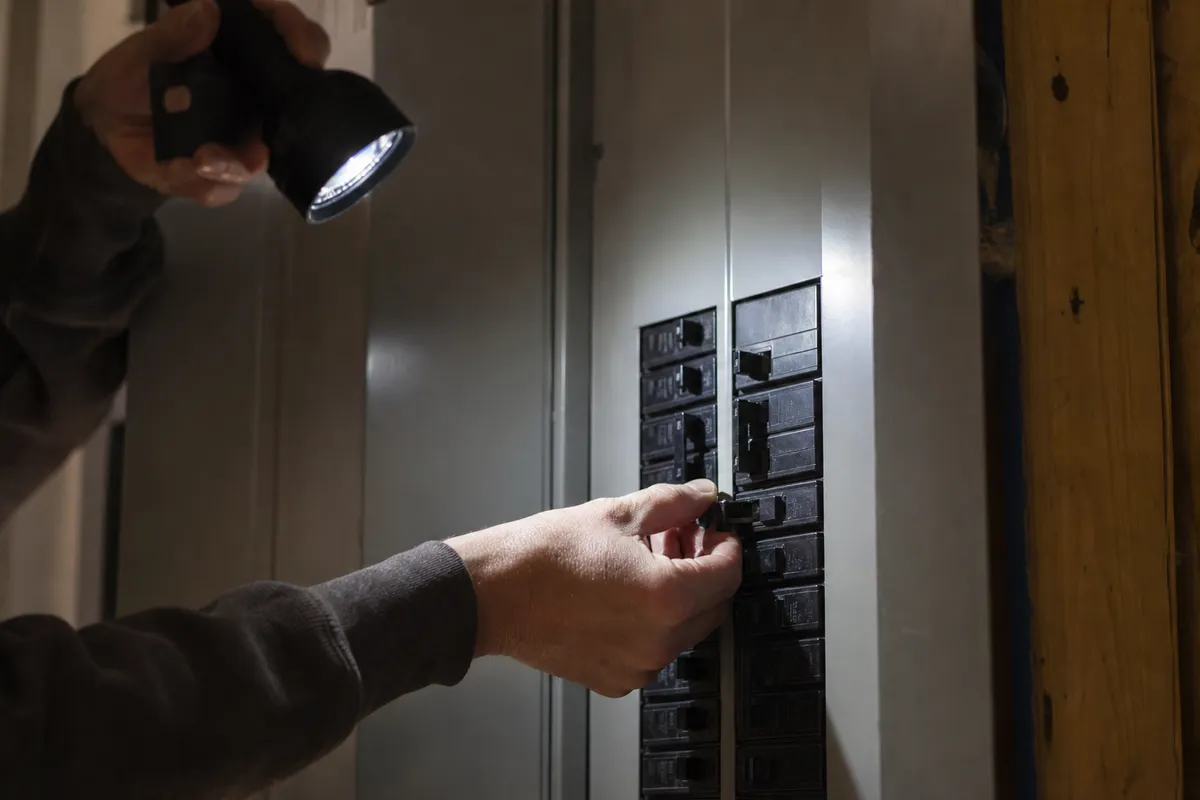
A breaker trips at 9pm, the kitchen goes dark, and half the neighborhood is on their phone flashlight trying to find the panel. I’ve gotten that call more times than I can count in twenty-plus years working panels from Seattle to Everett. Most of the time, resetting it is a two-minute fix. Sometimes it’s a warning sign that something behind the wall is overheating. Knowing the difference matters more than people think.
TL;DR
- A single trip after plugging in a space heater or vacuum is usually a normal overload. Safe to reset once.
- A breaker that trips again within seconds, feels hot, or smells like burning plastic means stop and call an electrician.
- Never hold a breaker in the ON position against resistance. That’s what the NEC calls defeating the overcurrent protection, and it’s dangerous.
- GFCI and AFCI breakers trip for different reasons than standard breakers — ground faults and arc faults rather than plain overload.
- Panels older than 25-30 years, or Federal Pacific and Zinsco brands, trip patterns you shouldn’t ignore.
- If a breaker won’t reset at all, or trips immediately, the problem is downstream, not in your head.
Why Breakers Trip in the First Place
A circuit breaker’s whole job is protecting the wire behind it. Under NEC 240.4, every conductor in your home needs overcurrent protection sized to its ampacity — a 15-amp breaker for 14-gauge wire, 20-amp for 12-gauge, and so on. When current draw exceeds that rating for too long, the breaker’s internal bimetal strip heats up, bends, and trips the switch. That’s not a malfunction. That’s the breaker doing exactly what it’s supposed to do.
Most residential trips fall into three buckets: overload (too many devices on one circuit), short circuit (hot wire touching neutral or ground), and ground fault (current leaking to a path it shouldn’t take, which is what GFCI breakers watch for). A fourth type, arc fault, is what AFCI breakers in bedrooms and living areas are designed to catch under NEC 210.12 — they sense the electrical signature of a loose connection or damaged cord arcing inside a wall, long before it becomes a fire.
“The phrase that moves a call from ‘schedule this week’ to ‘today’ is ‘it trips again right away’ or any mention of a burning smell. One reset is fine; fighting a breaker is how people turn a $149 diagnostic into a rewiring job. When in doubt, leave it off and call — we triage by what you describe.”
— Alina Kovalenko, Service Coordinator & Comfort Advisor at SPS Pro Services
When It’s Safe to Reset
If you plugged in a window AC unit, a hair dryer, and a space heater on the same circuit and the breaker tripped, that’s a textbook overload. Here’s what I tell homeowners in Seattle and Bellevue with older homes:
- Unplug or turn off whatever you just added to the circuit.
- Go to the panel. Find the breaker in the middle position — not fully off, but tripped.
- Push it firmly to OFF first, then back to ON.
- If it holds, you’re done. If it trips again immediately, stop.
That’s it for a simple overload. No need to call anyone if it holds and stays holding.
When You Should Not Reset It — and Call Us Instead
This is the part people skip, usually because they’re annoyed the power’s out. Here’s when I tell clients to leave it alone:
It trips again within seconds of resetting. That’s almost always a short circuit or a failing appliance still drawing current downstream, and it’s the kind of same-day problem our emergency electrician calls exist for. Repeated resetting stresses the breaker’s mechanism and, worse, ignores whatever’s actually wrong.
The breaker or panel is warm or discolored. Heat at the panel means a loose lug, a failing breaker, or overloaded bus bar. Washington’s L&I electrical program requires a licensed electrical contractor for any panel work beyond simple breaker reset — this isn’t a DIY repair, and for good reason.
You smell something burnt or see scorch marks. Don’t touch it. Shut off the main if you can do so safely, and call.
It’s a GFCI or AFCI breaker tripping repeatedly. These aren’t overload breakers. A GFCI tripping in a bathroom or kitchen usually means moisture got into an outlet, a fixture, or an appliance cord. An AFCI tripping in a bedroom circuit can mean a damaged wire inside a wall — I’ve found this in older Everett homes where squirrels or old staples nicked the insulation decades ago.
You have a Federal Pacific Electric (FPE) Stab-Lok panel or a Zinsco panel. Both brands were manufactured with breakers that can fail to trip when they should, or trip unpredictably. If your panel has either label and breakers are acting up, that’s a conversation about an electrical panel upgrade, not a reset.
The panel is undersized for what you’re running. A lot of homes built before 1975 around King and Snohomish counties came with 60 or 100-amp service. Add an EV charger, a heat pump, and a modern kitchen, and you’re asking 100 amps to do a 200-amp job. If you’re planning an EV charger installation or a heat pump installation, it’s worth having us check panel capacity first — trying to squeeze new 240-volt loads onto an old panel is a common cause of chronic tripping.
The Myth: “Just Reset It a Few More Times”
I hear this a lot. Homeowners figure if it holds on the third or fourth try, the problem fixed itself. It didn’t. A breaker that trips intermittently under the same load is telling you the wire, connection, or device is degrading — that’s a case for an electrical repair visit, not another reset. Breakers are also mechanical parts — they wear out. NEC doesn’t set a hard lifespan, but most manufacturers rate them for a limited number of trip cycles before the internal contacts degrade enough that they might not trip when they need to. Repeated manual cycling isn’t a fix; it’s a way to mask a fault until it becomes a fire.
What a Trip Might Really Be Telling You
Sometimes the breaker isn’t the story — it’s the messenger. A furnace blower motor drawing too much current as bearings fail will trip a breaker before it fails completely. If your heat’s out and the breaker keeps tripping when the furnace kicks on, that’s worth a look from our furnace repair team before you keep resetting it. Same logic applies to a failing water heater element tripping a 30-amp breaker repeatedly — that’s a job for water heater repair, not a breaker reset loop. And an AC compressor that trips its breaker on startup, especially during a July heat spell in Seattle or Bellevue, often points to a failing capacitor or contactor — our AC repair techs see this every summer.
Typical Costs: Reset vs. Diagnose vs. Repair
Prices vary by home age and panel condition, but here’s what most Puget Sound homeowners can expect for breaker-related work:
| Service | What’s Involved | Estimated Cost Range |
|---|---|---|
| Simple breaker reset | No visit needed, homeowner does it | $0 |
| Electrical diagnostic visit | Technician traces the fault, tests circuit | $125 – $225 |
| Single breaker replacement | Standard 15/20-amp breaker swap | $150 – $300 |
| GFCI/AFCI breaker replacement | Includes testing affected outlets | $200 – $375 |
| Panel repair (loose lug, bus bar issue) | Diagnostic plus repair | $300 – $700 |
| Full panel upgrade (100A to 200A) | New panel, permit, L&I inspection | $2,800 – $4,800 |
These are general ranges for the greater Seattle area; older homes with knob-and-tube remnants or fuse boxes can run higher.
Quick Checklist Before You Touch the Panel
- Note exactly what was running when it tripped
- Unplug or shut off that device before resetting
- Check the breaker for a middle (tripped) position vs. full OFF
- Reset once, firmly, and watch it — don’t hold it in place
- If it trips again immediately, stop and don’t try a third time
- Check for heat, discoloration, or smell at the panel
- Note if it’s a GFCI/AFCI breaker (has a test button) vs. standard
- If your panel is FPE, Zinsco, or over 30 years old, treat any irregular tripping as a call-the-electrician situation
- Never reset a breaker with wet hands or while standing on a wet floor
FAQ
Can a tripped breaker fix itself if I just wait? No. The breaker won’t reset on its own, and waiting doesn’t change the underlying fault. If it’s an overload, it needs the load removed first.
Is it dangerous to flip a breaker back and forth myself? Doing it once, safely, is standard practice — that’s what the switch is for. The danger is in repeated cycling after it keeps failing, or forcing it when it won’t hold.
How do I know if my panel needs an upgrade instead of a repair? If you’re adding an EV charger, a heat pump, or you’re on a 60-100 amp panel with FPE or Zinsco breakers, an upgrade conversation makes more sense than chasing individual trips. We can evaluate your panel capacity on site.
If a breaker in your home won’t stay reset, or you’re just not sure what’s normal, call SPS Pro Services at (206) 427-8907 and we’ll walk through it with you.