
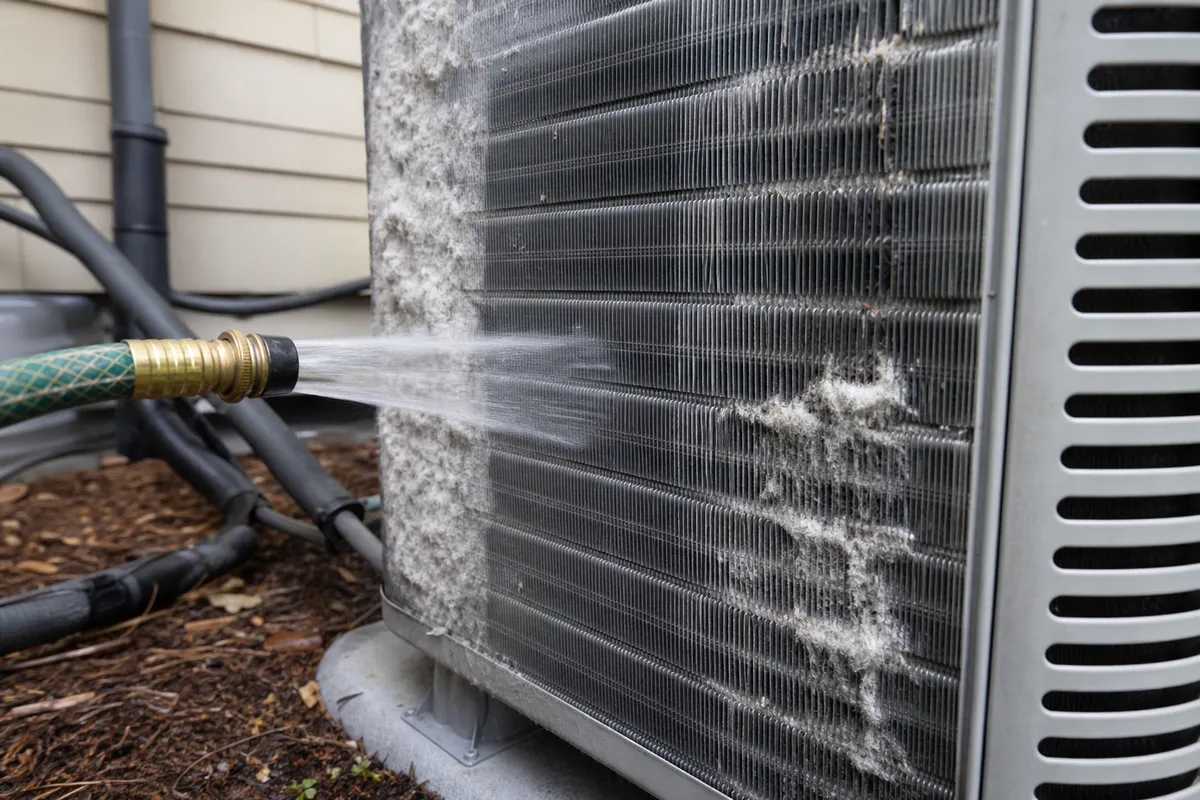
I got a call last July from a homeowner in Lake City whose AC was running nonstop but barely cooling the house. Her outdoor unit looked fine from the driveway. Up close, the fins were packed with cottonwood fluff and grass clippings so thick I could barely see the copper tubing underneath. That unit was working twice as hard as it should have, and her PSE bill for that month showed it. Dirty coils are the most common reason a perfectly good AC or heat pump starts underperforming in Seattle summers.
TL;DR
- Dirty condenser coils can raise your cooling costs by 10-30% and shorten compressor life.
- Always cut power at the disconnect before touching the unit. This is not optional.
- A garden hose on gentle flow works better than a pressure washer, which bends fins and voids warranties.
- Clean coils twice a year: once in spring before cooling season, once in fall after cottonwood and leaf season.
- If the coil looks corroded, bent, or you smell anything electrical, stop and call a tech instead of pushing through it.
Why Coil Cleaning Matters More Here Than People Think
Seattle doesn’t get brutal summers like Phoenix, but King and Snohomish counties see more heat pumps and AC units installed every year, especially after the 2021 heat dome. Most of these systems sit outside near landscaping, gutters, and big-leaf maples that drop seed pods and debris three seasons out of four. Add cottonwood fluff in June and fir needles in October, and outdoor coils here clog faster than in drier climates.
A condenser coil’s whole job is to reject heat from the refrigerant into outside air. When fins are coated in dust, pollen, or grass clippings, airflow drops and the compressor has to work harder to hit the same output. I’ve measured head pressures 15-20% higher than spec on units that just needed a hose-down. That translates directly into extra kilowatt-hours on your PSE or Snohomish PUD meter, and it accelerates wear on parts that are expensive to replace.
“Cottonwood season is real coil-killer weather here — two weeks in June can matt an outdoor unit solid. A garden-hose rinse from the inside out, power off first, recovers more capacity than people believe. What I ask homeowners to leave alone is fin-combing and anything involving the electrical cabinet.”
— Sergei Petrov, Founder & Lead HVAC Technician at SPS Pro Services
What You’ll Need
- Insulated screwdriver to remove the top grille or side panels
- A soft-bristle brush (a paintbrush works fine)
- A fin comb if you see bent fins
- Garden hose with a spray nozzle, no pressure washer
- Coil cleaner spray, foaming type, rated for aluminum fins
- Work gloves and eye protection
- A shop vacuum with a brush attachment, optional but helpful for heavy debris
Step by Step: Cleaning Your AC Condenser Coil
1. Kill the power at the disconnect. Every outdoor condenser has a metal disconnect box mounted on the wall near the unit, usually with a pull-out fuse block or a breaker switch. Pull it. Then go to your electrical panel and flip the breaker for the AC as a second layer of safety. If your panel is older, undersized, or you’re not sure which breaker feeds the unit, that’s worth a look anyway. A lot of homes we service in Bellevue and Everett still run on 100-amp panels from the 1970s, and adding modern HVAC or EV charging loads to those panels causes nuisance trips. We cover that in more detail on our electrical panel upgrade page if you’re curious whether yours needs attention.
2. Clear the area around the unit. Pull weeds, cut back shrubs, and rake away leaves and grass clippings within two feet of the cabinet. I’ve seen units in Everett basically swallowed by ornamental grasses by August. Airflow needs at least 24 inches of clearance on all sides to work properly.
3. Remove the top grille or fan shroud. Most residential condensers have four screws holding the fan assembly to the top panel. Set the fan aside gently, it’s still wired to the unit even after you remove the screws, so don’t yank it or stretch the wires.
4. Vacuum or brush loose debris from inside the cabinet. Leaves, seed pods, and dead insects collect at the bottom. Get this out before you introduce water, or you’ll just make mud.
5. Brush the fins from the outside in. Use light strokes in the direction of the fins, not across them. Fins are aluminum and bend easily. If you see a section that’s already crushed flat, a fin comb (about $12 at any hardware store) can straighten it back out and restore airflow.
6. Apply foaming coil cleaner. Spray it on according to the label, usually a 10-15 minute dwell time. This lifts grease, pollen, and grime out from between the fins where a brush can’t reach.
7. Rinse from the inside out with a garden hose. This is the step people get wrong most often. Spraying from outside just packs debris deeper into the coil. Rinse from the inside of the cabinet outward, using moderate pressure. Never use a pressure washer. I’ve seen more than one unit ruined by someone with a 2,000 PSI washer flattening fins across the whole face of the coil, which cuts airflow permanently.
8. Let it dry, then reassemble. Put the fan shroud back, reattach screws, restore power at the breaker and the disconnect.
9. Run the system for 15 minutes and check performance. Feel the supply air at a nearby register or check the temperature split between return and supply air. A healthy AC or heat pump should show a 16-22 degree drop across the coil on a cooling cycle.
DIY Cleaning vs. Professional Tune-Up: What It Actually Costs
| Service | Typical Seattle-area Cost | What’s Included |
|---|---|---|
| DIY coil cleaning (tools + cleaner) | $25-45 one-time | Cleaner spray, fin comb, your own labor |
| Professional AC/heat pump tune-up | $150-250 | Coil cleaning, refrigerant check, electrical inspection, condensate line flush |
| Ignoring dirty coils for 2-3 years | $1,500-3,500 | Premature compressor failure, higher summer PSE/SnoPUD bills, possible full AC repair or replacement |
The math is simple. A $200 tune-up once a year is cheaper than one compressor replacement, and it usually pays for itself in reduced summer electricity use within two to three years, especially on older 10-SEER units still running in a lot of Seattle homes built before 2000.
When to Call a Pro Instead
- The coil is visibly corroded, pitted, or has white oxidation
- You notice oil residue near fittings, which usually means a refrigerant leak
- The unit trips the breaker repeatedly even with clean coils
- Fins are more than 30% bent or crushed and a comb won’t fix it
- You’re dealing with a heat pump doing double duty for heating in winter, since a coil problem there also affects your comfort during cold snaps, on top of summer cooling
If you’re weighing a full system replacement instead of continued repairs, our heat pump installation page breaks down efficiency ratings and what a ducted or ductless system runs in this region.
Practical Maintenance Checklist
- Cut power at disconnect and breaker before any work
- Clear vegetation and debris 24 inches around the unit
- Vacuum loose debris from inside the cabinet
- Brush fins gently in their natural direction
- Apply foaming coil cleaner and let it dwell
- Rinse from inside out with a garden hose, never a pressure washer
- Straighten bent fins with a fin comb
- Reassemble and restore power
- Check temperature split after a 15-minute run cycle
- Schedule a professional tune-up once a year, ideally each spring
Mini FAQ
How often should I clean my AC condenser coil in the Seattle area? Twice a year covers most homes here: once in April or May before the cooling season starts, and once in October after leaves and cottonwood debris have settled. Homes near large trees in Seattle or Bellevue may need a mid-summer check too.
Can dirty coils damage my furnace or ductwork too? Not directly, but a struggling AC or heat pump can pull double duty on shared ductwork, and airflow issues sometimes show up as uneven heating later in the year. If you’re already noticing weak airflow in winter, it’s worth a look at furnace repair as well, since the two systems often share the same air handler.
Is it safe to clean coils myself if my house also has an EV charger or heat pump water heater nearby? Yes, as long as you shut off power to the AC unit specifically at its own disconnect. Those other loads run on separate circuits. If you’re adding an EV charger installation or a heat pump water heater repair is overdue, that’s a good reason to have an electrician look at your panel capacity while they’re there.
Call SPS Pro Services at (206) 427-8907 if your coils are past the point of a garden hose and need a professional look, or book AC maintenance and we’ll handle the deep clean on a schedule.