
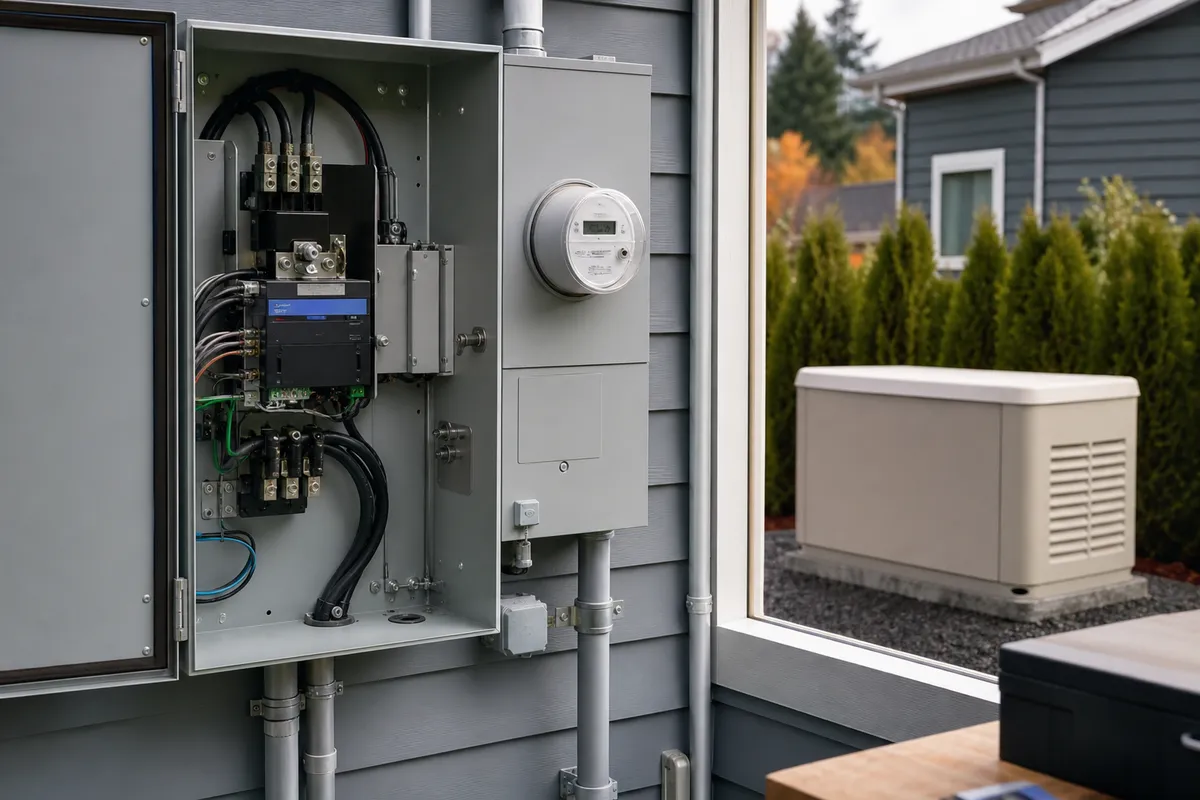
The power goes out on a Tuesday night during a windstorm off the Sound, and three houses down, the lights come back on in about twelve seconds flat. No one ran outside with a flashlight. No extension cords through a cracked window. That’s a whole-house standby generator doing its job, and I get asked about how that happens at least once a week on service calls.
I’ve been wiring these systems in King and Snohomish counties for years, and the same questions come up every time: how does it know the power is out, is it actually safe to run without me flipping a switch, and what does one of these things cost installed. Let’s go through it the way I’d explain it standing in your driveway.
TL;DR
- A standby generator runs on natural gas or propane and starts automatically within 10-30 seconds of a utility outage, using a device called an automatic transfer switch (ATS).
- The ATS is the real hero here — it disconnects your house from PSE or Snohomish PUD power before connecting the generator, which prevents backfeeding the grid.
- NEC Article 702 and Washington L&I electrical rules require this isolation; a manual switch or improper interlock is a code violation and a real safety hazard for utility linemen.
- Most whole-house installs in the greater Seattle area run $9,000 to $16,000 depending on generator size, panel condition, and gas line work.
- An old or undersized electrical panel is the number one reason quotes come in higher than homeowners expect.
How does the generator know the power went out?
The transfer switch monitors incoming utility voltage continuously. When it drops below a threshold, usually around 90 percent of nominal voltage for a set number of seconds (this avoids false starts from a brief blink), the switch sends a signal to the generator’s engine control module. The engine cranks, runs through a warm-up cycle, and once it hits stable voltage and frequency, the ATS disconnects your house from the utility line and connects it to the generator. Total time from outage to lights back on is usually 10 to 30 seconds, depending on the unit.
When utility power comes back, the switch senses stable voltage from PSE or Snohomish PUD, waits a cooldown period, then switches back and lets the generator cool down before shutting off. You never touch anything.
“After every big windstorm, the generator calls come in waves, and the households that ride it out calmly are the ones that did the load math before the outage. Decide what must run — heat, fridge, well pump, medical gear — and size to that. The transfer-switch conversation is where the real planning happens.”
— Alina Kovalenko, Service Coordinator & Comfort Advisor at SPS Pro Services
Why can’t I just wire it to switch on manually?
I get this question a lot, usually from homeowners who had a contractor buddy suggest a simpler setup. Here’s the problem. If your house is connected to both the utility grid and a generator at the same time, even briefly, you’re backfeeding power onto the grid. That’s dangerous for line workers who assume a de-energized line is safe, and it’s flatly against NEC 702.6, which requires that a transfer switch prevent interconnection of separate power sources. Washington L&I inspectors check for this specifically during permit inspections, and it’s one of the most common reasons a DIY generator install fails inspection.
An interlock kit on your main panel can be code-compliant if installed correctly, but for a true whole-house system that covers your furnace, water heater, and major circuits without you doing anything, an automatic transfer switch is the standard and the safest route.
Does my panel need to be upgraded first?
Sometimes. A lot of homes in Seattle, Bellevue, and Everett still have 100-amp panels, especially houses built before the late 1980s. If you’re running a heat pump, an EV charger, and want a generator that covers the whole house, that 100-amp panel is often maxed out on paper before you add anything new.
I’ve walked into plenty of jobs in older Seattle neighborhoods where the panel was original to a 1962 build, still running fuses instead of breakers in some sections. In cases like that, we don’t stop at adding a transfer switch — we do an electrical panel upgrade first so the whole system has room to breathe and meets current code. Skipping this step is how homeowners end up with a generator that trips breakers under load instead of running the whole house.
What size generator do I actually need?
This depends on what you want backed up. A partial system covering your furnace, heat pump, well pump if you have one, refrigerator, and some outlets and lighting circuits can run on a 14kW to 20kW unit. A true whole-house setup that includes central AC, an electric water heater, and an EV charger usually needs 22kW to 26kW or larger.
I always do a load calculation before quoting size, not a guess. Undersizing means the generator shuts down under load when your AC compressor and water heater kick on at the same time. Oversizing wastes money on fuel and equipment you don’t need.
What does this cost in the Seattle area?
Here’s a realistic breakdown based on typical jobs I’ve priced in King and Snohomish counties over the past couple years.
| Component | Typical Range (Installed) |
|---|---|
| 14-20kW generator, ATS, basic gas line run | $9,000 - $12,000 |
| 22-26kW generator, ATS, longer gas line or trenching | $13,000 - $16,000 |
| Electrical panel upgrade (if needed, 100A to 200A) | $2,800 - $4,500 |
| Annual maintenance (oil, filters, battery, load test) | $250 - $400 |
These are estimates, and actual pricing depends on your specific site conditions, gas meter capacity, and how far the generator sits from your panel and gas line. Homes on propane instead of natural gas may need a larger tank sized to the generator’s burn rate.
Common myths I hear on service calls
“My generator will run forever on one tank.” Not on propane systems. A 20kW unit at half load burns close to 2 gallons of propane per hour, so a standard 500-gallon tank gets you a few days, not weeks, especially if it’s already partially full for other appliances.
“Any electrician can hook this up.” Technically, sure, but NEC 700 and 702 requirements plus Washington L&I permit rules mean this needs someone who pulls electrical permits regularly and understands utility interconnection rules on top of residential wiring.
“I don’t need one, my furnace runs on gas anyway.” True, but your furnace’s blower motor, ignition control board, and thermostat all need electricity. Without power, a gas furnace doesn’t run either. If you’ve ever had a furnace repair call during a winter outage, you know the furnace itself wasn’t the problem, the power was.
Practical checklist before you call for a quote
- Know your panel size (check the main breaker, usually stamped 100A, 150A, or 200A)
- Note if the house runs on natural gas or propane, and where your meter sits
- List what you want backed up: whole house, or just critical circuits like heat, fridge, and water heater
- Check if you’re planning an EV charger, heat pump, or other major electrical addition soon, since that affects sizing
- Have your address ready so we can check if you’re in PSE or Snohomish PUD territory, since that affects utility coordination for the interconnection
A few honest field notes
I’ve been out to homes in Seattle after windstorms where the generator kicked on before the homeowner even noticed the lights had flickered. I’ve also seen installs from other companies where the transfer switch was wired wrong and backfed the panel, which the utility crew caught during outage repair and shut down on the spot. That’s not a small mistake. It’s a safety violation that can get someone hurt.
If your water heater is electric, don’t forget it draws real power under a generator load. I’ve had customers surprised their “whole house” backup didn’t include a properly sized water heater repair circuit because the original installer estimated low on capacity. Same goes for AC in the summer heat we’ve been getting more of lately. If your system needs an AC repair call every August because it’s already stressed, don’t expect a small generator to run it well either.
Mini-FAQ
Do I need a permit for a whole-house generator in Washington State? Yes. Both the electrical work and the gas line connection require permits, and L&I or your local jurisdiction will inspect the transfer switch installation before final sign-off.
How often does a standby generator need maintenance? Most manufacturers recommend an oil and filter change every 100 hours of run time or annually, plus a battery check and a monthly self-test cycle, which the unit usually runs automatically.
Can a generator run my EV charger and the rest of the house at the same time? Depends on generator size and your charger’s amperage. A 22kW or larger unit can usually handle a Level 2 charger alongside normal household loads, but we size this specifically rather than assume.
If you’re in the Seattle, Bellevue, or Everett area and want an honest load calculation and quote, call SPS Pro Services at (206) 427-8907.