
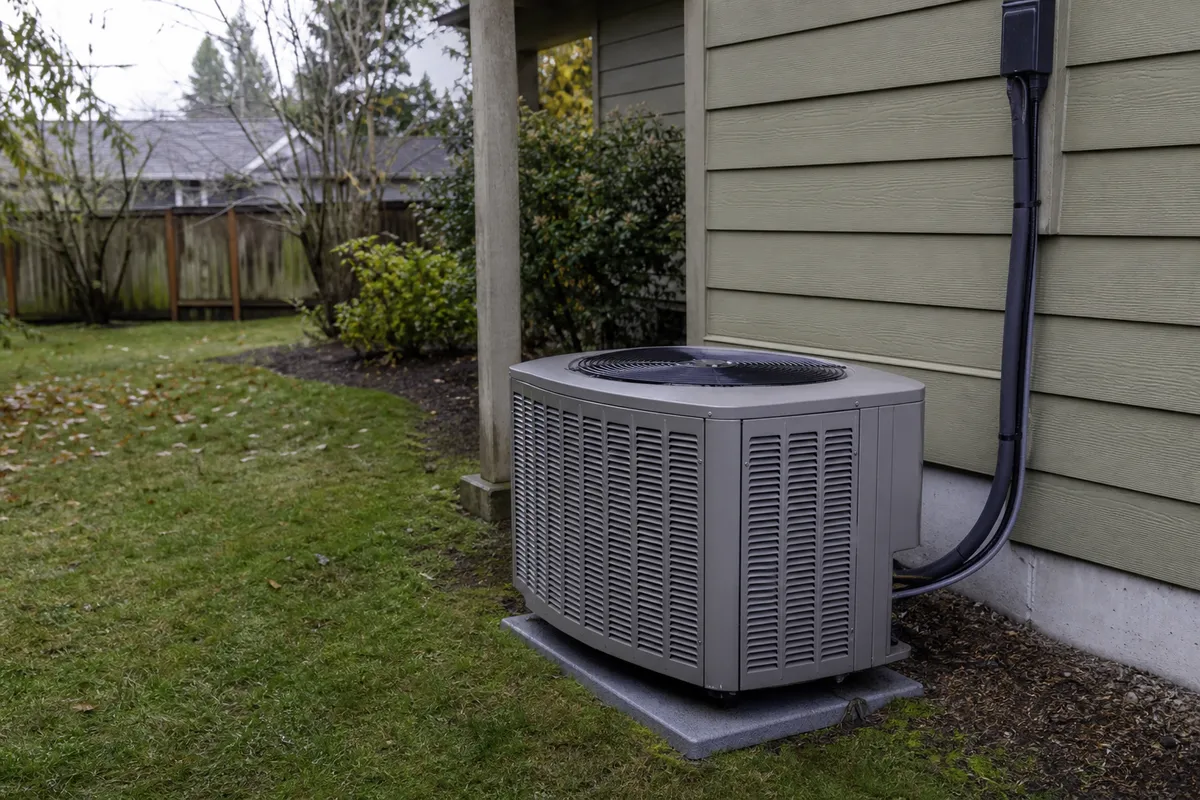
I get this question at least once a week, usually from a homeowner in Bellevue or Everett who just bought a house with ductwork but no idea what’s actually running the cold air. Central AC looks like a mystery box on a concrete pad. It isn’t. It’s four steps repeating over and over, and once you see the loop, you’ll never look at your outdoor unit the same way.
TL;DR
- Central AC moves heat out of your house using a refrigerant loop, not magic or “coldness” being pumped in.
- The same refrigeration cycle runs heat pumps, just with a valve that lets them reverse direction for winter heating.
- A properly sized system in a 1,800 square foot King County home typically cycles refrigerant through four stages: compression, condensation, expansion, evaporation.
- Straight AC only cools. A heat pump installation gives you cooling in July and heating in January from one outdoor unit.
- Most homes built before 1980 in Seattle and Everett have electrical panels too small for a heat pump plus other loads like an EV charger, so check that before you buy equipment.
- A tune-up or repair, not a full replacement, fixes most weak-cooling complaints I run into.
What’s Actually Inside a Central AC System
Every central AC has two main boxes and a set of copper lines connecting them.
- Outdoor unit (condenser): contains the compressor, a fan, and a coil. This is the noisy box on the pad or roof mount.
- Indoor coil (evaporator): sits inside your furnace cabinet or air handler, usually above the burner section on a gas furnace.
- Refrigerant lines: two copper pipes, one thick and insulated (suction line), one thin and bare (liquid line), running between the two.
- Ductwork: carries the now-cold air from the indoor coil to every room and pulls warm air back to start the loop again.
If your ducts are original to a 1960s rambler in Shoreline or Lynnwood, they’re often undersized for modern equipment. I’ve measured supply ducts sized for a 2-ton system trying to feed a 3.5-ton unit. That mismatch alone can cause 20 percent of the “my AC isn’t cooling” calls I take.
“Once homeowners understand the refrigerant loop, every symptom starts making sense to them: warm air means the loop can’t dump heat, ice means it can’t pick heat up. That mental model is worth more than any brand comparison — it’s how you know whether the fix is a $20 filter or a real repair.”
— Danil Sokolov, Heat Pump & Mini-Split Specialist at SPS Pro Services
The Refrigeration Cycle in Plain English
Forget the textbook diagrams for a second. Here’s what happens, in order, every 3 to 5 minutes your system runs a cycle.
- Compression. The compressor squeezes low-pressure refrigerant gas into a high-pressure, hot gas. This takes electricity, and it’s where most of your kWh usage happens.
- Condensation. That hot gas flows into the outdoor coil, where the fan blows outside air across it. Heat leaves the refrigerant, it turns from gas to liquid, and the outdoor unit exhausts that heat into your yard.
- Expansion. The now-liquid refrigerant passes through a metering device, a small brass valve or orifice, that drops its pressure fast. Pressure drop equals temperature drop. The liquid comes out the other side ice cold.
- Evaporation. That cold liquid hits the indoor coil. Your blower fan pushes warm house air across it, the liquid absorbs that heat and evaporates back into gas, and the now-cooled air goes out through your ducts. The refrigerant heads back to the compressor and the loop starts over.
That’s it. No coolant gets “used up” the way gas burns in a furnace. A sealed system should hold the same refrigerant charge for 15-plus years unless there’s a leak.
Central AC vs Heat Pump: What’s the Real Difference
This is where I earn my paycheck, because half my customers think these are different technologies. They’re the same machine with one extra part.
| Feature | Straight Central AC | Heat Pump |
|---|---|---|
| Cools in summer | Yes | Yes |
| Heats in winter | No, needs separate furnace | Yes, via reversing valve |
| Typical install cost range | Lower upfront | Higher upfront, offsets with fuel savings |
| Runs on | Electricity only | Electricity only |
| Backup heat source needed | N/A | Sometimes, for sub-25°F nights |
| Works with existing furnace ductwork | Yes | Yes |
| Rebates through PSE or SnoPUD | Limited | Frequently available |
If you’re already running a gas furnace and just want summer cooling, straight AC is the cheaper path. If your furnace is aging out or you’re tired of two utility bills, a heat pump installation does both jobs from one outdoor unit. I’ve swapped plenty of 20-year-old AC-plus-furnace combos in Seattle for a single heat pump and watched winter gas bills disappear entirely.
Why So Many Seattle-Area Homes Skip Central AC
King and Snohomish counties sit in a marine climate. Summer highs mostly stay in the 75 to 85°F range, so a lot of homes built before the 2000s never got central air, just a furnace and maybe a window unit for the two weeks in August that actually get hot. That’s changing. Since the 2021 heat dome pushed Seattle past 100°F, I’ve installed more cooling systems in the last four years than in the previous decade combined.
A few local realities that affect the decision:
- Utility territory matters. Most of Seattle and King County runs on Puget Sound Energy (PSE) electricity; much of Snohomish County is served by Snohomish County PUD, which typically runs a lower per-kWh rate. That difference changes your payback math on a heat pump versus gas furnace plus AC setup.
- Housing stock is older. A large share of homes in Seattle and Everett were built between 1940 and 1979, often with 60 to 100 amp electrical panels. Add a heat pump, an EV charger installation, and an electric water heater to one of those panels and you’ll trip breakers constantly.
- Attic and duct condition varies wildly. Homes in Bellevue built during the 1980s-90s boom often have better duct sizing than older Seattle bungalows, which matters more for cooling performance than brand of equipment.
Sizing Matters More Than Brand
I get asked “is Trane better than Carrier” constantly. Honest answer: at the residential tier, the compressors inside most major brands come from the same handful of manufacturers. What actually determines comfort and your electric bill is sizing.
An oversized system short-cycles, meaning it cools the air fast but shuts off before it pulls humidity out of the house. You get a cold, clammy living room. An undersized system runs constantly and still can’t hit the thermostat setpoint on a 90°F day. A proper Manual J load calculation, not a rule of thumb based on square footage, is the only way to get this right.
Checklist Before You Call for AC or a New System
- Note whether your existing panel is 100, 150, or 200 amp. If you’re also considering an electrical panel upgrade for EV charging or induction cooking, bundle that conversation with your HVAC quote.
- Check your furnace’s age. If it’s over 15 years old, replacing it alongside new AC or a heat pump often costs less combined than doing them separately later.
- Look at your ductwork for obvious damage, disconnected runs in the crawlspace, or crushed flex duct.
- Confirm your water heater isn’t next on the failure list. A water heater repair call often surfaces around the same time as an aging furnace, since both systems tend to hit end of life together in homes built the same era.
- Get your square footage, window count, and insulation level ready. That’s the core input for a proper load calculation.
- Ask any contractor for the Manual J numbers instead of a square-footage guess.
Mini-FAQ
Does central AC use a lot of electricity in Seattle? Less than you’d think for most of the year, because our cooling season is short. A 3-ton system running on peak August days typically draws 3 to 3.5 kW while cycling, but most homes only run it heavily for 20 to 30 days a year here compared to 100-plus days in places like Texas or Arizona.
Can I add central AC to my existing gas furnace? Almost always, yes. The furnace’s blower and ductwork usually work fine with an added evaporator coil and outdoor condenser. This is one of the more straightforward upgrades I quote, assuming your ducts are in decent shape.
My AC blows air but it’s not cold. What’s wrong? Most often it’s a dirty outdoor coil blocking airflow, a low refrigerant charge from a slow leak, or a failing capacitor on the compressor. All three are diagnosable in one visit through ac repair rather than a full replacement, and a furnace-side airflow problem can mimic the same symptoms, which is why I always check both when someone books a furnace repair call in the shoulder season.
Call SPS Pro Services at (206) 427-8907 and I’ll walk your system with you before we talk equipment, whether that ends in a simple repair or a full AC installation.