
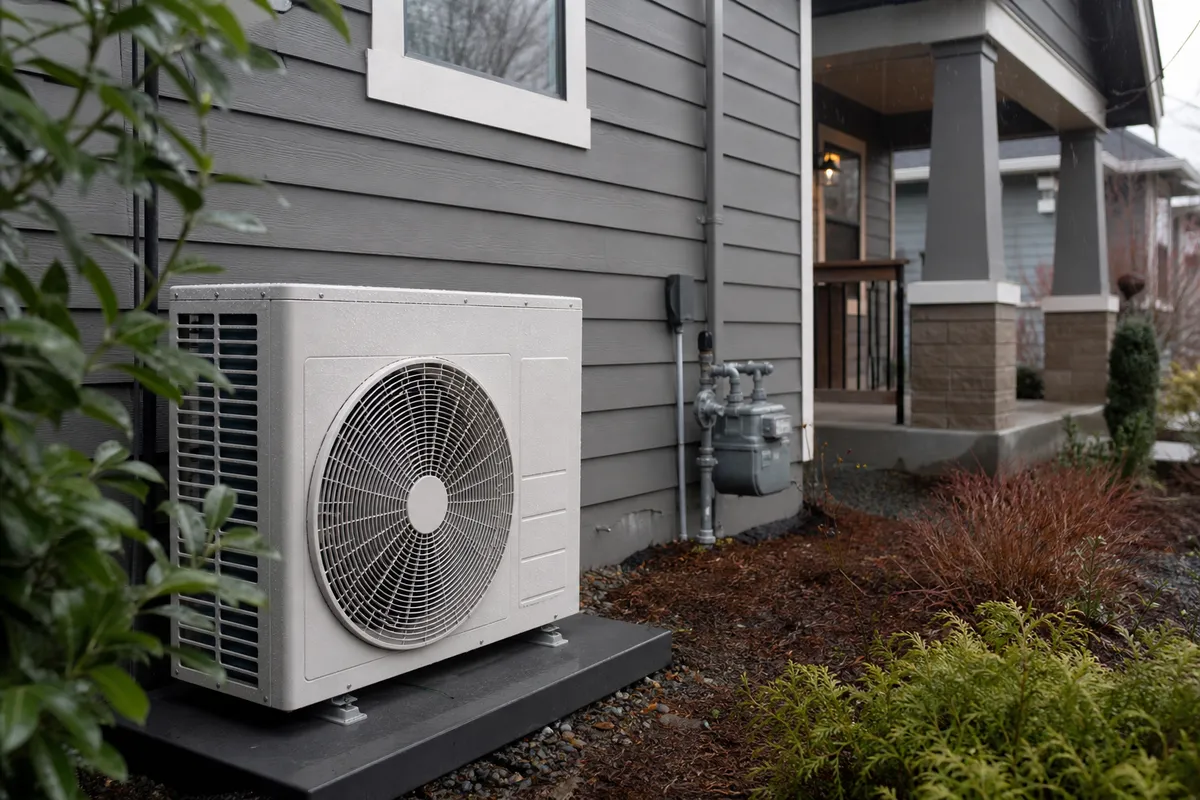
Every January I get the same call: someone’s 20-year-old gas furnace just died during a cold snap, and they want it replaced with “the same thing, but new.” Fair enough. But before you write that check, let’s talk numbers — because in 2026, the math around heat pumps versus furnaces in King and Snohomish counties has shifted more than most homeowners realize.
I’m not here to sell you a heat pump just because I install them. I’m here to run the kWh and therm math with you, the way I do for every SPS Pro Services customer, and let the numbers make the call.
TL;DR
- Seattle’s mild winters (rarely below 25°F) are close to ideal territory for modern cold-climate heat pumps.
- A heat pump also gives you air conditioning for the increasingly hot, smoky Augusts we’ve had since 2021 — a gas furnace never will.
- Furnaces still make sense in older, poorly insulated homes with undersized electrical panels, or as a backup paired with a heat pump (dual fuel).
- PSE electric rates and Snohomish PUD rates differ enough that your specific address changes the payback math.
- Most straightforward heat pump installs land in the $6,500–$14,000 range depending on ducted vs. ductless and home size; furnace-only replacements typically run $4,500–$8,500.
- If your panel is 100-amp or older, budget for an electrical panel upgrade before adding a heat pump or an EV charger.
Why This Question Is Different in 2026 Than It Was in 2018
When I started working on heat pumps here, cold-climate models still struggled below 20°F and homeowners had good reason to be skeptical. That’s largely gone now. Brands like Mitsubishi Hyper-Heat, Bosch, and Daikin now publish rated capacity down to -13°F to -22°F, and Seattle’s design temperature (the coldest it’s realistically going to get on a bad night) sits around 23-26°F depending on your exact location. Everett and parts of Snohomish County run a couple degrees colder in a hard freeze, but we’re still nowhere near the territory where a modern heat pump falls over.
Meanwhile, gas prices from Puget Sound Energy have climbed steadily, and electricity from PSE and Snohomish PUD — despite recent increases — remains some of the cleanest and most hydro-heavy power in the country. That combination is what tips the math for a lot of households.
“Seattle is close to the ideal climate for a heat pump: our winters are mild and damp, not brutal. The homes where I still recommend keeping a furnace are the ones with an existing newer gas unit and no cooling need — for everyone else, especially anyone replacing both heat and AC at once, the heat pump conversation is worth having.”
— Sergei Petrov, Founder & Lead HVAC Technician at SPS Pro Services
The Real Cost Comparison
Here’s what I’m actually seeing on invoices across Seattle, Bellevue, and Everett jobs this year. These are estimate ranges, not quotes — your home’s ductwork condition, square footage, and electrical service all move the number.
| Factor | Gas Furnace (replace like-for-like) | Heat Pump (ducted or ductless) |
|---|---|---|
| Typical install cost | $4,500 – $8,500 | $6,500 – $14,000 |
| Fuel source | Natural gas | Electricity |
| Provides cooling | No | Yes |
| Average lifespan | 15–20 years | 12–18 years |
| Winter efficiency in Seattle climate | 95-98% AFUE (gas) | 250-350% efficiency (COP 2.5-3.5) |
| Backup heat needed below ~20°F | No | Sometimes (electric resistance or dual fuel) |
| Panel upgrade often required | Rarely | Sometimes, especially on 100-amp service |
The efficiency line is the one people skip past too fast. A heat pump with a coefficient of performance of 3.0 turns 1 kWh of electricity into the equivalent of 3 kWh of heat. A furnace, even a good one, is capped below 1.0 because it’s burning fuel, not moving heat. That’s the entire argument in one sentence.
When a Furnace Still Wins
I’ll talk myself out of a sale if the house calls for it. A straight furnace replacement, or a furnace repair instead of full replacement, still makes sense when:
- Your electrical panel is old (60-100 amp) and upgrading it would eat the entire budget for the heating project itself.
- You’re in a rental or investment property with a short hold timeline and the furnace has years of life left — in that case a furnace repair is the smarter near-term move.
- Your home has ductwork in genuinely bad shape and a full HVAC redesign isn’t in the budget this year.
- You already have solar offsetting electric bills but a fixed-rate gas contract that makes gas artificially cheap for your situation.
If your furnace just went out and cooling isn’t a priority, a same-system swap keeps costs predictable. But it’s worth at least getting a heat pump quote alongside the furnace quote before you decide — I do both on most visits now because the price gap has narrowed.
When a Heat Pump Wins
For most single-family homes in Seattle, Bellevue, and Shoreline built between the 1950s and 1990s with reasonable attic insulation, a heat pump installation pencils out within 7-12 years through fuel savings alone, before you count the free air conditioning. That last part matters more every summer — 2021’s heat dome and the smoke seasons since have made cooling a real need here, not a luxury.
Heat pumps also make sense if:
- You’re already planning an EV charger installation and rethinking your electrical panel upgrade anyway — bundling projects saves a service call and sometimes a permit fee.
- Your ducts are in good shape and sized correctly, which keeps ducted heat pump costs closer to the furnace-replacement end of the range.
- You want to get off gas appliances gradually — pairing a heat pump with a future heat pump water heater is a common two-year plan I help households build.
- You’re in Everett or elsewhere in Snohomish PUD territory, where electric rates have historically run a bit lower than PSE, which shortens the payback period further.
A Quick Checklist Before You Decide
- Pull your last 12 months of gas and electric bills — actual therms and kWh, not simply dollar totals.
- Get your panel size checked (100-amp vs. 200-amp) before assuming a heat pump is a simple swap. 2b. If a panel upgrade is likely, price it alongside the heat pump, not after — combined labor is usually cheaper.
- Have your ductwork inspected for leaks or undersizing if you’re going ducted.
- Ask any contractor for the specific cold-climate model number and its rated capacity at 5°F and 17°F, not only “it works in cold weather.”
- Decide if you want cooling this year or if you’re comfortable waiting — that alone can shift the recommendation.
- If your water heater or AC unit is also aging, ask about bundling replacement timing to save on future service calls.
Mini-FAQ
Will a heat pump actually keep my house warm during a Seattle cold snap? Yes, if it’s sized and specified correctly. Cold-climate heat pumps rated for our region maintain full or near-full capacity down into the single digits, well below anything Seattle typically sees. The failures I get called for are almost always undersized units or old non-cold-climate models, not the technology itself.
Do I need a bigger electrical panel for a heat pump? Sometimes. Homes with 100-amp service and an electric range, EV charger, or electric water heater already on the panel often need an upgrade. Homes with 200-amp service usually have room. We check panel capacity as part of every heat pump installation quote.
Is it cheaper to repair my furnace or replace it with a heat pump right now? Depends on the furnace’s age and the repair cost. If a furnace repair is under $600-$800 and the unit is under 12 years old, repair usually wins short-term. Past 15 years old, or facing a heat exchanger replacement, it’s worth comparing that repair quote against a heat pump installation quote side by side.
If you want the actual numbers run for your specific house in Seattle, Bellevue, or Everett, call SPS Pro Services at (206) 427-8907 and we’ll walk through your bills and your panel before you spend a dollar.