
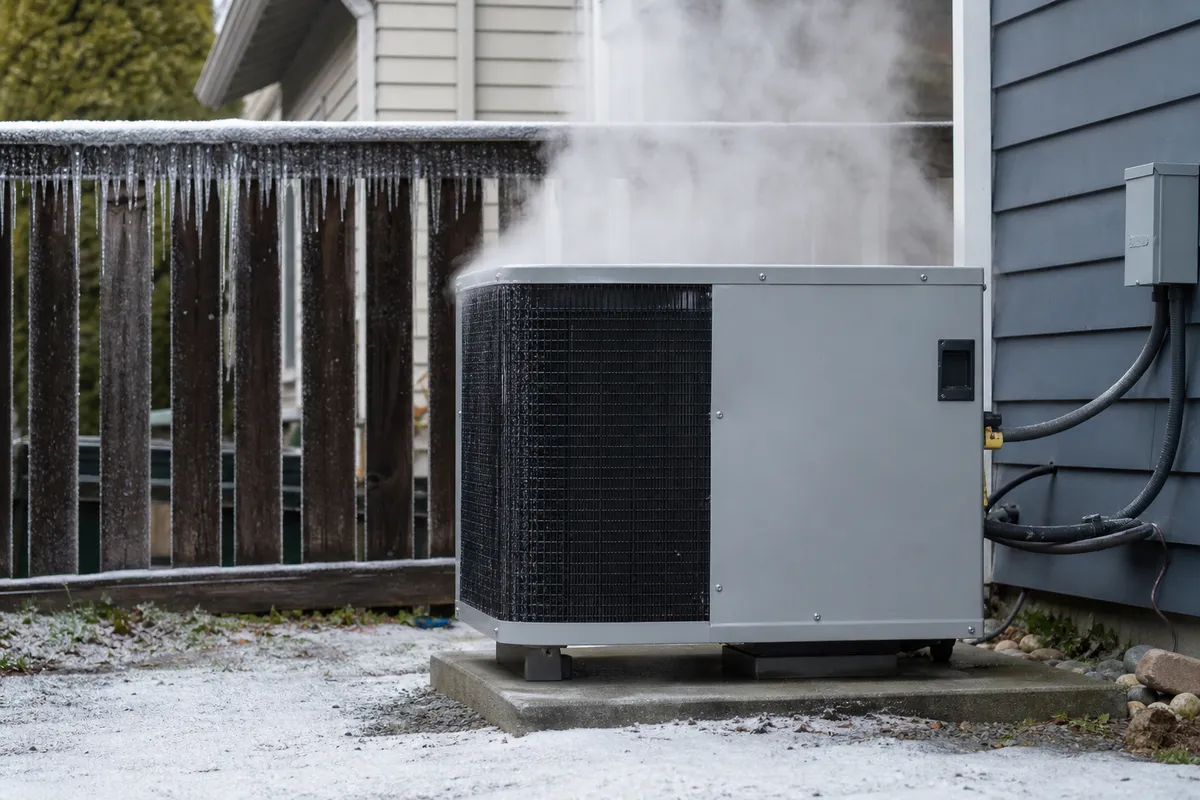
Your heat pump was fine all fall, and then a cold front rolls through — 28°F overnight in Everett, maybe 32°F in Seattle — and suddenly the air coming out of the vents feels lukewarm at best. You bump the thermostat, nothing changes, and you start wondering if you bought the wrong equipment. I get this call constantly between November and February, and nine times out of ten it’s not a broken heat pump. It’s a heat pump doing exactly what it’s designed to do, just misunderstood or mismatched to the house.
I’ve been running service calls on Trane, Mitsubishi, Daikin, and Bosch systems across King and Snohomish counties for years now, and cold-weather “it’s not heating” complaints follow a predictable pattern. Let’s go through the real causes, in order of how often I actually find them.
TL;DR
- Lukewarm air during defrost cycles is normal — the system pauses heating for 5-15 minutes to melt frost off the outdoor coil.
- Below 25-30°F, most heat pumps lose 30-50% of their rated capacity, which is why backup heat matters.
- Auxiliary/emergency heat not kicking in is the single most common real fault I find on cold-snap calls.
- Dirty outdoor coils, low refrigerant, and undersized systems all show up worse in cold weather, not better.
- If indoor temps drop more than 3-4°F below setpoint for hours, call a tech — don’t wait it out.
Is Lukewarm Air Actually Normal?
Yes, sometimes. Heat pumps don’t blow 130°F air like a gas furnace. Even working perfectly, supply air typically runs 90-105°F, which feels cool against your hand compared to a furnace but is still heating the room. If you’re testing by holding your palm at the vent, that’s not a reliable test below freezing outside temps.
The bigger normal-but-alarming event is the defrost cycle. When outdoor temps hover near freezing with humidity — very common in a Seattle winter — frost builds up on the outdoor coil. The system automatically reverses into cooling mode for a few minutes to melt it off, and during that time the indoor coil can actually blow cool or barely-warm air, sometimes with a puff of steam from the outdoor unit that looks like smoke. This happens every 30-90 minutes in bad conditions and each cycle runs 5-15 minutes. If your air goes cool for ten minutes then comes back warm, that’s the machine working, not failing.
“Half the ‘heat pump quit in the cold’ calls we get turn out to be a unit doing exactly what it should: defrost cycles look like failure to people who were never told about them. Steam off the outdoor unit and a few minutes of cool air inside is normal. Ice that never clears, or a system running nonstop without warming the house — that’s the real service call.”
— Sergei Petrov, Founder & Lead HVAC Technician at SPS Pro Services
Why Heat Pumps Struggle Below 30°F
This is physics, not a defect. A heat pump moves heat from outdoor air into your house using refrigerant, and the colder the outdoor air, the less heat energy there is to extract and the harder the compressor has to work to move it. Manufacturer spec sheets show this directly — a heat pump rated at 36,000 BTU/h at 47°F might only deliver 20,000-24,000 BTU/h at 17°F. That’s a 30-40% capacity loss, and it’s completely standard.
This is exactly why every properly designed heat pump system in our climate has backup heat — usually electric resistance strips, sometimes a paired gas furnace in a dual-fuel setup. When outdoor temps drop past your system’s “balance point” (often somewhere between 25-35°F depending on the equipment), the backup heat is supposed to kick in automatically to cover the gap. If it doesn’t, that’s when you get cold rooms and a thermostat that seems to be lying to you.
The Most Common Real Faults I Find
- Auxiliary heat not engaging. A stuck contactor, a tripped breaker on the strip heat circuit, or a bad thermostat setting can leave you running on compressor-only heat during a cold snap. This is the fault I find most often on emergency calls.
- Dirty or blocked outdoor coil. Leaves, cottonwood fluff, or ice buildup restrict airflow across the coil, which cripples heat transfer exactly when you need it most.
- Low refrigerant charge. Even a small leak reduces capacity noticeably at low temps, though it might have been barely noticeable in October.
- Failing defrost sensor or control board. If the system gets stuck in defrost mode or never triggers it, ice builds up on the coil and heating output drops steadily over hours.
- Undersized system for the house. If your load calculation was off, or someone installed a system sized for a smaller home, cold weather is when it shows. This is the one I see most in older homes in Bellevue and north Seattle that added square footage without redoing the HVAC sizing.
- Thermostat set to “Heat” instead of “Auto” backup mode, or emergency heat locked out by mistake after a schedule change.
- Clogged air filter restricting indoor airflow, which can trip limit switches or just starve the system of the air volume it needs to distribute heat evenly.
Quick Checklist Before You Call
- Check your thermostat display for an “aux heat” or “emergency heat” indicator — is it lit when it should be?
- Look at the outdoor unit. Is it caked in ice, snow, or debris? Clear leaves and branches away from the coil.
- Check your electrical panel for a tripped breaker feeding the strip heat or the outdoor unit.
- Pull the air filter and hold it up to a light. If you can’t see light through it, replace it.
- Listen for the outdoor unit running. Silence with the thermostat calling for heat suggests a control or power issue, not a capacity issue.
- Time how long “cool air” lasts. Under 15 minutes with warm air returning after — likely defrost cycle, normal. Longer than 20-30 minutes — worth a call.
- Note the outdoor temperature when the problem started. Below 25°F with no aux heat engaging is a strong sign of a backup heat fault.
What Capacity Loss Looks Like in Real Numbers
| Outdoor Temp | Typical Capacity vs. Rated (47°F) | What You’ll Notice |
|---|---|---|
| 47°F | 100% | Full output, quiet operation |
| 35°F | 75-85% | Slightly longer run times |
| 25°F | 55-65% | Aux heat likely engaging on cold mornings |
| 10°F | 40-50% | Aux heat running frequently, higher electric bill |
| 0°F and below | 30-40% or less | Most systems rely heavily on backup heat |
Seattle and Bellevue rarely see single digits, but Everett and inland Snohomish County spots can dip into the teens a few nights a year, and that’s when backup heat electric costs spike. PSE customers running strip heat during a cold week can see a noticeable jump on the next bill — I’ve had customers report an extra $60-120 for a single hard cold week, depending on house size and insulation. Snohomish PUD rates run a bit lower per kWh, so the hit is smaller there, but it’s still real money.
When It’s Time to Call a Pro
If your house is losing ground — temps dropping steadily below setpoint for more than an hour or two with no recovery — don’t wait for a “warm spell” to fix itself. Refrigerant leaks get worse, not better, and a stuck defrost cycle can ice over an entire coil overnight, sometimes damaging the fan motor. If your home also has an older furnace as backup, this is a good time to have that checked too — worn dual-fuel systems often reveal problems in whichever component is weaker. If you’re not sure which side is failing, a technician can diagnose both in one visit; we handle furnace repair and heat pump repair on the same call routinely.
If this is your second or third cold-weather callout in as many winters, it might be time to talk about whether your system is sized correctly or due for replacement. We quote heat pump installation across Seattle, Bellevue, and Everett, and a proper load calculation up front avoids exactly this kind of cold-snap shortfall.
Cold Weather Stresses More Than Your Heat Pump
Worth mentioning while we’re on the topic of winter strain: a lot of homes running electric backup heat, an EV charger, and an aging electric panel all at once hit capacity limits on the coldest nights. If your breakers are tripping or your panel is older than 20 years, an electrical panel upgrade is often the real fix, not another HVAC part. And if you’re planning an EV charger installation alongside a heat pump, get the panel capacity checked first — I’ve seen more than one Bellevue homeowner max out their service before either system was even fully loaded.
Mini-FAQ
Q: My heat pump blows cold air for a few minutes every hour — is something broken? A: Probably not. That’s likely a defrost cycle, which is normal in cold, damp Pacific Northwest weather. If it lasts over 20 minutes or happens every 10-15 minutes, have it checked.
Q: Should I switch to emergency heat manually during a cold snap? A: Only if your aux heat isn’t engaging automatically and you need heat immediately. Emergency heat mode runs backup strips continuously and skips the compressor, which costs more per hour — use it as a stopgap, not a long-term setting.
Q: Does a bigger heat pump fix the cold-weather problem? A: Sometimes, but oversizing brings its own issues, like short cycling and poor humidity control in summer. A proper load calculation for your specific house matters more than just buying bigger capacity.
If your heat pump is falling behind this winter, call SPS Pro Services at (206) 427-8907 and we’ll get a tech out to diagnose it before the next cold front hits.