
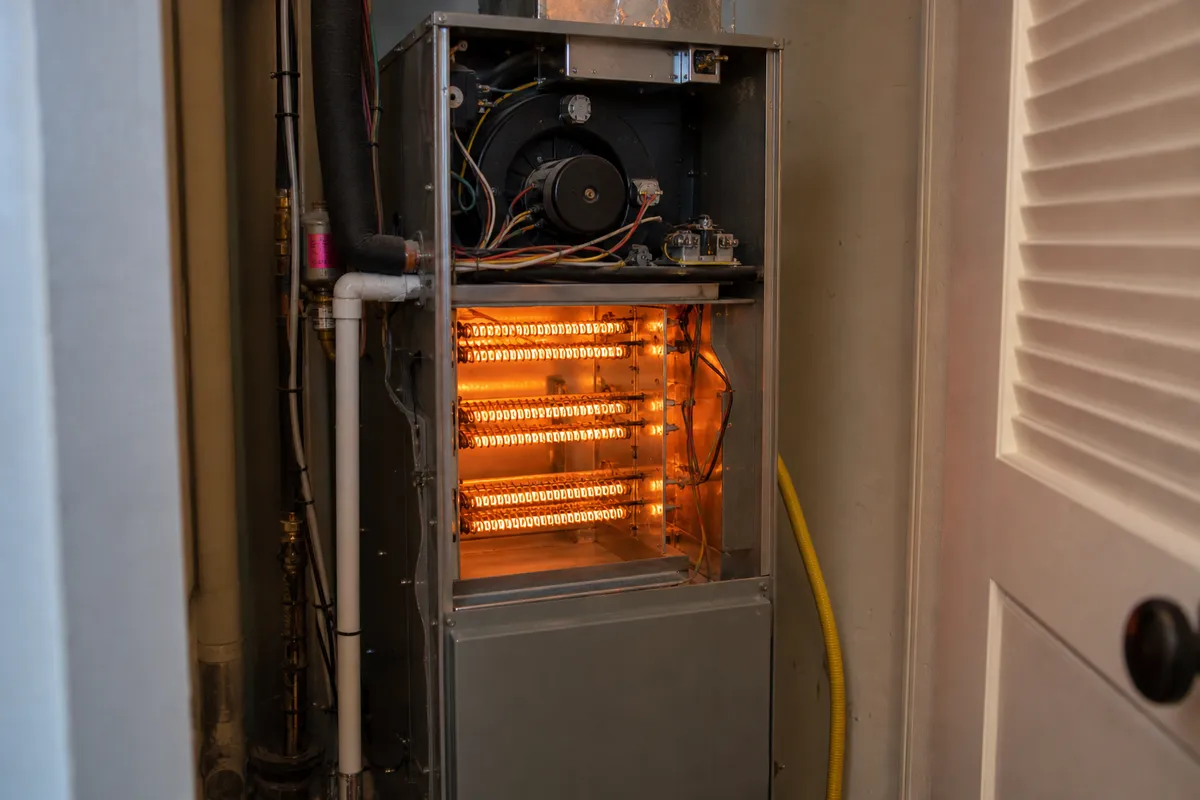
Every January I get the same call. Somebody in Lynnwood or Shoreline looks at their PSE bill, sees it jumped from $140 to $310, and asks if their heat pump is broken. Nine times out of ten it isn’t broken. It’s running on auxiliary heat, and nobody explained what that switch actually does or what it costs per hour. Let’s fix that.
TL;DR
- Auxiliary heat is a backup electric resistance element (or your furnace) that kicks in when the heat pump alone can’t keep up with the thermostat setpoint.
- Emergency heat is a manual override you flip when the outdoor unit itself has failed and you need heat from the backup source only.
- Auxiliary heat can cost 3 to 5 times more per hour to run than the compressor alone, because resistance heat strips draw straight amps with no multiplication effect.
- A properly sized heat pump in King and Snohomish counties should rarely need aux heat below 25°F, and almost never needs it above 35°F.
- If your system uses aux heat constantly even in mild weather, that’s a sizing, refrigerant charge, or thermostat setting problem, not normal operation.
What Auxiliary Heat Actually Is
A heat pump moves heat from outside air into your house. It’s efficient because it’s transferring existing heat, not manufacturing it. But as outdoor temperatures drop, the amount of usable heat in the air drops too, and the compressor has to work harder to extract less of it. At some point, the heat pump can’t produce enough BTUs to match your thermostat’s demand, especially during a fast temperature recovery like after you’ve had the setback at 62°F overnight.
That’s when auxiliary heat steps in. In most Seattle-area installs I do, it’s one of two things:
- Electric resistance heat strips built into the air handler
- An existing gas furnace paired with the heat pump in a dual-fuel setup
Either way, the system’s control board decides automatically, based on outdoor temperature and how far you are from setpoint, when to bring in the backup. You don’t touch anything. It just happens.
“Auxiliary heat is the most expensive button in the house when it runs unnoticed. We see winter bills double because a thermostat was quietly calling for strips every morning. If your thermostat shows ‘aux’ more than a few minutes at a time in our climate, something is set up or sized wrong — that’s a diagnostic visit that pays for itself.”
— Sergei Petrov, Founder & Lead HVAC Technician at SPS Pro Services
Emergency Heat Is Different — and Manual
Emergency heat is the setting on your thermostat, usually a switch or menu option labeled “EM HEAT” or “Emergency Heat,” that you flip yourself. It shuts the outdoor compressor off entirely and runs only the backup heat source. You’d use this if:
- The outdoor unit is frozen solid and not defrosting properly
- You’re waiting on a repair visit and the compressor is dead
- There’s a refrigerant leak and you don’t want the compressor cycling until it’s fixed
I tell customers: emergency heat is a “get me through the night” setting, not a long-term plan. Running resistance strips as your only heat source for days will show up on your PSE or Snohomish County PUD bill in a way you won’t like. If your outdoor unit needs attention, that’s a heat pump repair visit, not something to leave on emergency heat indefinitely. If the issue turns out to be furnace-side in a dual-fuel setup, our furnace repair team handles that side of it directly.
Why Aux Heat Is So Expensive Per Hour
This is the part nobody explains at the point of sale. A heat pump compressor might use 2 to 4 kW to move 3 to 4 times that much heat energy into your home. That’s the whole appeal, a coefficient of performance above 3.0 in mild weather.
Electric resistance strips have a coefficient of performance of exactly 1.0. One kW in, one kW worth of heat out. No multiplication. A typical 10 kW strip heater running for one hour uses 10 kWh. At PSE’s residential rate (roughly 12 to 13 cents per kWh as of last winter, plus delivery charges that push the effective rate closer to 15 to 16 cents), that’s about $1.50 to $1.60 an hour just for the strips, on top of whatever the compressor itself is drawing.
Compare that to compressor-only operation at 2.5 kW, roughly $0.38 to $0.40 an hour. Run aux heat for 6 hours during a cold snap and you’ve spent as much as the compressor would spend running alone for a day and a half.
Real Numbers: Compressor-Only vs. Auxiliary Heat
| Scenario | Approx. Draw | Cost per Hour (PSE ~$0.15/kWh) | Cost per Hour (SnoPUD ~$0.11/kWh) |
|---|---|---|---|
| Compressor only, mild weather (40°F+) | 2.0–2.5 kW | $0.30–$0.38 | $0.22–$0.28 |
| Compressor only, cold weather (25–35°F) | 3.0–3.5 kW | $0.45–$0.53 | $0.33–$0.39 |
| Aux heat strips engaged (10 kW) | 10 kW | $1.50 | $1.10 |
| Aux heat strips engaged (15 kW, larger home) | 15 kW | $2.25 | $1.65 |
| Emergency heat only, whole night (8 hrs, 10 kW) | 10 kW | $12.00 | $8.80 |
Snohomish PUD customers in Everett and north Snohomish County generally see lower per-kWh rates than PSE customers in Seattle and south Snohomish County, since PUD is a public utility with different rate structures. That gap matters more than people think once aux heat is involved, because you’re multiplying a bigger number.
When Aux Heat Kicking In Is Actually Normal
I don’t want anyone thinking aux heat is a design flaw. It’s a safety net, and in our climate it’s supposed to fire occasionally. Normal situations include:
- Outdoor temps below 30°F combined with a thermostat setback recovery (say, warming the house 6 degrees quickly)
- Defrost cycles in freezing, humid weather, common near Everett and lowland areas close to Puget Sound
- Extreme cold snaps, the kind that hit King County maybe 3 to 5 nights a year
What’s not normal is aux heat running every single day, all winter, even when it’s 45°F outside. That tells me one of three things: the heat pump is undersized for the house, the refrigerant charge is off, or the thermostat’s balance point setting is configured wrong. I’ve walked into homes in Bellevue where a previous installer set the aux lockout temperature at 50°F instead of 35°F, meaning the system called for backup heat constantly even on days when the compressor alone could’ve handled it fine. That’s an easy fix once someone catches it.
Checklist: Is Your Aux Heat Behaving Normally?
- Check your thermostat history or app. If “aux heat” or “emergency heat” is showing up on days above 40°F, that’s worth a service call.
- Note your setback habits. Big overnight setbacks (8+ degrees) force aux heat to work harder during morning recovery. Smaller setbacks (2 to 3 degrees) reduce aux use significantly.
- Compare your winter electric bill to last year’s. A jump of more than 25 to 30 percent during similar weather usually points to aux heat overuse.
- Ask your installer what the aux heat lockout temperature is set to. For most homes in Seattle and the greater lowland area, 30 to 35°F is appropriate.
- If you have a dual-fuel system, confirm the changeover point between heat pump and furnace makes economic sense given current gas and electric rates.
What This Means If You’re Shopping for a New System
If you’re comparing a new heat pump installation, ask the contractor directly what backup heat source they’re proposing and at what temperature it engages. A properly sized cold-climate heat pump, and there are good ones out there from Bosch, Mitsubishi, and Daikin, can carry most of the heating load down into the low 20s before needing meaningful aux support. That’s a very different bill than a builder-grade unit that starts leaning on strip heat at 40°F.
Also worth checking: if your electrical panel is older or already near capacity, adding heat strips, an EV charger, and a heat pump water heater can push you past your panel’s limit. I’ve had to pair more than one heat pump job with an electrical panel upgrade just to make room for everything safely, especially in homes also planning for an EV charger installation down the road.
Mini-FAQ
Does running emergency heat overnight damage my system? No, it won’t damage anything, but it’s expensive per hour and doesn’t fix the underlying compressor issue. Get the outdoor unit diagnosed as soon as possible.
Can I just set my thermostat to “emergency heat” all winter to save my compressor? You can, but you’ll likely triple or quadruple your heating costs for no real benefit. Emergency heat is a backup mode, not a money-saving setting.
My AC and heat pump are the same outdoor unit. Does aux heat affect summer cooling? No, aux heat only relates to heating mode. If you’re having cooling issues in summer, that’s a separate diagnosis, similar to what our AC repair technicians handle, and unrelated to how the aux heat strips perform in winter.
If your aux heat is running more than it should, or you want a straight answer on what a cold-climate heat pump would actually cost you to run in your specific house, call SPS Pro Services at (206) 427-8907.