
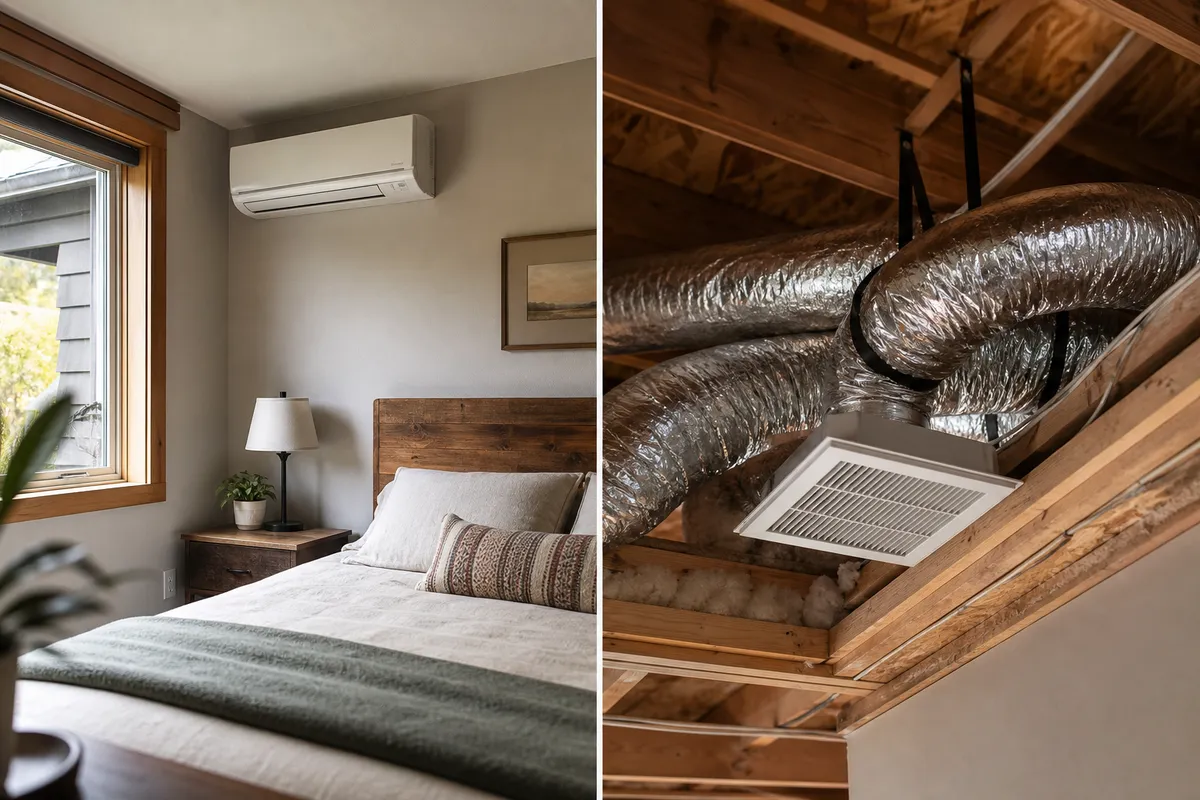
I get this question on almost every estimate: “Danil, should I go ductless or stick with ducts?” There’s no single right answer, but there is a right answer for your house, your ductwork, and your electric bill. Let’s break it down like I would standing in your basement with a flashlight.
TL;DR
- Ductless mini-splits cost less to install, hit higher efficiency numbers (SEER2 20+), and work best in homes with no ducts or leaky, undersized ducts.
- Ducted heat pumps cost more upfront but heat and cool the whole house evenly through existing supply and return runs — good if your ducts are sealed and sized right.
- Most Seattle-area ductless installs run $4,500–$9,000 per zone; whole-home ducted systems run $9,000–$16,000+ depending on tonnage and ductwork condition.
- Both cut heating costs versus resistance electric or old gas furnaces, but real savings depend on your PSE or Snohomish County PUD rate and how tight your envelope is.
- If your panel is under 100 amps, budget for an electrical panel upgrade before either system goes in.
What’s the Real Difference Between Ductless and Ducted Systems?
A ducted heat pump swaps in for your furnace and central AC. It uses your existing metal or flex ductwork to push heated or cooled air through every room. One outdoor unit, one indoor air handler, same vents you already have.
A ductless mini-split skips ducts entirely. One outdoor condenser connects to one or more wall-mounted, ceiling, or floor-console indoor heads through a small refrigerant line set (about 3 inches in diameter through the wall). Each indoor head is its own zone with its own thermostat.
The efficiency gap is real. A good ducted heat pump lands around 15-18 SEER2 and 9-10 HSPF2. A quality mini-split like a Mitsubishi Hyper Heat or Fujitsu Halcyon routinely tests at 20-33 SEER2 and 11-14 HSPF2. Why the gap? Duct losses. Even well-sealed ducts leak 10-20% of conditioned air into attics and crawlspaces. Ductless has zero duct loss because there’s no duct.
“The house usually makes this decision for you. Good existing ductwork tips the math toward a ducted system; no ducts or a 1940s gravity-furnace layout tips it hard toward ductless heads. What I push back on is tearing out working ducts to go ductless for looks — that money belongs in insulation.”
— Sergei Petrov, Founder & Lead HVAC Technician at SPS Pro Services
How Much Does Each Option Cost in the Seattle Area?
Here’s what I’m actually quoting on jobs from Shoreline to Kent this year. These are estimate ranges, not fixed prices — every house is different once I get in the crawlspace.
| System Type | Typical Install Cost | Best For | Efficiency Range |
|---|---|---|---|
| Single-zone ductless mini-split | $4,500 – $6,500 | One room, ADU, garage office | 20-30+ SEER2 |
| Multi-zone ductless (3-4 heads) | $12,000 – $18,000 | No-duct homes, additions | 18-25 SEER2 |
| Ducted heat pump (2.5-3 ton) | $9,000 – $13,500 | Homes with good existing ducts | 15-18 SEER2 |
| Ducted heat pump + duct sealing/repair | $13,000 – $17,000+ | Older homes with leaky ducts | 15-18 SEER2 (real-world higher after sealing) |
Add $1,500-$3,000 if your electrical panel needs upgrading to handle the new circuit — common in Everett and older Seattle homes still running 60-100 amp service from the 1970s or earlier.
Which Homes Fit Ductless Mini-Splits Best?
I install a lot of ductless in three situations:
-
No ductwork at all. Older Craftsman and Tudor homes in Seattle’s Wallingford, Ballard, and Green Lake neighborhoods often heated with a single oil furnace or wall gravity heater — no ducts to speak of. Running new ductwork through plaster and lath is expensive and invasive. A 2-3 zone mini-split solves heating and cooling without opening walls.
-
Additions and ADUs. You built a backyard studio or finished a bonus room over the garage, and it’s not on the main system. One ductless head handles it clean, no need to extend ducts or oversize your main furnace.
-
Room-by-room comfort problems. Bonus rooms that are always 8 degrees off from the rest of the house. Bedrooms over an unheated garage. A single ductless head zoned separately fixes it without rebalancing the whole system.
One thing homeowners don’t always love at first: the indoor head is visible on the wall. Ceiling cassettes and slim ducted units hide better if that matters to you, but they cost more.
When Does a Ducted Heat Pump Make More Sense?
If your home already has ductwork that’s in decent shape — sealed boots, reasonable insulation, sized correctly for the square footage — a ducted heat pump is usually the simpler and more cost-effective path. You keep your existing vents, your existing zoning if you have any, and you get whole-home comfort without a wall unit in every room.
Ducted also makes sense if you’re replacing a failing gas furnace and want to go fully electric. I’ve done this swap dozens of times in Bellevue, where a lot of 1980s-1990s homes have oversized ducts from the original builder-grade furnace. Downsizing to a correctly sized heat pump on that same ductwork often improves comfort even before counting the fuel switch.
The catch: if your furnace has been limping along and you’ve been calling for furnace repair every winter, get your ducts inspected before you commit. Leaky ducts under a ducted heat pump waste conditioned air just like they did under the furnace — you’re not fixing the real problem, just changing the equipment.
What About Cooling? Don’t Forget Summer
Both ductless and ducted heat pumps cool your home, and that matters more than it used to. Seattle summers have gotten hotter — we’ve had multiple 90+ degree stretches the last few years, and homes built before 1990 in King and Snohomish counties often have zero air conditioning. If you’re currently running a window unit or calling for AC repair on an aging system, a heat pump replaces both your heating and cooling in one piece of equipment. That’s the real win of going heat pump instead of furnace-plus-AC: one system, one maintenance schedule, one electric bill line item instead of two fuel sources.
Electrical and Utility Considerations
Every heat pump install — ducted or ductless — needs a dedicated 208/240V circuit. On older homes with 100-amp panels already loaded up with an electric range, dryer, and maybe an EV charger, adding a heat pump can push you over capacity. I check panel load calculations on every quote. If you’re at or near capacity, we’re talking about an electrical panel upgrade to 150 or 200 amps before the heat pump goes in, not after.
On the utility side: PSE customers pay roughly 12-13 cents per kWh as of 2025 rate schedules; Snohomish County PUD customers see somewhat lower rates, often 10-11 cents per kWh, because SnoPUD draws heavily from Bonneville hydro power. That difference matters for your payback math — a SnoPUD customer in Everett running a Hyper Heat mini-split at 12 HSPF2 pays less per delivered BTU than a PSE customer with the identical equipment in Seattle. Run your own numbers against your last 12 months of bills before assuming a national average payback period applies to you.
Practical Decision Checklist
- Walk your attic or crawlspace: are ducts sealed with mastic, or just wrapped in old cloth tape that’s falling off?
- Check your panel: how many amps, and how much headroom is left after appliances and EV charging?
- Count the rooms that run hot or cold compared to the rest of the house — that’s a strong signal for a zoned ductless approach.
- Pull your last winter’s PSE or SnoPUD bill and calculate cost per kWh before comparing brand efficiency ratings.
- Get a load calculation (Manual J), not a rule-of-thumb “1 ton per 500 square feet” estimate — oversizing wastes money on both equipment types.
- If your water heater is also aging out, ask about combining a water heater repair or replacement visit with your heat pump quote to save a truck roll.
FAQ
Can I mix ductless and ducted in the same house? Yes, and I do this often. Main living areas stay on a ducted heat pump through existing vents, while a bonus room or ADU gets its own ductless head. It’s a normal hybrid setup, not a compromise.
Which lasts longer, ductless or ducted? Both typically run 15-20 years with regular filter cleaning and annual service. Ductless outdoor units tend to have fewer moving parts exposed to duct-related wear, but either system fails early if it’s oversized or the refrigerant charge was never verified at install.
Do I lose efficiency if I keep my old ductwork? Yes, if it leaks. Sealed, insulated ducts in good condition lose maybe 5-10% efficiency versus ductless. Leaky, uninsulated ducts in a hot attic or crawlspace can lose 20-30%. Get them tested before deciding ducted is the cheaper option — sometimes duct sealing plus a ducted heat pump still beats ductless in equipment cost while closing most of the efficiency gap.
Call SPS Pro Services at (206) 427-8907 for a heat pump installation quote — I’ll walk your ductwork or bare walls with you before we talk equipment.