
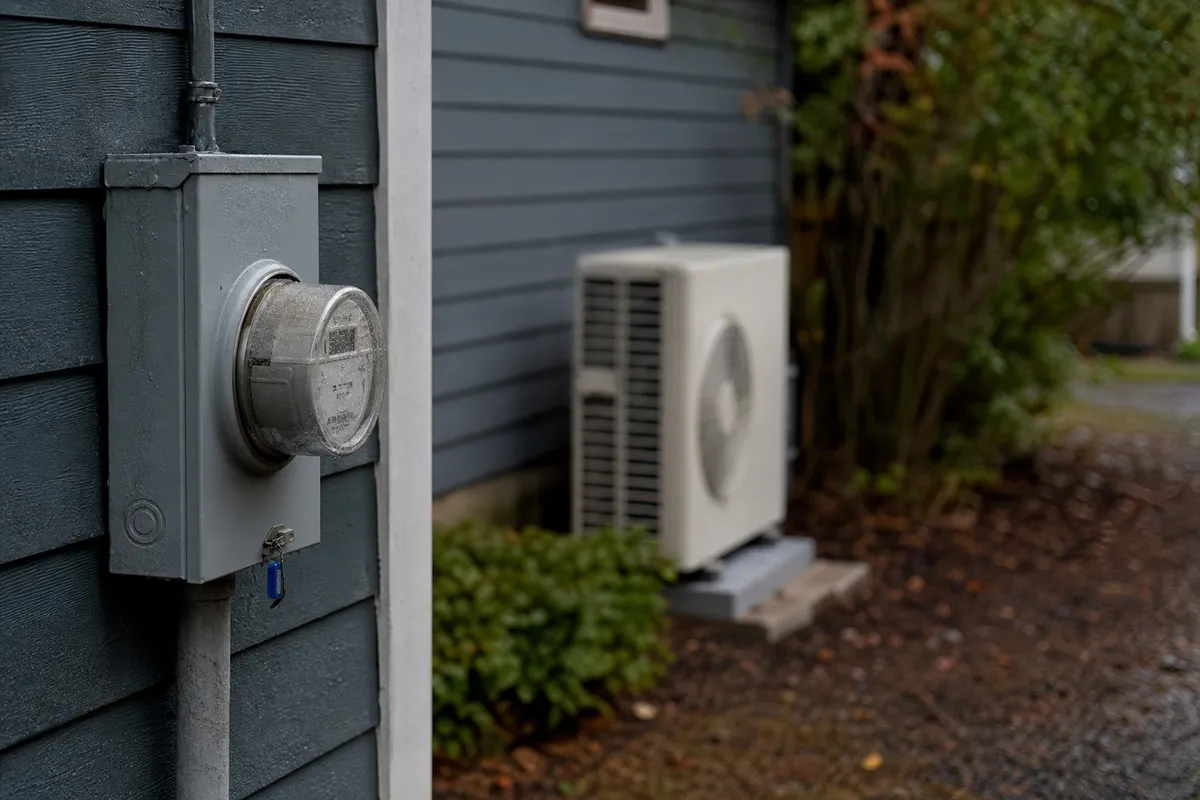
A customer in Kenmore asked me last winter if his new heat pump was going to double his PSE bill. He’d heard that from a neighbor who still runs a 1990s electric furnace. I pulled up his actual usage data instead of guessing, and the answer surprised him. Let’s use real numbers instead of gut feelings.
TL;DR
- A modern heat pump (SEER2 16-18, HSPF2 8-9) typically pulls 1.5 to 4 kW while running, depending on outdoor temperature and unit size.
- For an average 2,000 sq ft Seattle-area home, expect roughly 800-1,400 kWh per month for heating in the coldest months (December-February).
- At PSE’s residential rate (around $0.13-0.14 per kWh as of 2025) that’s about $105-$195/month in peak winter.
- Snohomish PUD customers pay less per kWh (roughly $0.10-0.11), so the same usage runs closer to $85-$150/month.
- Heat pumps use less total energy than resistance electric heat or old gas furnaces paired with AC, because they move heat instead of generating it.
- Sizing matters more than brand. An oversized or undersized unit will waste money regardless of the label on the box.
How a Heat Pump Actually Spends Electricity
A heat pump doesn’t create heat by burning fuel or glowing a coil red hot. It moves heat from outside air into your house using a refrigerant cycle, the same idea as your refrigerator but running backward. That’s why the “coefficient of performance” (COP) matters. A COP of 3 means you get 3 units of heat for every 1 unit of electricity you put in. Compare that to a baseboard heater, which has a COP of exactly 1.
At 47°F outside, a good cold-climate heat pump like a Bosch IDS or Mitsubishi Hyper-Heat still holds a COP around 3.5-4. Drop to 17°F, and COP falls to about 2-2.5. It’s still beating electric resistance heat by a wide margin, but it’s pulling more amps to keep up. That’s the honest tradeoff: efficiency drops as it gets colder, but it never drops below “better than baseboard.”
“On the electrical side, the kWh story is simple: moving heat beats making heat. What I watch for at install time is panel capacity — a heat pump plus an EV charger on an original 100-amp panel is where bills stay fine but breakers start complaining. We check that before quoting, never after.”
— Marcus Reed, Senior Electrician at SPS Pro Services
Real Kilowatt-Hour Numbers From Local Homes
I track run data on a lot of the systems we install through heat pump installation, and here’s what typical King and Snohomish County homes actually pull:
- A 2-ton (24,000 BTU) mini-split system heating a 1,200 sq ft rambler in Everett: roughly 400-600 kWh/month in January.
- A 3-ton ducted heat pump in a 2,000 sq ft Bellevue split-level: roughly 900-1,300 kWh/month in January.
- A 4-ton system in a larger Seattle Craftsman with poor attic insulation: can run 1,500-1,800 kWh/month in the coldest stretch.
Insulation and air sealing move these numbers more than the equipment brand does. I’ve seen two identical Bellevue homes on the same street pull a 30% difference in kWh because one had blown-in attic insulation and the other still had 1960s batts.
Cost Comparison: Heat Pump vs Other Systems
Here’s how monthly winter heating costs typically shake out for a 2,000 sq ft Seattle-area home, using late-2025 utility rates.
| Heating System | Typical Monthly Energy Use | Estimated Monthly Cost (PSE) | Estimated Monthly Cost (SnoPUD) |
|---|---|---|---|
| Heat pump (SEER2 16+) | 900-1,300 kWh | $115-$180 | $95-$145 |
| Electric resistance/baseboard | 2,200-2,800 kWh | $290-$390 | $230-$310 |
| Gas furnace (therms, not kWh) | 90-130 therms | $110-$160 (gas rate) | $110-$160 (gas rate) |
| Gas furnace + separate AC | Furnace cost above + summer AC electric | $110-$160 + $20-$40 summer | $110-$160 + $15-$30 summer |
A gas furnace can look competitive on paper, but it doesn’t cool your house in July, and Puget Sound Energy’s gas rates have climbed steadily since 2022. If your furnace is over 15 years old and you’re weighing repair against replacement, it’s worth comparing against a heat pump quote before you sink more money into furnace repair visits every winter.
Why Sizing Beats Brand Loyalty
I get asked constantly whether Mitsubishi beats Daikin, or whether Bosch beats Carrier. Honestly, the efficiency gap between top-tier brands is small, usually a few percentage points of HSPF2. What actually swings your electric bill:
- Correct load calculation for your square footage and window exposure.
- Ductwork condition, if you’re running a ducted system instead of ductless heads.
- Thermostat habits — heat pumps work best left at a steady setpoint, not big swings.
- Backup heat strip settings, since an incorrectly configured aux heat kicks in too early and burns resistance-heat kWh you didn’t need.
- Refrigerant charge and airflow, checked at installation and during maintenance.
A 3-ton unit crammed into a house that needs 4 tons will run constantly at max draw and still fall short on cold nights. An oversized 5-ton unit in a house that needs 3 tons will short-cycle and waste energy on startup surges. Get a real Manual J load calc, not a rule-of-thumb guess based on square footage alone.
Panel Capacity: The Question People Forget to Ask
Before you commit to a heat pump, check your electrical panel. Older homes in Seattle and Everett — plenty built before 1970 — often still run 100-amp service. Add a heat pump, and maybe an EV charger down the road, and that panel gets tight fast. If your panel is already near capacity, budget for an electrical panel upgrade alongside the heat pump quote. I’ve had jobs in Bellevue where the panel upgrade cost more than the heat pump install itself, but skipping it isn’t an option once you’re pulling 30-40 amps for heat plus another 40-50 for a Level 2 EV charger.
Speaking of EVs, if you’re planning an EV charger installation in the same year as a heat pump, tell your electrician upfront. Sequencing panel work correctly saves a second service call and a second permit fee.
What About Water Heaters and AC While We’re Talking Electricity
Two related systems worth a quick word. A heat pump water heater uses roughly 60-70% less electricity than a standard electric tank, and it’s worth asking about when your current unit needs more than a patch job from water heater repair. And if you already have central AC and are wondering whether to just add heat separately, remember a heat pump replaces both your furnace and your AC in one unit, so you’re not paying for AC repair on a separate aging system every summer.
Practical Checklist Before You Sign a Heat Pump Quote
- Ask for the Manual J load calculation, not an eyeball estimate.
- Confirm HSPF2 and SEER2 ratings on the specific model quoted, not the brand’s marketing average.
- Check your panel’s amperage and available breaker slots.
- Ask what backup heat source kicks in below what outdoor temperature.
- Get quoted monthly kWh estimates for your specific home size, not a generic number.
- Ask whether your home qualifies for PSE or Snohomish PUD heat pump rebates this year.
- Confirm the labor warranty length in writing, typically one year on labor separate from manufacturer parts coverage.
Serving Seattle, Bellevue, and Everett Homes
Housing stock varies a lot across the region. A 1920s bungalow in /seattle/ has different duct and insulation challenges than a 1990s build in /bellevue/, and older Snohomish County homes around /everett/ often still run on baseboard heat that a single heat pump conversion can cut way down on. We size every quote to the actual house, not a regional average.
Mini-FAQ
Will a heat pump work during a Puget Sound cold snap? Yes, a cold-climate rated heat pump (look for HSPF2 8.5+ and a low-temperature rating to 5°F or below) keeps working through typical January lows in the 20s. Backup heat strips cover the rare sub-15°F nights.
Is SnoPUD really cheaper than PSE for running a heat pump? Generally yes, SnoPUD’s residential rate has run 2-3 cents per kWh lower than PSE in recent years, which adds up to $20-$40/month difference on heavy winter usage.
Does a heat pump raise my summer electric bill too? Slightly, since it’s also your AC. Expect $30-$60/month in summer cooling costs for an average home, less than running a separate old AC unit.
Call (206) 427-8907 to get a load calculation and a real kWh estimate for your specific house before you decide.