
The first 90-degree day of the summer, my phone does not stop. During July’s heat stretch I ran nine calls in two days between Redmond and Marysville, and four of the nine were things the owner could have fixed in ten minutes: a tripped breaker in Sammamish, thermostat batteries in Everett, a float switch doing exactly its job in Kirkland after the condensate line clogged.
The other five were real failures — three bad capacitors, a dead condenser fan motor, one low refrigerant charge. But the point stands: about half the “my AC is dead” calls I run don’t involve a broken air conditioner at all.
So before you book a service call, walk this checklist. It’s the same order of operations I use when I arrive, minus the tools. If the system still won’t cool afterward, you’ll at least be able to tell me exactly what it’s doing, which makes the diagnosis faster and cheaper.
TL;DR
- Check the cheap stuff in order: thermostat mode and batteries, breaker panel, outdoor disconnect, condensate float switch, air filter.
- “Runs but blows warm air” and “completely dead” are different problems — the first is usually refrigerant, coil, or compressor; the second is the power chain.
- If you see ice anywhere on the copper lines or indoor coil, stop. Switch the system to fan-only and let it thaw for several hours before anyone can diagnose it.
- The single most common repair I make is a failed capacitor: $189-$350, fixed in one visit.
- Stop DIY at the refrigerant circuit and anything inside an electrical panel — that’s where professional repair starts.
What should I check before calling anyone?
Run these in order — you’re following the path power and control signals take through the system.
- Thermostat mode and setpoint. COOL, not HEAT or OFF, with the setpoint at least 3 degrees below room temperature. A wrong mode after a summer power blink is common.
- Thermostat batteries. A blank or dim screen means dead batteries; even some hardwired thermostats lose settings when backups die.
- Breaker panel. Find the breakers labeled AC, condenser, or air handler — usually two. A tripped breaker sits mid-position. Flip fully OFF, then ON. If it trips again immediately, stop and call; something is genuinely shorted.
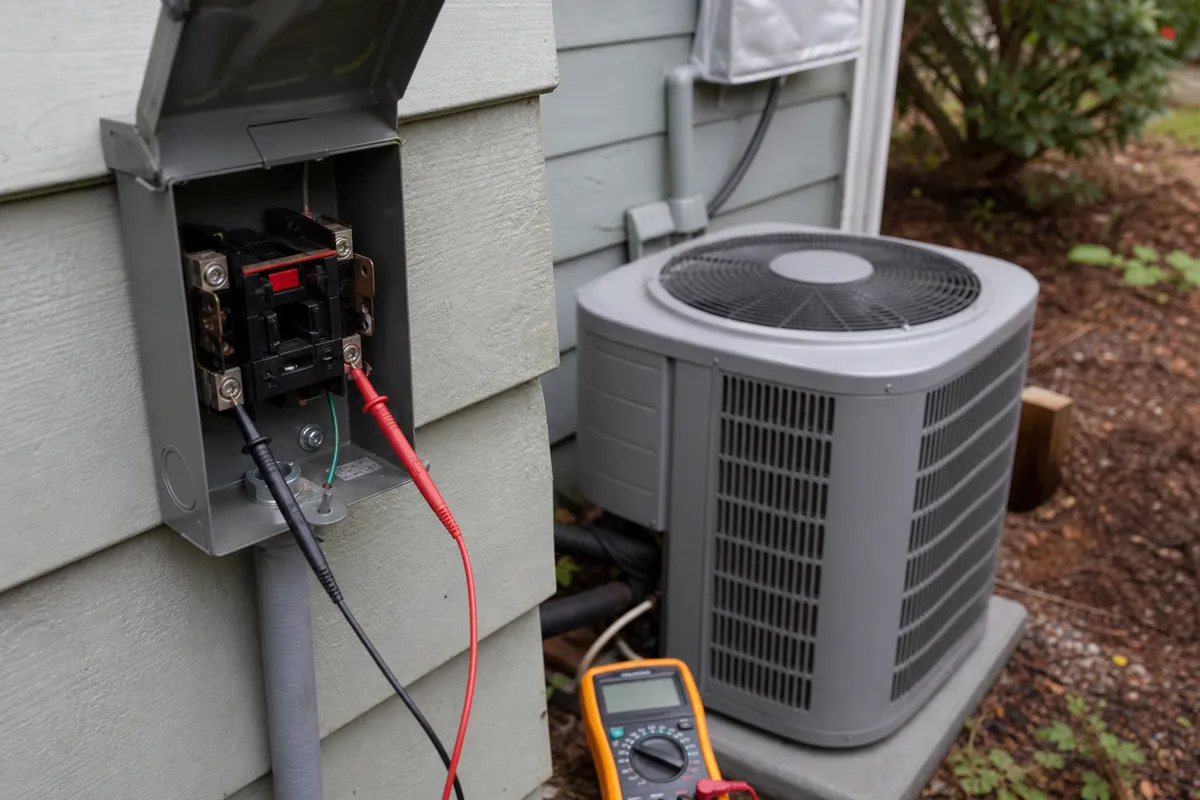
- Outdoor disconnect. The small gray box near the condenser. Landscapers and painters pull these and forget. Make sure the pull-out block is seated, right-side up.
- Condensate float switch. If the drain line clogs, this switch cuts the AC off on purpose to prevent a flood. Standing water in the drain pan is your answer — clear the drain and the switch resets.
- Air filter. Pull it. If you can’t see light through it, replace it. A suffocated filter can ice the coil and shut the system down.
- Look for ice. Check the larger copper line at the outdoor unit. Any frost: thermostat OFF, fan ON, wait 4-6 hours. Never run a frozen system.
Why does my AC run but blow warm air?
This is the most useful diagnostic split there is. If the indoor fan runs and you feel airflow at the vents, the control chain and blower are fine — the problem lives on the refrigeration side, and there are only a few candidates.
The outdoor unit isn’t running at all. Go outside while it should be cooling. Condenser fan not spinning plus a hum is classically a failed capacitor — the component that gives the compressor and fan motor the phase-shifted jolt they need to start. Complete silence points to its breaker, disconnect, or contactor.
The outdoor unit runs, but air is barely cool. Now you’re into refrigerant charge, a dirty condenser coil, or an iced evaporator. Here’s the physics in one breath: your AC moves heat by evaporating refrigerant in the indoor coil (absorbing heat) and condensing it in the outdoor coil (rejecting heat). Low charge means less refrigerant evaporating, less heat absorbed, and eventually a coil so cold it ices over. A filthy outdoor coil means the system can’t dump heat, pressure climbs, and capacity drops. Either way, warm-ish air at the vents.
The air is cool but the house won’t catch up. On a 95-degree day, a correctly sized system here may only hold the house 15-20 degrees below outdoor temperature — often normal, since most systems were sized for typical summers, a topic I cover in AC sizing for Seattle summers. It can also be leaky ductwork, or ducts dirty enough to choke airflow, which is where duct cleaning earns its keep.
Why won’t my AC turn on at all?
Total silence — no indoor fan, no outdoor unit, nothing — means the problem is in the power or control chain, and you trace it like a wire: thermostat → low-voltage transformer → safety switches → breaker.
The usual culprits, in the order I find them: dead thermostat, tripped float switch, tripped breaker, a blown low-voltage fuse on the control board (often from a chewed or shorted thermostat wire — I’ve pulled two rodent-damaged wires out of Everett crawlspaces this summer), or a failed transformer. The first three are on your checklist; the last two need a meter.
One pattern worth knowing: indoor fan runs, outdoor unit never starts, breaker and disconnect verified — that’s most often the capacitor or contactor outside. Cheap parts, quick fixes, but they sit in a 240-volt cabinet, so that’s where your part of the job ends.
What does a technician do that I can’t?
Honest answer: mostly, we measure things. The checklist finds problems you can see. A tech finds the ones you can’t, with about four tools:
A multimeter with capacitance testing. A capacitor reading more than about 6% below its microfarad rating is failing even if the unit still limps along. This is the #1 repair in my truck — I stock the common sizes because I replace several every hot week. The honest price is $189-$350 installed, not $700.
Refrigerant gauges and thermometers. Charge can’t be judged by feel; we measure pressures plus superheat and subcooling. “It needs a top-off every summer” is not maintenance — it’s a leak, and refrigerant work legally requires EPA certification anyway.
Amp clamp. Motor current draw against nameplate ratings says whether a motor is healthy, struggling, or about to die — before it does.
Static pressure probes. These tell us whether your ductwork is strangling the system, which no amount of parts-swapping fixes.
“The capacitor is the part I check first on every no-cool call, because it’s a ten-dollar component doing the hardest job in the cabinet — kicking a compressor from zero to 3,500 RPM against pressure. When homeowners try to limp through a heat wave on a weak one, that’s when we lose compressors. A $250 fix becomes a $2,000 problem.”
— Sergei Petrov, Founder & Lead HVAC Technician at SPS Pro Services
What do common AC repairs cost around Seattle?
Real ranges from our invoices in King and Snohomish counties, parts and labor:
| Repair | Typical cost | How often I see it |
|---|---|---|
| Run/start capacitor | $189-$350 | Constantly — the #1 fix |
| Contactor replacement | $200-$400 | Common |
| Condensate drain clear + float switch | $200-$450 | Common in humid stretches |
| Condenser fan motor | $450-$750 | Several per summer |
| Refrigerant leak search + repair + recharge | $600-$1,200 | Regularly |
| Blower motor (ECM) | $700-$1,200 | Occasionally |
| Compressor replacement | $1,800-$3,000+ | Rare — usually replacement territory |
Diagnostic visits are credited toward the repair. Once a quote crosses about a third of replacement cost on an older unit — especially a compressor past 12-15 years — I start talking about new system options instead, and here that conversation usually includes a heat pump, since it replaces heating and cooling in one box.
When should I stop DIY and pick up the phone?
Draw the line at three places. Refrigerant: high pressure, certification required, and a “recharge” without finding the leak just rents you cold air until it escapes again. Line-voltage electrical: capacitors store a charge even with power off, and 240-volt cabinets are not a place to learn. Repeat symptoms: a breaker that trips twice, ice that returns after a thaw and filter change, a unit that hard-starts with a groan. Each is a deeper fault, and running the system anyway is how small repairs become big ones — and if it fails in the middle of a heat wave, that’s exactly what our emergency AC service is for.
Frequently asked questions
Why does my AC hum but not start?
A hum from the outdoor unit with nothing spinning is the textbook sign of a failed capacitor — the motor is energized but can’t generate starting torque. Sometimes a stuck fan bearing does the same thing. Either way, cut power to the unit and book a repair; letting a motor sit energized and stalled overheats the windings.
Why does my AC breaker keep tripping?
Once could be a power surge or a marginal breaker. Repeatedly means a real electrical fault: a shorted compressor winding, a failing fan motor drawing locked-rotor current, or damaged wiring. Do not keep resetting it — each restart hammers the compressor. Leave it off and get it diagnosed.
How cold should the air from my vents be?
A healthy system delivers supply air 15-20°F cooler than the return air. A split under about 12°F suggests low charge or airflow problems; over 22°F usually means weak airflow — think dirty filter or blocked returns.
Sources
Worked the checklist and it still won’t cool? Call SPS Pro Services at (206) 427-8907 — same-day AC repair across King and Snohomish counties, diagnostic credited toward the fix.