
The call came from Sammamish on a muggy Tuesday in late July: water dripping through the kitchen ceiling, directly below the upstairs air handler closet. The homeowner had shut off the AC, put a pot under the drip, and was bracing for a five-figure disaster.
The actual problem was a quarter-inch plug of algae in a PVC pipe. Her condensate drain line had grown a biofilm colony all summer, the line sealed shut, the pan overflowed, and gravity did the rest. Forty-five minutes with a wet-vac and a flush, $285, done. The drywall patch cost more than the AC fix.
Most homeowners don’t realize their air conditioner is a water-making machine by design. Once you understand where the water comes from and where it’s supposed to go, the whole failure makes sense — and so does the fix.
TL;DR
- Your AC produces water on purpose: the cold indoor coil condenses humidity out of the air — easily a gallon or more per humid day.
- Cause #1 of leaks, by a wide margin: the drain line clogging with algae and biofilm.
- Cause #2: a frozen evaporator coil melting off faster than the pan can drain.
- A float switch that shuts the AC off before the pan overflows is the cheapest insurance in HVAC — a “dead” AC with a full drain pan means that switch just saved your ceiling.
- DIY clearing (wet-vac at the outlet, vinegar flush) fixes most clogs; cracked pans and attic installs are pro territory — typical repair runs $200-$450.
Where is all this water coming from?
Nothing is “leaking” in the plumbing sense. Your indoor evaporator coil runs around 40°F while cooling. When 75°F household air hits that surface, it drops below its dew point and moisture condenses onto the coil — exactly like a cold glass sweating on a summer porch, except the coil has hundreds of square feet of fin surface.
On a dry Seattle day the system might pull a few pints from the air; on the muggy days we get more of every summer, easily one to three gallons over a day of runtime. All of it drips into a sloped drain pan, flows into a PVC drain line, and exits to a floor drain, a condensate pump, or a stub-out pipe by the foundation. That mystery pipe dripping outside on hot days is the system working correctly.
So a “leaking AC” almost always means one thing: the water is being made normally but isn’t leaving normally.
Why does the drain line clog in the first place?
The drain pan is a dark, warm, permanently damp box that collects dust the filter missed — a textbook growth chamber. Algae, mold, and bacterial biofilm colonize the pan and line, and the slime builds until the pipe — usually 3/4-inch PVC with a couple of elbows — seals off. I’ve cleared clogs the size of a pencil eraser that flooded a pan.
Clogs concentrate at predictable spots: the trap near the air handler, elbows, and horizontal runs with too little slope. Systems that sat idle for nine months — most Seattle-area ACs — are prime candidates, because biofilm dries into a crust in fall and breaks loose to jam the trap the first hot week of July. Not coincidentally, that’s when my condensate calls cluster.
Your first line of defense is the float switch: a small sensor in the pan or plumbed into the line that shuts the AC down when water backs up, before the overflow. If your system cooled fine yesterday and is mysteriously dead today with water in the pan, that switch did its job. Older systems often don’t have one — we add them for modest money, and I refuse to leave an attic install without one.
What if the coil is frozen instead?
The second cause of water leaks is sneakier: a frozen evaporator coil. Low airflow (dirty filter, blocked returns, dirty coil) or low refrigerant charge drops the coil below 32°F, and condensate freezes on the coil instead of dripping into the pan. The system runs, ice builds, cooling fades.
Then the homeowner shuts the unit off, or ice finally blocks airflow entirely, and the whole block melts at once — sheeting off the coil in places the pan doesn’t cover. You get a “leak” that appears hours after the AC stopped running, which confuses everyone.
The tell: weak cooling beforehand, or frost on the copper lines at the outdoor unit. If you see ice, switch the thermostat to OFF with the fan ON, put towels down, and let it thaw 4-6 hours before anyone diagnoses anything. If the freeze traces back to a dirty filter, get on a schedule — here’s how often to actually change it.
Can I clear the drain myself?
Often, yes. This is one of the few AC repairs I genuinely encourage homeowners to try — low risk, ordinary tools.
- Kill power at the thermostat and the breaker. Water plus a running blower is not a workspace.
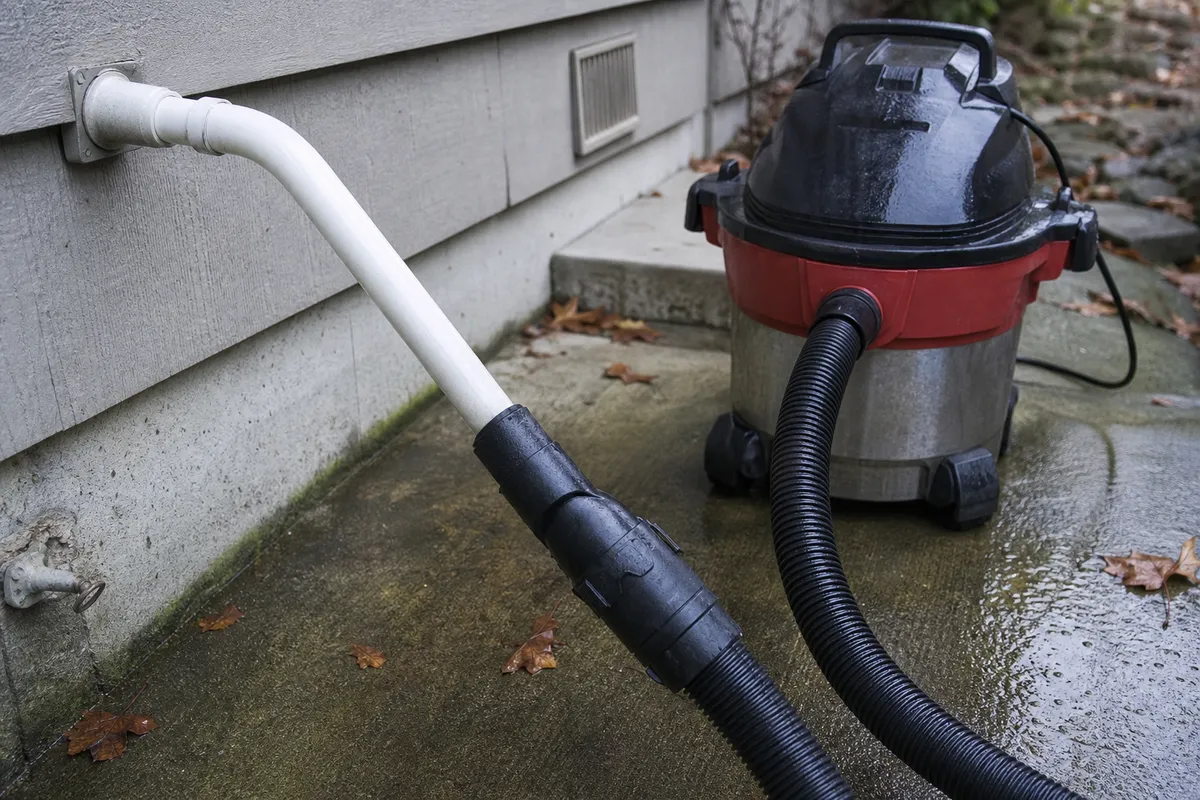
- Find the drain outlet — the PVC stub near the foundation, or at the floor drain.
- Wet-vac the outlet. Seal a wet/dry vacuum hose against the pipe end with a rag and run it 2-3 minutes. Suction pulls the clog out whole, which beats pushing it deeper. You’ll often hear the slug of slime hit the canister.
- Flush the line. Pour a cup of plain white vinegar down the vented tee or cleanout near the indoor unit. Skip bleach — it’s harsh on metal pans and pump seals.
- Empty the drain pan with the wet-vac and wipe out the sludge.
- Confirm flow. A quart of water into the cleanout should appear at the outlet within a minute.
- Repeat the vinegar flush monthly during cooling season.
Where DIY ends: a rusted or cracked pan (water reappears right after a cleared line), a dead condensate pump, a line with no cleanout access, or a drain issue on a system that also isn’t cooling well — that combination points to the refrigerant side, and that’s a tech’s job.
What does a water leak actually cost to fix?
Real numbers from our work orders around King and Snohomish counties:
| Problem | Typical cost | Notes |
|---|---|---|
| Clear clogged drain line + flush | $200-$350 | Most common fix |
| Drain clear + add float switch | $275-$450 | The switch is the upgrade that matters |
| Condensate pump replacement | $300-$500 | Basements and closets without gravity drains |
| New primary drain pan | $400-$750 | Requires partial coil access |
| Frozen-coil diagnosis + refrigerant leak repair | $600-$1,200 | When ice, not algae, caused the water |
| Ceiling drywall repair after overflow | $500-$2,000+ | The bill nobody budgets for |
That last line is the argument for taking drips seriously. The AC-side fix is a couple hundred dollars; the water damage from ignoring it is measured in thousands. I’ve seen a Mukilteo attic overflow travel two floors down a wall cavity, and moisture trapped in ceilings becomes a mold and indoor air quality problem — the EPA’s guidance starts with fixing the moisture source.
“The condensate calls I hate are the attic air handlers with no secondary protection. Code requires a backup pan with its own drain or a shutoff switch under attic units for a reason — the primary will clog eventually, it’s only a question of when. If your air handler is above living space and you don’t know whether there’s a float switch under it, find out this week, not in August.”
— Sergei Petrov, Founder & Lead HVAC Technician at SPS Pro Services
What are the rules for attic installations?
If your air handler lives in the attic — common in newer construction in Redmond, Sammamish, and around Marysville — the stakes are higher because everything below it is finished living space. Mechanical code requires defense in depth: a secondary drain pan under the unit with its own line to a conspicuous spot (the mystery pipe over a window or eave — if it drips, it’s a warning flare, not a normal drain), or a float switch in that pan, or both.
When I quote a new system install for an attic, the secondary pan and switch are non-negotiable line items. On older attic systems in Kirkland and around the Eastside, half the value of my annual AC maintenance visits is verifying that safety chain still works: pan intact, switch functional, secondary line clear. A five-minute check that has saved more ceilings than anything else I do.
Frequently asked questions
Is it normal for my AC to drip water outside?
Yes — steady dripping from the small PVC pipe near your foundation on warm, humid days means the condensate system is working as designed. Not normal: water pooling around the indoor unit, dripping from the secondary “warning” pipe under an eave, ceiling stains, or dripping from uninsulated ductwork.
Can I keep running the AC while it’s leaking?
If water is staying in the pan, you have a little time, but the smart move is to shut it off until the drain flows. If water is reaching drywall, flooring, or anything electrical, kill it at the breaker immediately. A hot afternoon is cheaper than mold remediation.
Why does my AC only leak at night?
Usually it’s not — night is when the overflow finally crests, because evening runtime tops off a pan that filled all day. It can also mean a partial clog: slow drainage keeps pace at low humidity, then falls behind during long evening cycles. Either way, the line needs clearing.
Sources
Water where it shouldn’t be? Call SPS Pro Services at (206) 427-8907 for same-day condensate and AC repair — diagnostic fee credited toward the fix.